HMM Announces 2030 Mid-to-Long-Term Investment Strategy
Increase Ships and Enter Integrated Logistics Business
Expand Eco-Friendly Container Ships to Over Half
Shipping Alliance Maintained with Name Change Only
 As the HMM acquisition battle officially begins, the HMM headquarters located in Park One Tower, Yeouido. Photo by Jo Yongjun jun21@
HMM has decided to invest 23.5 trillion KRW by 2030 to strengthen its container business and increase eco-friendly vessels. The net-zero (complete carbon neutrality) target will also be advanced by five years. The shipping alliance, which had been shaken by the withdrawal of the German carrier Hapag-Lloyd, has decided to maintain the existing system. Rather than seeking new cooperation partners or joining new shipping alliances, the company has settled on enhancing its own competitiveness to assert its presence.
On the 10th, HMM announced its "2030 Mid-to-Long-Term Strategy" containing these plans. The core of future business is to strengthen bulk transportation centered on containers. The intention is to build a more stable portfolio to respond to volatility and enhance competitiveness.
For the container business, HMM plans to invest 11 trillion KRW to increase its fleet capacity from 84 vessels and 920,000 TEU (1 TEU equals one 20-foot container) this year to 1.55 million TEU (130 vessels) by 2030. It will also invest 1.7 trillion KRW to secure container boxes.
The bulk business will also be expanded. The current fleet of 6.34 million DWT (36 vessels) will be expanded to 12.56 million DWT (110 vessels) by 2030, with an investment of 5.6 trillion KRW. The company plans to grow tankers and dry bulk carriers evenly without concentration. Additionally, it will proactively enter the eco-friendly energy transportation business to secure market share early and diversify its business.
HMM also plans to expand its integrated logistics business. About 4.2 trillion KRW will be allocated for new terminals and facility investments suitable for expanding the container service network, expanding existing port terminals, and securing additional key hub port terminals. The company will enter the high-profit inland logistics base (ODCY) business and provide end-to-end (from cargo departure to arrival) services to establish a foundation for comprehensive logistics business entry.
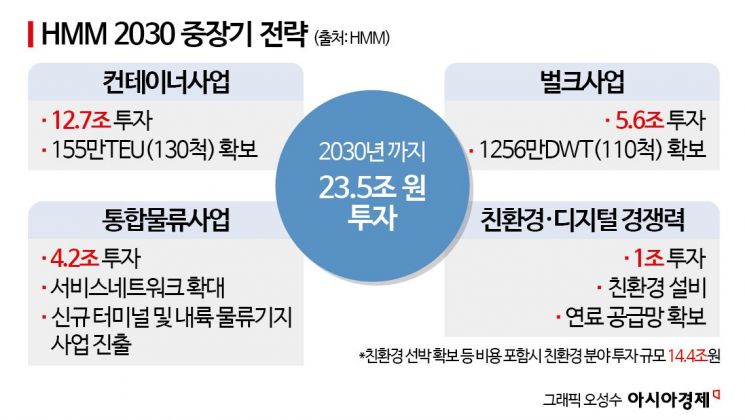
HMM plans to invest about half of its mid-to-long-term investment in eco-friendly initiatives. It aims to increase the number of low-carbon and zero-carbon vessels to 70 and achieve carbon neutrality across all transportation segments. Currently, HMM's low-carbon and zero-carbon vessels consist only of nine methanol-powered ships ordered last year. None of these vessels have been delivered yet. Except for Maersk, it is known that very few large methanol-powered vessels have been delivered. However, most vessels HMM has received since 2020 can be converted to LNG-powered ships. Including 20 ultra-large vessels already received and 12 vessels being delivered this year, the current number of eco-friendly vessels is estimated at about 41. The company plans to nearly double this number.
In addition to securing eco-friendly vessels, HMM will invest nearly 1 trillion KRW directly in eco-friendly initiatives. To achieve early net-zero by 2045, 900 billion KRW will be invested in vessel retrofitting and securing eco-friendly fuel supply chains, and 100 billion KRW will be allocated to building a digital-based organizational system.
An HMM official explained, "Since the direction toward eco-friendliness is set, this is money that must be invested eventually," adding, "European shippers are increasingly preferring eco-friendly carriers, so the faster the transition, the more it helps secure an initial sales network."
Regarding the much-discussed reorganization of the shipping alliance, the existing form will be maintained. The shipping alliance that HMM belonged to, "THE Alliance," will be renamed "Premier Alliance," but the cooperation system with Japan's ONE and Taiwan's Yang Ming will continue as is. Instead, for the somewhat lacking European routes, the company will cooperate with MSC, the world's number one, to build a route network. The cooperation period of Premier Alliance is five years starting from February next year.
Kim Kyung-bae, CEO of HMM, said, "Through the new cooperation system, we plan to have the highest level of competitiveness compared to other cooperation groups," adding, "We will continue efforts to build a stable business portfolio and an eco-friendly management system to become a global eco-friendly carrier."
© The Asia Business Daily(www.asiae.co.kr). All rights reserved.


















