Further Intensified by Strong Rain Clouds Formed Due to Ocean-Atmosphere Moisture Imbalance Phenomenon
The Korea Institute of Ocean Science and Technology (KIOST) has revealed that even typhoons of similar intensity can experience rapid intensification when passing through marine heatwave regions, in an effort to clarify the impact of high sea surface temperatures on typhoons.
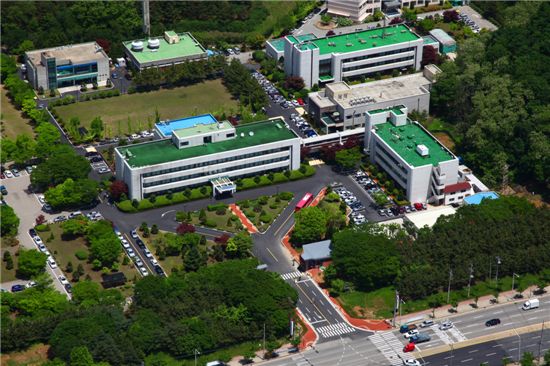 Korea Institute of Ocean Science and Technology
KIOST analyzed 312 typhoons that occurred over the past 38 years and published the results in ‘Communications Earth & Environment,’ a sister journal of Nature.
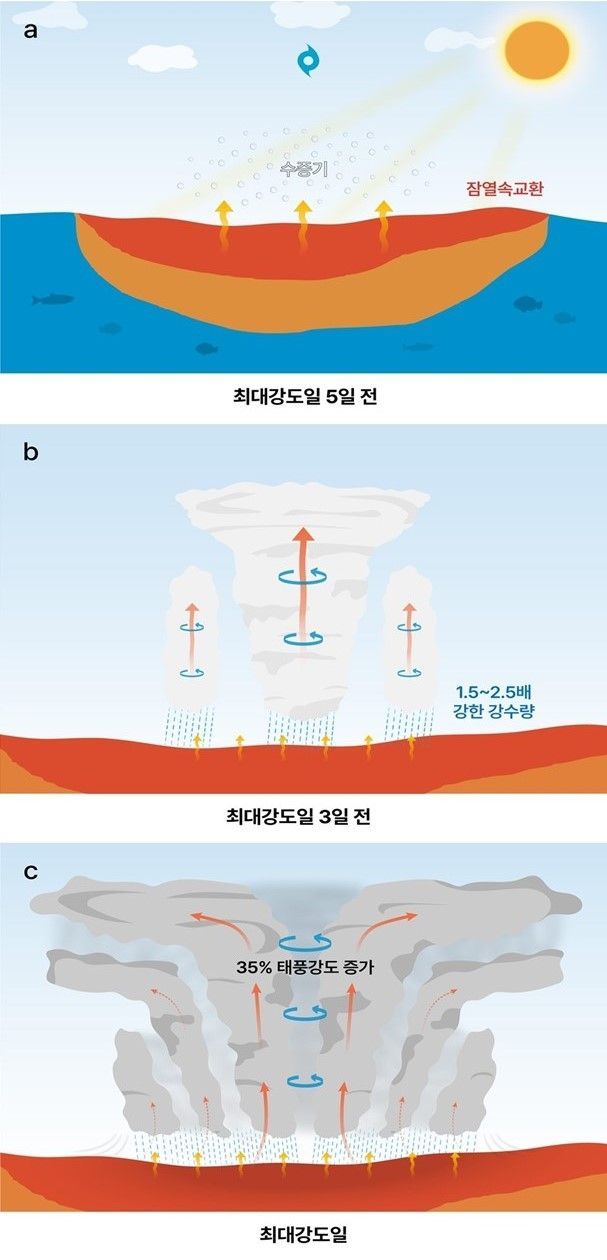
According to the analysis, when a typhoon passes through a marine heatwave region, a strong ‘Moisture Disequilibrium’ phenomenon occurs due to the temperature difference between the heated seawater and the atmosphere, causing the seawater to actively supply water vapor into the atmosphere.
As a result, a large amount of water vapor flows into the center of the typhoon formed in the lower atmosphere, generating strong rain clouds. The vortical hot tower, a low-pressure vortex accompanied by heavy precipitation, further strengthens the existing typhoon circulation.
A marine heatwave region refers to a state where the sea surface temperature exceeds the top 10% of all recorded values over the past 30 years (according to NOAA) and persists for more than five days.
A low-pressure vortex refers to a vortex with a scale of 10 to 30 km, where winds rotate counterclockwise.
In contrast, in general ocean regions, the ‘Moisture Disequilibrium’ phenomenon is not significant, so the amount of water vapor entering the lower atmosphere from the sea surface is much less than in marine heatwave regions, resulting in weaker rain clouds.
The research team led by Dr. Park Myungsook at the KIOST Ocean Satellite Center utilized high-resolution sea surface temperature data (NOAA) and microwave satellite precipitation data (NASA) from the Northwest Pacific and Atlantic?representative typhoon genesis regions?to compare and analyze 128 typhoons that passed through marine heatwave regions and 184 typhoons that passed through general ocean regions over the past 38 years (1982?2019).
According to the study, when typhoons pass through general ocean regions, their average maximum intensity is 78.80 knots, but when passing through marine heatwave regions, the average maximum intensity increases to 106.72 knots, about 35% stronger. Precipitation also increases by approximately 1.5 to 2.5 times compared to typhoons passing through general ocean regions.
For example, Typhoon Talim, which caused significant damage to China and other areas in 2017, intensified from 40 knots to 120 knots as it passed through a marine heatwave region (above 30 degrees Celsius) in the Northwest Pacific.
While previous studies have examined the correlation between marine heatwaves and individual typhoons occurring at specific times, this is the first study in the world to directly identify the impact of marine heatwaves on hundreds of typhoons over a long period.
This is because the definition of marine heatwaves was first reported in academia in 2016, and only recently have studies begun to directly examine the correlation between marine heatwaves and individual natural phenomena (such as typhoons, heatwaves, or low-salinity events).
Reference: Alistair Hobday (CSIRO), Lisa Alexander & Sarah Perkins (ARC), Progress in Oceanography, February 2016 issue (“A hierarchical approach to defining marine heatwaves”)
The results of this study provide an important foundation for understanding the direct interaction between marine heatwaves and typhoons, and are expected to serve as basic data for predicting and establishing response systems for climate change and extreme weather events in the future.
This research is being carried out as part of the Ministry of Oceans and Fisheries’ “Diagnosis of Northwest Pacific Warming and Typhoon Genesis & Rapid Intensification Affecting the Korean Peninsula” and the National Research Foundation of Korea’s “Development of a Typhoon Intensity Prediction System around the Korean Peninsula Based on Satellite-Numerical Models Using Artificial Intelligence.” KIOST and Korea Maritime and Ocean University (KMOU) participated in the research.
Lee Heeseung, President of KIOST, stated, “In order to protect the lives and property of the public from the increasingly severe climate crisis, we must continue to closely monitor oceanic and atmospheric phenomena,” and added, “We will make efforts to ensure that these research results are actively used in actual policy-making for climate change response.”
© The Asia Business Daily(www.asiae.co.kr). All rights reserved.

















