A new concept stretchable display that maintains performance even when the surface is stretched with high elasticity has been developed domestically. This display was developed based on the idea of introducing a repeatedly indented structure like the surface of a golf ball, reducing the effective contact area and thereby decreasing the adhesion between surfaces.
KAIST announced on the 10th that Professor Seunghyup Yoo's research team from the Department of Electrical Engineering and Computer Science, in collaboration with Professor Han-eol Moon of Dong-A University and the Realistic Media Research Division at the Electronics and Telecommunications Research Institute (ETRI), has developed an organic light-emitting diode (OLED) display that simultaneously achieves a high initial emission area ratio and high stretchability.
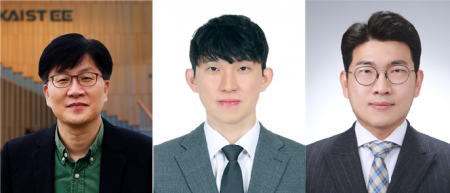 (From left) Professor Yoo Seung-hyup of KAIST, Dr. Kim Subon of KAIST, Professor Moon Han-eol of Dong-A University. Provided by KAIST
Existing stretchable displays secure performance and stretchability simultaneously by positioning the emitting parts in a rigid isolated structure to maintain performance without mechanical deformation during stretching. The connector parts are configured in bent shapes such as horseshoe forms to allow easy deformation according to the stretch.
Typically, such structures are limited to two-dimensional planes, which requires reducing the ratio of the emitting area to the total area to secure space for the bent connecting connectors, showing a limitation.
In contrast, the joint research team proposed a three-dimensional height-crossing structure where the bent connecting connector can utilize hinge-type rotation and tension simultaneously, not limited to a two-dimensional plane. They realized OLED display technology with an 85% emission area ratio and 40% maximum system stretchability in the initial unstretched state.
During the research process, the joint team also confirmed stable performance maintenance even under repetitive operations and deformation of curved surfaces.
The research process was not smooth from the beginning, as it was a concept never attempted before.
For example, the adhesion between the OLED substrate and the stretchable platform, which must be overcome when the height changes during the stretching of the ultrathin OLED, was larger than expected. This caused the ultrathin OLED, which should have popped up, to fail to float as designed and instead stick disorderly to the base.
However, the joint research team solved this problem by introducing a repeatedly indented structure like the surface of a golf ball, significantly reducing the adhesion between surfaces by decreasing the actual contact area.
According to the joint research team, when the OLED display was designed with this devised idea, it was possible to implement a perfectly functioning stretchable display.
Professor Yoo said, “Securing stretchable OLED technology with a high emission area ratio and excellent stretchability is an important key to solving the challenges of stretchable display technology,” adding, “Dr. Subon Kim’s persistent research and the cooperation of ETRI and Dong-A University played a significant role from the conception of the idea to its successful implementation.”
Meanwhile, this research was conducted with support from the Korea Research Foundation’s Leading Research Center program, Mid-career Researcher program, and the Electronics and Telecommunications Research Institute’s research operation fund support project.
© The Asia Business Daily(www.asiae.co.kr). All rights reserved.
![Clutching a Stolen Dior Bag, Saying "I Hate Being Poor but Real"... The Grotesque Con of a "Human Knockoff" [Slate]](https://cwcontent.asiae.co.kr/asiaresize/183/2026021902243444107_1771435474.jpg)
















