Mid-September Approaching... Tuesday Afternoon Gwangju and Daejeon 35°C, Seoul 34°C
Late Heat Continues with Most Areas Exceeding 30°C... 85% of the Nation Under Heatwave Warning
On the 9th, daytime temperatures in Daejeon approached 35 degrees Celsius, breaking the record for the highest temperature in September for the second consecutive day. The highest temperature in Seoul also exceeded 34 degrees, ranking second highest ever recorded. The early September heat is expected to continue on the 10th.
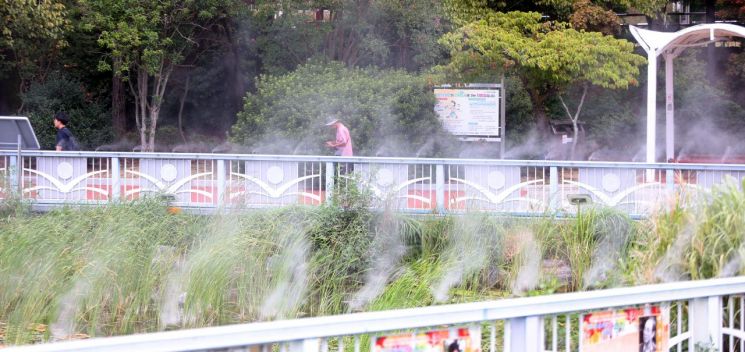
According to the Korea Meteorological Administration, the highest temperature in Daejeon on the 9th was 34.9 degrees Celsius, the highest September temperature since weather observations began in Daejeon in 1969. This broke the record for the second consecutive day, following the previous day's high of 34.3 degrees.
Other locations that experienced their hottest September day on record include Icheon in Gyeonggi Province (33.0 degrees), Jeongseon in Gangwon Province (34.8 degrees), Chungju (33.7 degrees) and Cheongju (34.7 degrees) in North Chungcheong Province, Hongseong (33.4 degrees), Boryeong (33.6 degrees), Buyeo (34.4 degrees), and Geumsan (34.9 degrees) in South Chungcheong Province, Tongyeong in South Gyeongsang Province (35.7 degrees), and Wando in South Jeolla Province (35.2 degrees).
The highest temperature in Seoul was 34.1 degrees Celsius, the second highest September temperature in 116 years since 1908, following 35.1 degrees recorded on September 2, 1939. Modern meteorological observations in Seoul began in October 1907.
Similarly, Paju in Gyeonggi Province (32.2 degrees), Seosan in South Chungcheong Province (32.8 degrees), Gunsan (33.1 degrees) and Jeongeup (34.9 degrees) in North Jeolla Province, and Uiryeong in South Gyeongsang Province (35.2 degrees) also recorded their second highest September temperatures on this day.
As early September ends on the 10th, daytime temperatures are expected to soar to 35 degrees in Gwangju and 34 degrees in Daegu, with most regions continuing to experience late-season heat exceeding 30 degrees.
The minimum temperatures on the morning of the 10th are expected to range from 20 to 25 degrees, with daytime highs between 30 and 35 degrees. Expected minimum and maximum temperatures in major cities are Seoul 25 and 34 degrees, Incheon and Busan 25 and 32 degrees, Daejeon 23 and 35 degrees, Gwangju 24 and 35 degrees, Daegu 22 and 34 degrees, and Ulsan 23 and 32 degrees.
Currently, out of 183 weather advisory zones nationwide, heatwave warnings have been issued in 155 zones excluding the East Coast, Gangwon mountain areas, and Hallasan. As of 4 p.m. on the 9th, heatwave alerts were issued for Gapyeong, Goyang, Yongin, and Anseong in Gyeonggi Province; Gongju in South Chungcheong Province; Cheongju in North Chungcheong Province; Damyang, Haenam, Wando, and Yeongam in South Jeolla Province; and Changnyeong in South Gyeongsang Province. Including the previous day's warnings for Gokseong and Gurye in South Jeolla Province and Uiryeong and Jinju in South Gyeongsang Province, a total of 15 zones are under heatwave warnings.
For the time being, most regions will continue to experience heat with apparent temperatures rising above 33 degrees Celsius (some areas reaching 35 degrees). Some urban areas, the West Coast, South Coast, and Jeju are expected to experience tropical nights for a while. Showers are forecast to begin in Chungcheong and southern regions from the afternoon of the 10th, with rain expected in Jeju due to a pressure trough at the same time. Although hourly rainfall may reach up to around 20 mm, temperatures will briefly drop when it rains but will quickly rise again, so the heat will not be significantly alleviated.
On the 10th, ozone levels in the Seoul metropolitan area, western Gangwon, Chungcheong, North Jeolla, South Jeolla, and North Gyeongsang are expected to reach 'bad' levels. Ozone is produced by photochemical reactions of air pollutants under strong sunlight, so concentrations are higher when the sun is strong. In the seas, strong winds and high waves are expected until the afternoon of the 11th in the southern part of the West Sea, the southern part of the South Sea, and the waters around Jeju. Particularly, from the 10th, gusts, thunder, and lightning are expected in the waters around Jeju, with very strong winds blowing at 30 to 60 km/h (9 to 16 m/s) from early morning in the outer southern waters of Jeju and the eastern outer waters of the South Sea, and from the afternoon in the southern outer waters of the West Sea. Waves will be very high, reaching 1.5 to 4.0 meters.
© The Asia Business Daily(www.asiae.co.kr). All rights reserved.
!["The Woman Who Threw Herself into the Water Clutching a Stolen Dior Bag"...A Grotesque Success Story That Shakes the Korean Psyche [Slate]](https://cwcontent.asiae.co.kr/asiaresize/183/2026021902243444107_1771435474.jpg)
















