Capital Region Special Committee and National Unity Committee Hold First Meeting
Han Dong-hoon: "Ruling Party Struggles in Capital Region... Discussing Public Sentiment"
Han Dong-hoon, leader of the People Power Party, restarted his centrist, metropolitan, and youth-friendly initiatives from the 9th, ahead of the Lunar New Year holiday. This move is interpreted as an effort to overcome the ruling party's stagnant approval ratings, which have been hovering in the low to mid-30% range amid legislative conflicts and economic downturn.
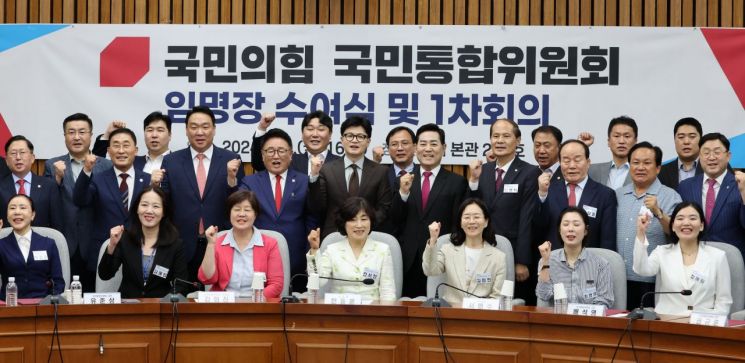
On the same day, Han attended consecutive first plenary meetings of the Metropolitan Vision Special Committee (Chairman: former lawmaker Oh Shin-hwan) and the National Integration Committee (Chairman: Kim Ha-jin, Jeonnam Provincial Party Chairman) held at the National Assembly in Yeouido. At the Metropolitan Special Committee, Han explained, "The People Power Party continues to struggle in the metropolitan area. Ultimately, this has prevented the party from becoming the majority and has significantly hindered our ability to conduct politics for the people," adding, "We intend to actively resolve this issue."
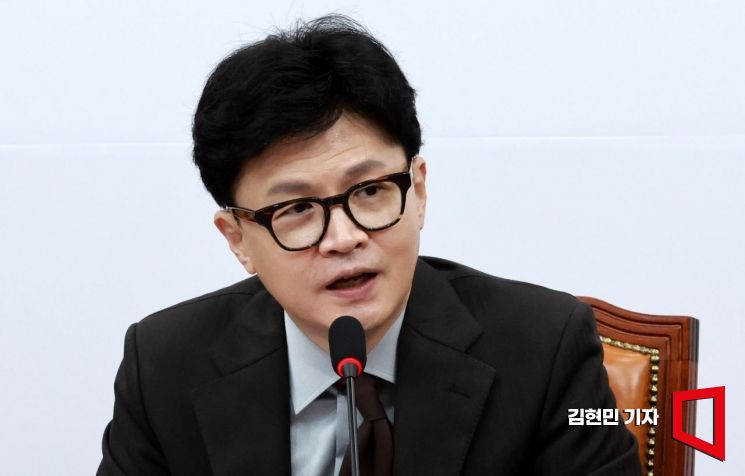 Handonghun, the leader of the People Power Party, is speaking at the Supreme Council meeting held at the National Assembly on the 9th. Photo by Hyunmin Kim kimhyun81@
Han also explained that advocating for the revival of district party organizations is a strategic move to secure a majority of metropolitan lawmakers in the next general election. According to current Party Act and Political Funds Act, non-incumbent committee heads cannot have offices like sitting lawmakers nor can they raise political donations. Han stated, "This is part of our efforts to properly secure our political potential in the metropolitan area," adding, "Our special committee is devising ways for the People Power Party to transform into a metropolitan-centered party, discussing how to properly respond to metropolitan issues and public sentiment, including changes in the metropolitan population structure and voter trends, and seeking solutions."
He also initiated efforts to bridge deepened conflicts and disparities among regions, classes, and generations. In his greeting at the National Integration Committee meeting, Han emphasized, "There are various disparities in our country, including regional, asset, and generational gaps. I believe it is ultimately the role of politics to narrow these gaps," and added, "By resolving these disparities, we can improve our quality of life and ultimately achieve national integration."
Han's recent focus on preempting livelihood issues such as the financial investment income tax (금투세) and the ruling-opposition-government consultative body, as well as strengthening various party organizations including centrists, metropolitan, and youth factions, is interpreted as a determination to reverse the party's declining approval ratings. The fact that less than a month remains until the October 16 by-elections for basic local government heads after the Chuseok holiday also seems to be a reason for Han's swift actions.
According to a party support survey conducted by Realmeter on behalf of Energy Economy Newspaper from the 5th to 6th, targeting 10,001 voters aged 18 and over nationwide (97% wireless, 3% wired; response rate 2.5%; automated response method; 95% confidence level with a sampling error of ±3.1 percentage points; detailed information available on the Central Election Poll Deliberation Commission website), the People Power Party recorded 34.6%, while the Democratic Party of Korea recorded 40.1%. Although this is a 1.8 percentage point increase compared to a week earlier, the People Power Party still trails the Democratic Party beyond the margin of error. Notably, the combined support for opposition parties excluding conservative-leaning reform parties such as the Innovation Party (7.8%) and the Progressive Party (2.2%) stands at 50.1%.
© The Asia Business Daily(www.asiae.co.kr). All rights reserved.


















