"Franchisees Face No Commission Burden... Card Industry Conditions Worsen"
As the card merchant fee rates are expected to be lowered by the end of this year, card company workers have demanded an immediate halt to the additional reduction of merchant fee rates and the abolition of periodic recalculations. They argue that the qualified cost recalculation system is a so-called 'wringing out a dry rag' system that undermines the competitiveness of card companies.
The Card Company Labor Union Council, consisting of seven card companies (Shinhan, KB Kookmin, Hyundai, Lotte, Woori, Hana, and BC Card), along with the National Office and Financial Workers' Union and the National Financial Industry Union, held a press conference on the 9th in Jongno-gu, Seoul, making these claims. The financial authorities' qualified cost recalculation system is a procedure that analyzes the cost of merchant fees?including card companies' funding costs, risk management costs, and general management and marketing costs?every three years and adjusts the fee rates for preferred merchants with annual sales of 3 billion KRW or less.
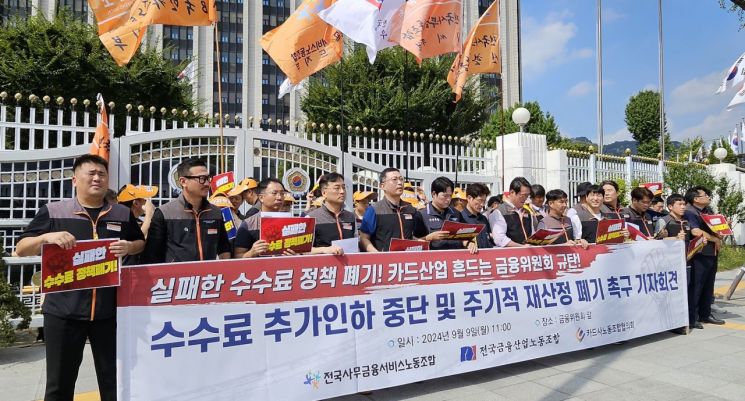 Seven card companies (Shinhan, KB Kookmin, Hyundai, Lotte, Woori, Hana, and BC Card) gathered as the Card Company Labor Union Council, along with the National Office Financial Workers' Union and the National Financial Industry Union, held a press conference on the 9th in Jongno-gu, Seoul, demanding the abolition of the qualified cost recalculation system.
 [Photo by Jeon Young-joo ange@]
The card unions argue that preferred merchants do not feel burdened by card fees, making the qualified cost recalculation system unnecessary. Jang Mun-yeol, chairman of the Woori Card union, stated, "Currently, for small and medium merchants with annual sales under 1 billion KRW, the merchant fee rate is between 0.5% and 1.25%. They receive a tax credit of 1.3% of card sales under the Value-Added Tax Act. The effective fee rate for preferred merchants is negative." He added, "Since merchants pay fees and then get more back through taxes, card fees cannot be a burden for small and medium merchants."
On the other hand, the card unions criticize that the qualified cost recalculation system is worsening both profitability and soundness of card companies. Chairman Jang lamented, "Card companies that cannot make adequate profits with the current merchant fee rates are ultimately reducing services to the public. Due to government populism, card companies have lost business performance and innovation, and lending has become their main business."
Lee Jae-jin, chairman of the Office and Financial Workers' Union, said, "Lending business deteriorates the soundness of card companies. As of September last year, the delinquency rate of cash loans surged to 1.6?2.5%. The deterioration of soundness increases card companies' bad debt expenses, which in turn reduces profits and inevitably leads to a decline in competitiveness."
The card unions demand the abolition of the qualified cost recalculation system, arguing that it fails to properly reflect card companies' costs and only fosters conflict. Chairman Lee stated, "When card companies try hard to reduce costs such as labor expenses to make profits, the saved costs are again used as grounds for future fee rate reductions. This is the reason for abolishing the qualified cost recalculation system. The card unions will raise the flag of struggle and fight to the end if the system is not abolished."
© The Asia Business Daily(www.asiae.co.kr). All rights reserved.
![Clutching a Stolen Dior Bag, Saying "I Hate Being Poor but Real"... The Grotesque Con of a "Human Knockoff" [Slate]](https://cwcontent.asiae.co.kr/asiaresize/183/2026021902243444107_1771435474.jpg)
















