Amendments to the Fair Trade Act and Large-scale Distribution Act
Revisions to Platform 甲甲 and 甲乙 Regulations
Strengthening Business Operators' Burden of Proof
The government has ultimately scrapped the enactment of the Platform Competition Promotion Act (Platform Act) aimed at preventing unfair practices by platform companies with monopolistic positions. Instead of enacting a separate law to timely regulate the monopolistic behaviors of giant platforms and restore market competition, the legislative direction has been finalized to amend the existing Fair Trade Act. The core proposal to introduce a prior designation system was also abandoned, considering industry opposition due to concerns over overlapping and excessive regulation.
On the 9th, the Fair Trade Commission (FTC) reported the 'Legislative Direction for Promoting Fair Competition on Platforms and Preventing the Recurrence of the Timed Deal Incident' to the government-party consultative meeting and announced the legislative promotion direction for institutional improvements in platform monopolies and the supplier-buyer sector. This shift to amending existing laws came seven months after the original Platform Act draft was reconsidered due to strong industry backlash in February.
Prohibition of Four Major Unfair Practices...Fines up to 8% of Sales
The FTC plans to amend the Fair Trade Act and the Large-scale Distribution Business Act to block anti-competitive behaviors occurring in the platform market’s dominant-dominant (monopoly) and dominant-subordinate relationships. Instead of legally 'prior-designating' platforms with monopolistic status, the amendment will apply a 'post-presumption' approach when violations occur. Although the initially proposed prior designation system was removed, the FTC explained that by including quantitative criteria for post-presumption, the effect of prior designation can be partially achieved.
The post-presumption targets are platforms that meet either ▲ a market share of 60% and over 10 million users, or ▲ a combined market share of 85% or more among three or fewer companies, each with over 20 million users; however, platforms with domestic sales of 4 trillion KRW or less are excluded even if these conditions are met.
Six service areas?intermediation, search, video, social networking services (SNS), operating systems (OS), and advertising?will be subject to this law. Nam Dong-il, Secretary General of the FTC, emphasized, "By legislating fact-finding investigations in these six service areas, we will ensure prompt law enforcement when violations occur." Whether to disclose the results of these investigations will be decided through discussions during the legislative process.
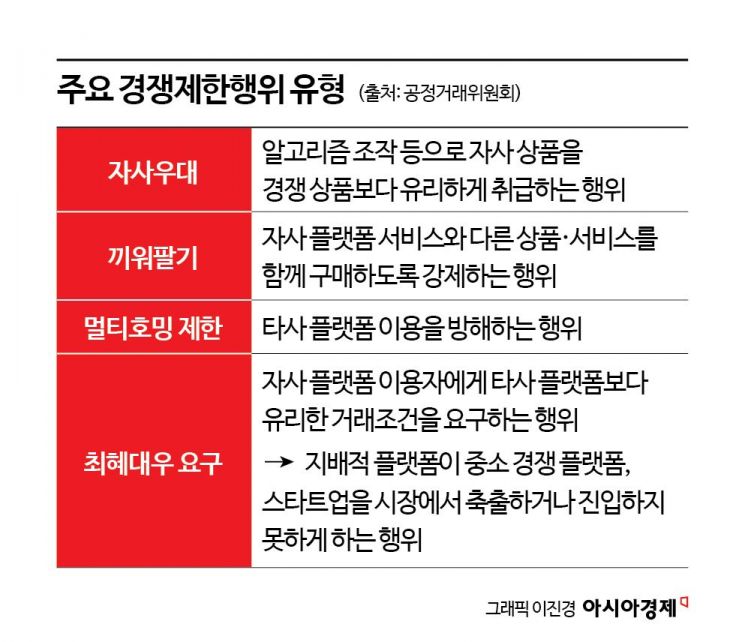
The prohibited unfair practices include self-preferencing (favoring one’s own products over competitors’ through algorithm manipulation), tying sales (forcing the purchase of other products or services together with the platform’s own services), multi-homing restrictions (hindering the use of other platforms), and most-favored-nation demands (requiring better trading conditions for the platform’s users than those offered by other platforms). The FTC minimized the criteria for designating dominant operators and the scope of unfair practices, considering industry opposition.
Burden of Proof on Operators... "Effectiveness Achieved Even with Post-Regulation"
Once the amended law is enforced, if the FTC determines that a platform company has engaged in illegal activities, the burden of proof that the conduct is lawful will rest with the operator. The FTC expects that strengthening the operator’s burden of proof will shorten the time required for case processing. Although this is not a complete shift of the burden of proof to operators as in the European Union’s Digital Markets Act (DMA), the FTC believes that by placing a significant portion of the burden on companies during court proceedings, the effectiveness originally intended by the legislation can be achieved even with post-regulation.
Shin Dong-yeol, Director of the FTC’s Competition Policy Bureau, said, "Even without insisting on enacting a new law including prior designation, amending the existing Fair Trade Act alone can achieve the original legislative objectives and effects." He added, "(With the amendment) we expect to increase compliance among regulated entities and quickly establish regulation in the market."
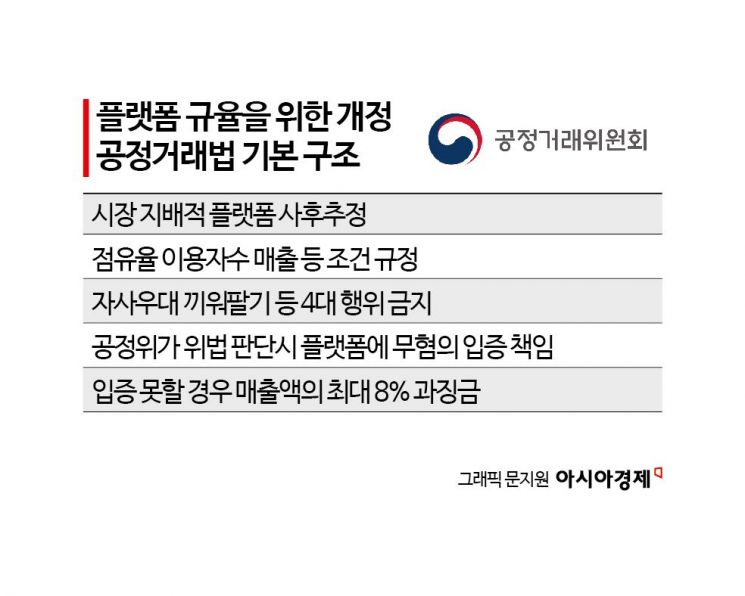
If a violation is confirmed, the FTC can impose fines and issue business suspension orders that immediately halt the operator’s transactions. The fine rate has been raised to a maximum of 8% of related sales, up from the previous 6%. This is still lower than the maximum 10% fine rates adopted or proposed by advanced countries with similar legislation.
Han Ki-jung, Chairman of the FTC, stated, "The temporary suspension order system introduced in the current Electronic Commerce Act has been criticized for being practically difficult to use due to strict requirements." He added, "Since this regulation targets a few platforms with strong dominance, the requirements will be strict, but we will carefully assess the legal principles to ensure that this system can be applied when necessary."
However, some argue that adopting post-presumption and strengthening the operator’s burden of proof are insufficient alternatives to achieve the original goals of the Platform Act. The initial intent was to create clear legal regulatory measures targeting giant platforms, predefine market boundaries and dominance assessments, and significantly shorten the time to handle platform unfair practices. Critics say the legal checks are too delayed and insufficient. The scope of post-presumption regulation is narrow, and concerns about reverse discrimination against overseas platforms have also been raised. Industry insiders mention dominant platforms likely subject to post-presumption include search (Naver), app markets (Google, Apple), and SNS (Kakao).
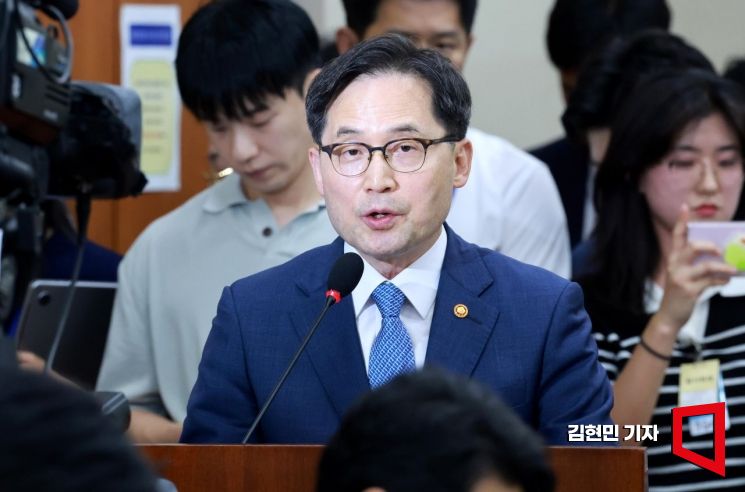 Han Ki-jung, Chairman of the Fair Trade Commission, is speaking at the urgent inquiry on the "Timon and Wemakeprice Settlement and Refund Delay Incident" held on the 30th at the National Assembly's Political Affairs Committee. Photo by Hyunmin Kim kimhyun81@
Strengthening Protection for 'Subordinate' Operators... Final Plan to be Prepared After Public Hearing This Month
To prevent a recurrence of the Timed Deal incident, the FTC is also pursuing including platform companies of a certain scale (telecommunication sales intermediaries) as subjects of regulation under the Large-scale Distribution Business Act. Two designation criteria have been discussed: ▲ annual intermediation revenue of 10 billion KRW or more or intermediation transaction amount of 100 billion KRW or more, and ▲ annual intermediation revenue of 100 billion KRW or more or intermediation transaction amount of 1 trillion KRW or more.
Additionally, the settlement period for these platforms will be shortened, and mandatory measures will be introduced to entrust sales proceeds to reliable institutions such as banks. The settlement period will be set shorter than the traditional retail industry’s 40 days, with multiple options such as 'within 10 to 20 days from purchase confirmation' or 'within 30 days from the monthly sales closing date.' To prevent sales proceeds from being used for other purposes and causing harm to sellers and consumers, platforms will be required to separately manage 100% or 50% of sales proceeds through a third-party institution.
Chairman Han explained, "The amended law will be implemented after a grace period to allow sufficient preparation for the newly introduced regulations, and the regulatory intensity will be gradually increased through transitional provisions." The FTC plans to promptly coordinate with the National Assembly to propose amendments to the Fair Trade Act, for which inter-agency consultations have already been completed. Regarding the Large-scale Distribution Business Act amendments, which are still under review with multiple options, the FTC will gather opinions from various sectors through a public hearing and finalize the plan within this month.
© The Asia Business Daily(www.asiae.co.kr). All rights reserved.



















