KAIST·NYU Sign MOU to Establish Joint AI Degree Program
Aiming to Operate in One Year
Korea Advanced Institute of Science and Technology (KAIST, President Kwang Hyung Lee) and New York University (NYU, President Linda Mills), a leading private university in New York City, have finalized their decision to introduce a joint degree program in the field of artificial intelligence. It is expected that including the name of Korea's prestigious engineering school in a newly established graduate school recruiting students worldwide to study AI in New York City, the largest city in the United States, will further enhance trust in Korea's AI technology and academia.
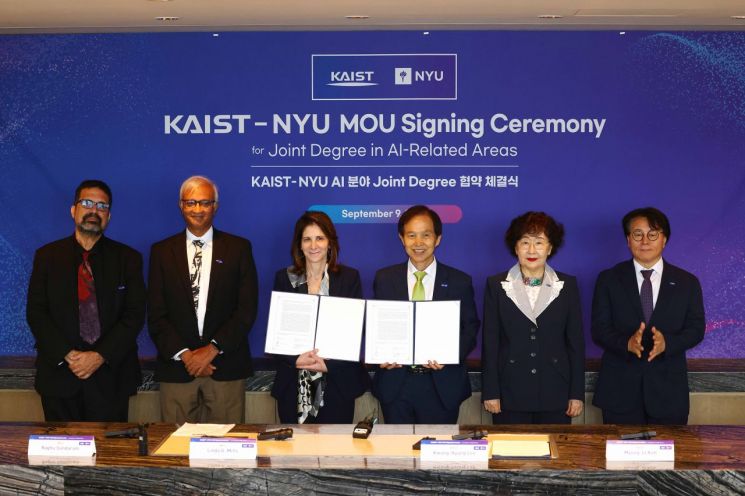 On the 9th, attendees are taking a commemorative photo after signing the KAIST-NYU joint degree program MOU held at the Four Seasons Hotel in Seoul. (From left) Elliott Borenstein, NYU Vice President; Ragu Sundaram, NYU Vice President; Linda Mills, NYU President; Kwang Hyung Lee, KAIST President; Myung Ja Kim, KAIST Chairperson; Hyun Deok Yeo, KAIST G-SCHOOL Director. Photo by KAIST
On the 9th, KAIST and NYU signed a memorandum of understanding at the Four Seasons Hotel in Seoul to introduce the joint degree program in AI, attended by President Kwang Hyung Lee and President Linda Mills. This agreement was reached as the directions of the two university presidents aligned after 2 years and 6 months of exchanges and AI development collaboration between the two schools.
This is the first time KAIST is pursuing a joint degree program. While NYU has experience implementing joint degree programs with other national universities, this is the first case with a Korean institution. It is a significant challenge for both universities.
The specific details of the joint degree program will be developed by an operating committee composed equally of members from both universities. The goal is to start operations within one year, but considering the time required for approvals, especially on the U.S. side, the actual start of the academic program may be somewhat delayed. Since it involves establishing a new department, it is not an easy task. Classes will mainly be held in New York City, where the NYU campus is located.
President Kwang Hyung Lee of KAIST said, “President Mills and I share the belief that ‘the best way to predict the future is to create it.’ We have decided to nurture the best talents who can develop and apply AI and the future together.” President Mills also highly valued the significance, saying, “We are at a crossroads now. This joint degree program is important for AI and future development.”
President Mills added, “Already, the two universities have formed 12 research groups and over 200 professors are exchanging ideas.” This emphasized the well-progressed cooperation between the two sides.
President Lee showed a 'KAIST NYU' badge pinned on his suit jacket and introduced it by saying, “NYU made this badge.” This indicates how much significance NYU places on this project.
President Lee described the meeting of the two universities as a ‘marriage’ and explained that the ‘precious child’ of this marriage is the AI joint degree program.
The union of the two universities is complementary in nature. President Lee said, “KAIST has strengths in engineering, while NYU excels in theory,” and added, “We expect this to be an unprecedented innovative experiment creating ‘one artificial intelligence degree’ by combining the strengths of both schools.”
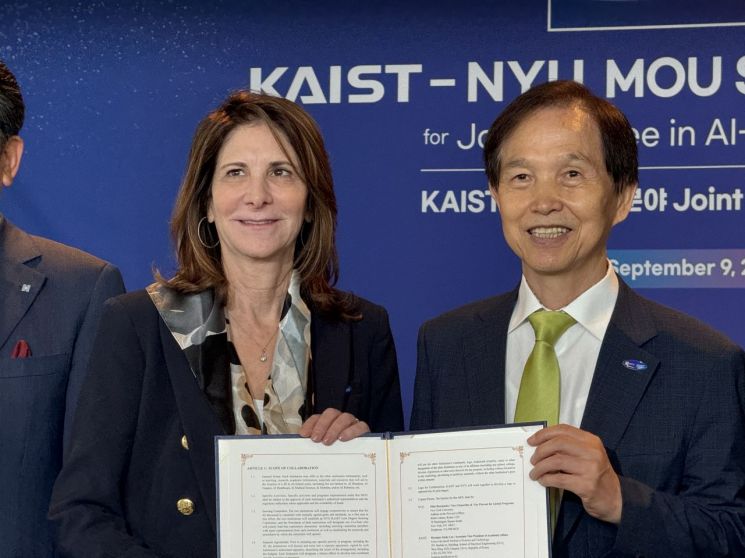 Lee Kwang-hyung (right in the photo), President of KAIST, is wearing a badge on his suit jacket that features both KAIST and NYU side by side. President Lee mentioned that NYU made this badge themselves. Photo by Baek Jong-min
President Lee mentioned that NYU alumni in Korea also welcome KAIST’s participation, introducing that “the Korean NYU alumni association has raised donations amounting to 1.8 billion won.” He predicted there would be strong support from the Korean-American community as well.
President Lee stated that with the promotion of this joint degree program, the establishment of a KAIST New York campus can be considered practically completed. A school official explained that this was a realistically feasible choice rather than directly establishing a school in the United States.
© The Asia Business Daily(www.asiae.co.kr). All rights reserved.


















