Reservoir Water Level Drops Below Alert Threshold of 62.1 Million Tons
From the 21st, 115,000 Tons to Be Supplied from Geumgang via Waterway Operation
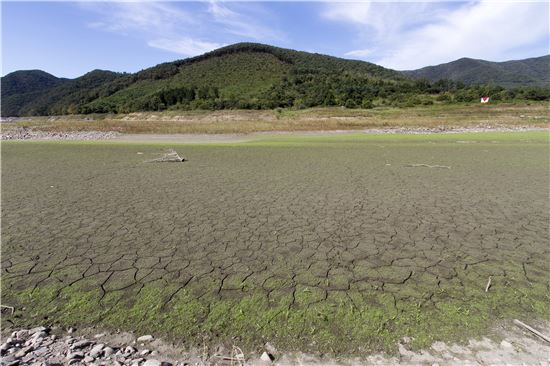 The upper stream view of Boryeong Dam during the 2015 drought
Boryeong Dam, which supplies water to eight regions in South Chungcheong Province, is drying up amid the ongoing heatwave. Although water can be supplied from the Geumgang River via a waterway, the worsening water shortage every year is raising the need for the construction of additional dams.
According to South Chungcheong Province on the 9th, as of the 5th, the water storage at Boryeong Dam was 61.9 million tons, falling below the 62.1 million tons crisis alert level, and entering the drought watch stage. Since the rainy season (July 28), precipitation has been only 80mm, which is 25% of the average year.
The province plans to operate the waterway and supply 115,000 tons of water per day from the Geumgang River to Boryeong Dam, starting after the flood season ends on the 21st, considering the water quality and levels of the dam and rivers.
The waterway connecting the downstream Baekje Weir of the Geumgang River and the upstream of Boryeong Dam was opened in 2016 to resolve the recurring droughts. When a crisis alert is issued for Boryeong Dam’s water level, up to 115,000 tons of water can be transferred daily from the Geumgang River.
Although the waterway has fulfilled its role whenever Boryeong Dam’s water storage is at risk, the number of days it has been operated in the past three years shows a growing dependency: 117 days in 2021, 231 days in 2022, and 130 days in 2023, nearly half the year, indicating the need for a fundamental solution.
South Chungcheong Province receives water from Boryeong Dam, Daecheong Dam, Yongdam Dam, and others. The available water supply is 2.06 million cubic meters per day, of which 1.371 million cubic meters are currently used. By 2027, with the completion of the Seosan seawater desalination project, the western region of Daecheong Dam, and the Cheongyang groundwater dam, water can also be supplied to industrial complexes being established in Seosan and Asan. However, if additional water is not secured by 2035, when 15 industrial complexes including Cheonan Future Mobility are scheduled for completion, demand is expected to exceed supply, making water shortages a reality.
Accordingly, the construction of the Cheongyang Jicheon Multi-purpose Dam, selected by the government as a climate response dam candidate, is urgently needed. If a multi-purpose dam is built on the downstream Jicheon, stretching from Jangpyeong-myeon in Cheongyang County to Eunsan-myeon in Buyeo County, it can supply 11,000 cubic meters of water per day, enough for 380,000 people. Cheongyang and Buyeo Counties, which currently rely on Daecheong Dam and Boryeong Dam, would be prioritized for water supply, potentially resolving water shortage issues.
Governor Kim Tae-heum said at the departmental directors’ meeting held that day, "As Boryeong Dam has entered the drought watch stage, please ensure thorough operation of the waterway immediately after the flood season," and added, "Dams are essential for various climate responses, including droughts and floods."
He also emphasized, "While I understand some opposing views, in South Chungcheong Province, the only place available for water storage is Jicheon, which is why we are planning the Jicheon Dam," and added, "We will work to address the concerns of Cheongyang residents through dialogue."
© The Asia Business Daily(www.asiae.co.kr). All rights reserved.
















