KDI Announces September Economic Trends
Domestic Demand Slump Expected for 10th Consecutive Month
The Korea Development Institute (KDI), a government-funded research institute, stated on the 9th that "the high interest rate trend is delaying domestic demand recovery, thereby constraining economic improvement." It assessed that domestic demand is showing red flags due to sluggish retail sales and construction investment, along with increasing debt repayment burdens. This assessment contradicts the government's evaluation, which sees signs of domestic demand improvement.
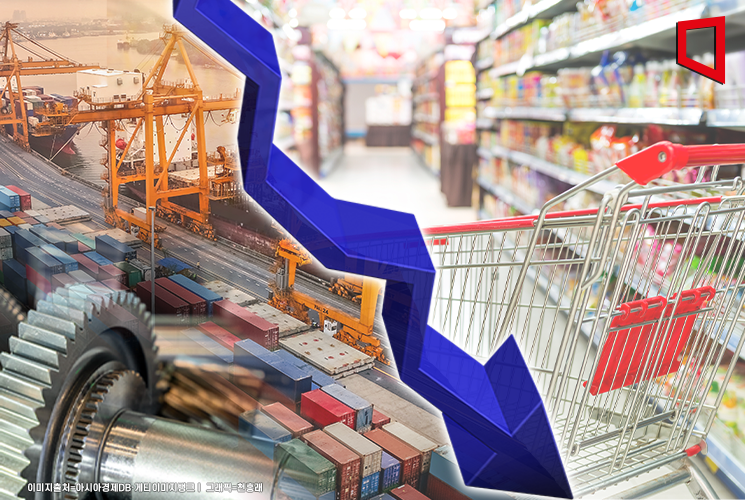
In its 'September Economic Trends' report released that day, KDI evaluated that "despite strong export growth, domestic demand has not recovered, resulting in a somewhat delayed economic improvement." Having diagnosed domestic demand slowdown and weakness since December last year, KDI again expressed concerns about domestic demand this month, noting that economic improvement remains difficult. This presents a continuing divergence from the government's recent outlook, which anticipates signs of domestic demand recovery.
KDI explained, "Exports, centered on ICT, continued a solid recovery trend, but retail sales and construction investment remain sluggish." Additionally, it added, "The business outlook for domestic companies stayed at a low level, and the delinquency rate among sole proprietors continued to rise." It also stated, "Prolonged contraction in goods consumption and only modest growth in service consumption resulted in a weak consumption trend."
Retail sales, which reflect actual goods consumption, decreased by 2.1% as of July, narrowing the decline from June (-3.6%), but KDI assessed that most product categories still remain sluggish. Service consumption saw increased production in the information and communication sector (5.0%), but production in accommodation and food services (-3.0%) and arts, sports, and leisure-related services (-0.7%) remained weak.
While the high interest rate environment limits the recovery of facility investment, the recent shift of the facility investment index to an upward trend is noteworthy. Facility investment in July recorded a high growth rate of 18.5%, with transportation equipment (64.9%) showing growth due to a surge in investment in aircraft and other items.
However, KDI evaluated that "considering the leading indicators of facility investment, the high growth rate may be partially adjusted." It further explained, "Domestic machinery orders in July increased significantly (-13.1% → 14.5%), whereas the growth rate of transportation equipment imports in August (82.5% → 5.3%) narrowed."
Construction investment continues to show a sluggish trend. Construction output (constant prices) in July decreased by 5.3%, continuing the decline centered on the building sector, similar to the previous month. KDI noted, "Leading indicators remain at low levels, suggesting that construction investment weakness is likely to persist."
Exports in August continued a strong growth trend driven by ICT items, increasing by 11.4%. Although automobiles declined (-4.3%), ICT items (39.3%) led the export recovery. Imports grew by 6.0%, lower than the previous month (10.5%), due to a slowdown in sectors excluding energy resources. The trade balance maintained a surplus trend at $3.83 billion.
KDI assessed that the inflation rate "has approached the target level." Actual consumer prices in August rose by 2.0%, lower than the previous month (2.6%). KDI explained, "The recent decline in Dubai crude oil prices may act as a factor to slow future inflation increases."
Meanwhile, regarding the global economy, KDI pointed out that "there are numerous downside risk factors, including the high interest rate trend, geopolitical risks, and instability in manufacturing sectors of major countries." It also explained, "Although the international financial market saw a sharp contraction in investment sentiment due to increased economic uncertainty in August, it is gradually stabilizing thanks to expectations of a soft landing for the U.S. economy and strengthened prospects for interest rate cuts."
© The Asia Business Daily(www.asiae.co.kr). All rights reserved.
![Clutching a Stolen Dior Bag, Saying "I Hate Being Poor but Real"... The Grotesque Con of a "Human Knockoff" [Slate]](https://cwcontent.asiae.co.kr/asiaresize/183/2026021902243444107_1771435474.jpg)










