"Stopping Wrong Policies and Restoring Original State Is the Only Hope"
Concerns have been raised that due to the disruption in emergency room operations, approximately 10,000 patients per day may not receive emergency treatment during the Chuseok holiday period.
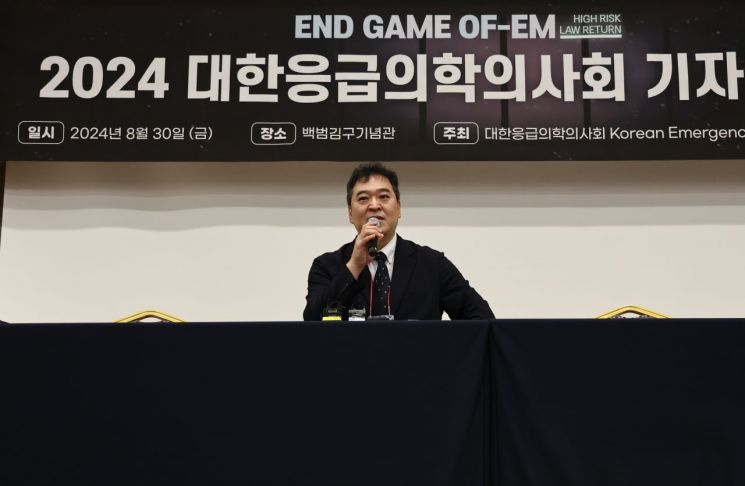 Lee Hyung-min, president of the Korean Society of Emergency Medicine, is speaking at a press conference during the Korean Society of Emergency Medicine academic conference held on the afternoon of the 30th of last month at the Baekbeom Kim Koo Memorial Hall in Yongsan-gu, Seoul.
 [Image source=Yonhap News]
The Korean Society of Emergency Medicine announced on the 9th the results of a survey on the current status of emergency rooms, answered by 503 emergency medicine specialists from September 3 to 7. They stated, "The daily number of emergency room visits, which is usually around 20,000, increased to 30,000 during the holiday last year," and explained, "There are already difficulties in providing care, and during the Chuseok holiday, about 10,000 patients per day may not be able to receive emergency treatment."
According to the survey, 97% of emergency room doctors in medical institutions in the Seoul metropolitan area recognized the Chuseok holiday as a crisis situation. In non-metropolitan areas, 94% responded that it was a crisis.
Additionally, 93% of respondents said that their workload had increased since March. Even in non-training hospitals that originally had no residents, 99% of respondents reported an increase in workload.
Among respondents working in emergency rooms of training hospitals, 55% said they were operating with reduced beds. However, the Emergency Medicine Society estimated that the actual rate of bed reduction could be higher, as some hospitals either had a decrease in authorized beds or did not report bed reductions to the National Emergency Medical Information Network (NEDIS).
The Korean Society of Emergency Medicine stated, "The decline in the final treatment capacity of tertiary hospitals is the direct cause of the current difficulties in accommodating emergency room patients," and added, "It is clear that during the holiday period, the limitations of medical resources will worsen, and patients with nowhere to go will not receive appropriate treatment."
They continued, "We have repeatedly pointed out this crisis, and the responsibility for the collapse of emergency medical care during the holiday period clearly lies with the government's policy failure."
Furthermore, they said, "The government explains that there are no problems except for a few emergency rooms that have closed, but this does not meet the public's expectations and is vastly different from the perceptions of emergency medicine specialists working on the front lines," and stated, "Most emergency medicine specialists condemn the government for distorting the situation on the ground and lying with statistics."
They concluded, "If a bipartisan parliamentary council is formed, medical reform can be discussed, but the return of residents cannot be considered," emphasizing, "If we want to normalize healthcare, the only hope is to immediately stop the flawed policies and restore the original state."
© The Asia Business Daily(www.asiae.co.kr). All rights reserved.

















