Request for System Improvements Such as 'Railway-Only Tariff' to KEPCO
Need to Reflect Financial Limitations and Public Service Characteristics of Railway Organizations
Busan Transportation Corporation (President Lee Byungjin) announced that 15 national railway operating organizations, including Korea Railroad Corporation and Seoul Metro, delivered a joint proposal to Korea Electric Power Corporation on the 3rd, urging for improvements to the electricity tariff system, such as the introduction of a dedicated railway tariff.
Following the introduction of the ‘cost-linked tariff system’ in 2021, electricity rates have surged by over 40% in the past three years. Compared to 2021, urban railway operators are now paying an additional 112.4 billion KRW (39.9%) annually, and Korea Railroad Corporation is paying an extra 154.4 billion KRW (37.3%) per year in electricity costs.
As a result, railway operating organizations, which are already operating with fares that do not even cover one-third of transportation costs, are facing increased financial difficulties due to the rise in electricity costs, which account for 10?15% of operating expenses excluding labor costs.
Railway operators currently pay electricity rates under the ‘industrial power’ contract category. However, industrial power rates are designed for profit-oriented businesses that can reflect electricity price increases in their product prices. The operators argue that applying these rates to public-interest railway organizations is unreasonable.
Additionally, KEPCO imposes electricity charges based on peak power usage, differentiated by season and time of day, to manage generation capacity. However, electric railways cannot adjust their electricity usage by season or time, as power demand is concentrated during commuting hours, holidays such as Seol and Chuseok, and national events to ensure public convenience and mobility rights. Therefore, they emphasize the urgent need to improve the current system that uniformly applies industrial rates to railways.
Reflecting this situation, the 15 national railway operating organizations have proposed the establishment of a new ‘railway power’ contract category at a level similar to ‘educational power’ and improvements to the method of applying the basic charge for maximum demand power.
Despite various self-help efforts by the 15 railway operating organizations nationwide, such as introducing high-efficiency products and improving facility operation efficiency, which reduced electricity consumption by 1.1% in 2023 compared to the previous year, electricity costs still increased by 25.1%, making operations difficult.
Lee Byungjin, President of Busan Transportation Corporation, stated, “Our mission is to continuously provide transportation welfare services to as many citizens as possible,” adding, “We hope that the delivery of this joint proposal will lead to improvements in the electricity tariff system, taking into account the unique characteristics and public nature of electric railways, and we will actively pursue further self-help measures at the corporation level.”
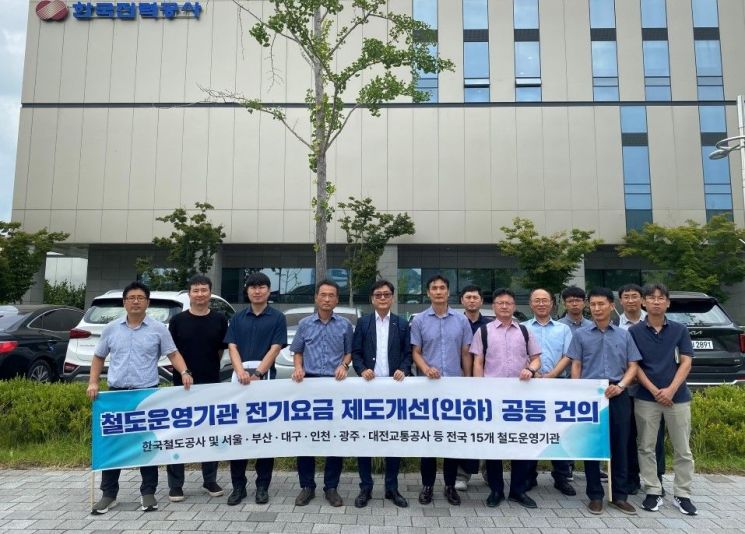 Busan Transportation Corporation is jointly proposing improvements to the electricity tariff system with 14 railway operating organizations nationwide.
© The Asia Business Daily(www.asiae.co.kr). All rights reserved.
![Clutching a Stolen Dior Bag, Saying "I Hate Being Poor but Real"... The Grotesque Con of a "Human Knockoff" [Slate]](https://cwcontent.asiae.co.kr/asiaresize/183/2026021902243444107_1771435474.jpg)
















