Sung Tae-yoon "Preparing Guidelines to Distinguish Speculators and Actual Buyers"
Real Estate Uptrend Slows... Rental Laws 2 Should Be Repealed
Opposition Criticizes 250,000 Won Support Plan as "Pinpointing Vulnerable Groups"
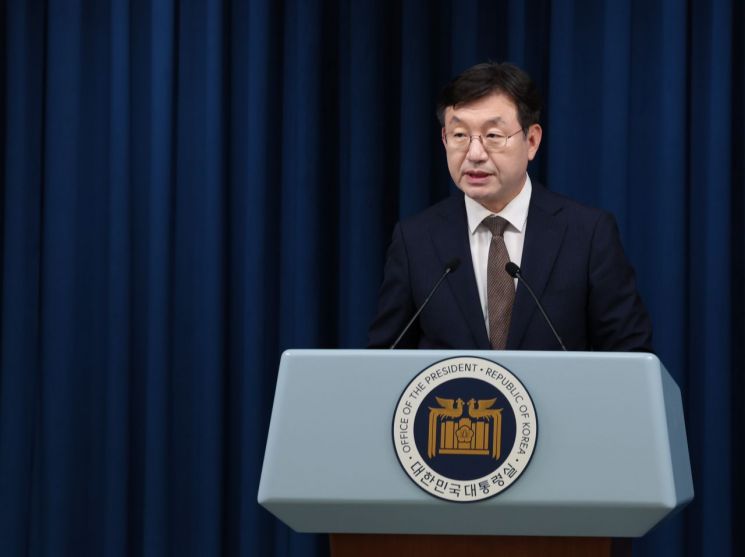 Sung Tae-yoon, Chief of Policy Office at the Presidential Office, is giving a briefing on current issues related to medical reform at the Presidential Office building in Yongsan, Seoul on the 26th.
 [Image source=Yonhap News]
Seong Tae-yoon, Chief of Policy at the Presidential Office, recently addressed concerns that strengthening loan regulations to stabilize the real estate market could cause unintended harm to genuine borrowers. On the 8th, he stated, "While overall loan soundness is being managed, it would be problematic if genuine borrowers face difficulties obtaining loans."
Appearing on MBN's Current Affairs Special that day, Seong emphasized, "Strict management is applied to loans that can be considered for investment or speculation purposes, but it is necessary to allow loan demand that arises from actual residential moves to be fulfilled."
He added, "While financial institutions autonomously handle loans themselves, the authorities will prepare guidelines to distinguish between genuine demand and other cases to ensure there are no difficulties, and we will do our best."
Regarding the recent real estate market, Seong said, "It is true that prices have risen mainly for new apartments in Seoul and the metropolitan area. However, prices in the outskirts of the metropolitan area and non-apartment properties have either declined or remained stable. Since the government announced policies forecasting a large-scale supply expansion, the upward trend has slowed for three consecutive weeks."
Seong also stressed the need to repeal the so-called 'Lease 2 Laws,' including the right to request contract renewal and the rent ceiling system.
He explained, "It has been four years since the Lease 2 Laws were implemented in August 2020, and the pressure from the fourth year has arrived. Contrary to the policy's original intent four years ago, it is causing housing insecurity for tenants, so improvements in this area are necessary."
Regarding the Democratic Party's proposal to provide 250,000 won to all citizens, Seong said, "Rather than simply distributing cash, targeted support for vulnerable groups is something to consider."
He noted, "Debt, which was around 600 trillion won in the past, has now approached nearly 1,000 trillion won, and the national debt-to-GDP ratio has significantly increased under the previous administration, making it difficult to continue the past trend of expanding government spending. Especially, with government spending having expanded, interest burdens have also increased."
However, Seong emphasized, "Support for vulnerable groups needs to be concentrated. For example, providing 250,000 won to all citizens would cost about 13 trillion won, making it difficult to implement as is, but pinpointed support focused on low-income groups is necessary."
He continued, "We are strengthening support for vulnerable groups through measures such as delivery fee subsidies, financial burden relief for small business owners, and expanding the New Start Fund. Recently, efforts have been made to restore the ecological function of nuclear power plants to enhance overall economic productivity and ensure these benefits reach the public."
Regarding the base interest rate cut, Seong said, "It is difficult for us to advocate for lowering interest rates in this direction," but reiterated, "It is appropriate for conditions to move toward a rate cut."
He added, "Compared to countries that have cut or are about to cut interest rates, South Korea's consumer price inflation rate is lower. While lowering interest rates helps the economy, it can also lead to household debt expansion and destabilize the real estate market. Therefore, it is necessary to combine two approaches: strengthening loan management and supervision while reducing the principal and interest repayment burden."
© The Asia Business Daily(www.asiae.co.kr). All rights reserved.
![Clutching a Stolen Dior Bag, Saying "I Hate Being Poor but Real"... The Grotesque Con of a "Human Knockoff" [Slate]](https://cwcontent.asiae.co.kr/asiaresize/183/2026021902243444107_1771435474.jpg)
















