Statistics Professor: "No Impact or Possibly Negative Effect"
Criminal Charges Possible Due to Systematic Score Manipulation
As parents continue to post verification messages stating that they have registered for the 2025 College Scholastic Ability Test (CSAT) science inquiry section to raise their children's standard scores, an expert has analyzed that this method does not help improve the standard scores.

On the 6th, SBS conducted a simulation experiment with Professor Kim Tae-yoon, an emeritus professor of statistics at Keimyung University, to test whether the strategy of increasing the number of science inquiry test-takers by even one person to help children receive slightly higher standard scores is effective. Following the actual CSAT standard score calculation method, the experiment showed that when 200 parents took a subject with 1,000 test-takers and all scored zero to lower the average, the top-tier 1st and 2nd grade standard scores either remained unchanged or even decreased by one point.
Professor Kim explained to SBS, "The idea is to lower the average score so that students' scores appear relatively higher, but the standard deviation also increases accordingly," adding, "These effects offset each other, so instead of rising by 10 to 20 points, the scores only slightly increase or decrease." The analysis suggested that to raise the top-tier standard score by one point, at least 500 parents would need to take the same subject and all score zero. However, lawyer Lee Seung-woo pointed out in an SBS interview that this strategy could be considered an organized manipulation of CSAT scores and may lead to criminal penalties.
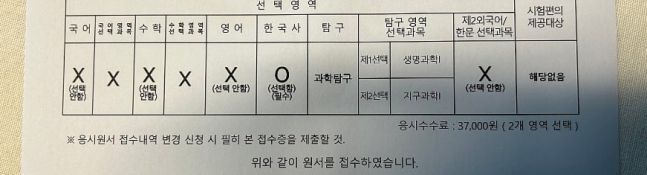 A parent revealed that they took the science inquiry section to raise their exam-taking child's standardized score in the science inquiry area. [Image source=Captured from Naver Cafe]
Since the CSAT registration began on the 22nd of last month, posts from parents verifying their registration for the science inquiry section have continued to appear on admission-related online communities. On the last day of CSAT registration, the 6th, a parent identified as A said, "A mother born in '95 is pouring a bucket of water into the Han River trying to create a son born in '25," adding, "Seeing my child distressed over scoring 45 points in Earth Science and getting a 2nd grade made me anxious. Those hesitating, please hurry and register."
On the 30th of last month, another parent, B, said, "I will protect my children's standard scores in Chemistry 1 and Biology 1," adding, "It seems difficult to take Korean, English, and Math, so I only registered for the 4th session. Securing time to focus and pray during sessions 1 to 3 already feels reassuring. Parents who are hesitating, let's join together."
The reason parents are taking the CSAT science inquiry section is analyzed to be due to the so-called 'Satam-run' phenomenon. 'Satam-run' refers to the significant increase in students applying to engineering and natural science departments choosing social studies inquiry subjects instead of science inquiry because major top-tier universities recognize social studies as inquiry subjects for natural science departments, including medical fields, allowing science students to select social studies.
In the June mock exam alone, the number of test-takers for Physics I, Chemistry I, Biology I, and Earth Science I in the science inquiry section decreased by approximately 4,000 to 12,000 per subject compared to the previous year. Conversely, among social studies inquiry subjects, the number of test-takers for Social and Culture increased by more than 24,000 compared to the June mock exam last year, with eight subjects excluding East Asian History seeing increased participation.
When mid- to low-ranking examinees switch from science inquiry to social studies inquiry, the number of students who can achieve 1st or 2nd grade also decreases accordingly. Therefore, it appears that parents are submitting registration forms for science inquiry subjects one after another, hoping for a score improvement effect for their children by increasing low scorers in subjects with fewer test-takers. This is because, due to the nature of standard scores, which indicate how far a test-taker's raw score deviates from the average, lowering the average is known to raise the standard scores of high scorers.
© The Asia Business Daily(www.asiae.co.kr). All rights reserved.


















