Significant Increase in Patients Treated for Parkinson's Disease and Alzheimer's Dementia
Importance of Early Diagnosis Using PET-CT Scans Rapidly Rising
Centum General Hospital Provides Fast and Accurate Diagnosis with Advanced PET-CT
Due to rapid population aging, the incidence of degenerative brain diseases such as Parkinson's disease and Alzheimer's dementia has been continuously increasing.
These diseases have a serious impact on patients' daily lives, making early detection extremely important. In particular, the initial symptoms of Parkinson's disease and Alzheimer's dementia are often mild, resulting in delayed diagnosis and intervention in many cases.
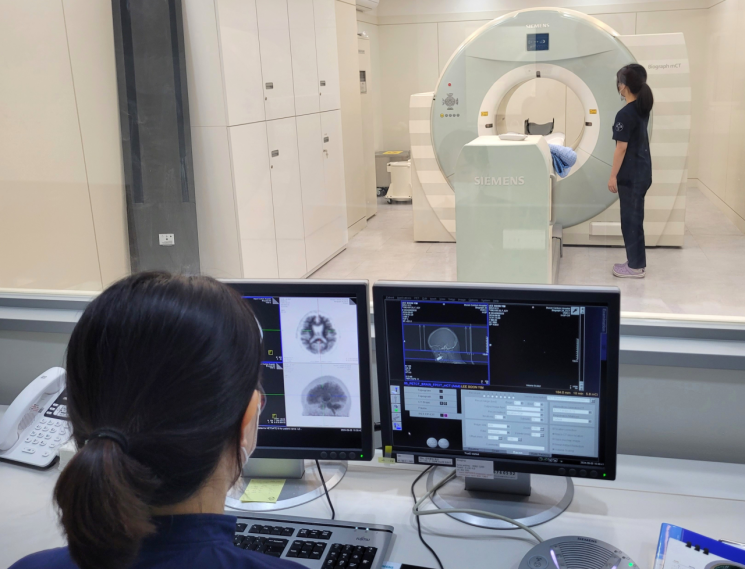
According to statistics from the Health Insurance Review and Assessment Service, the number of patients treated for Parkinson's disease in Korea increased by about 13%, from 125,607 in 2019 to 142,013 in 2023. During the same period, the number of dementia patients increased by 22.3%, from 551,845 to 674,963.
Professor Yoo Namtae of the Department of Neurology at Centum General Hospital said, "Degenerative brain diseases gradually worsen, and in many cases, symptoms appear only after the disease has already progressed. Therefore, early detection and intervention are crucial in determining the patient's quality of life." He emphasized that utilizing advanced diagnostic equipment such as PET-CT (Positron Emission Tomography-Computed Tomography), a cutting-edge medical technology, for early detection and accurate diagnosis is very important for improving the quality of life for patients and their families.
Professor Yoo explained, "Parkinson's disease occurs due to damage to dopamine nerve cells in the brain, causing symptoms such as tremors in the hands, arms, legs, or face, slowness of movement (bradykinesia), and muscle rigidity. Alzheimer's dementia is caused by the accumulation of beta-amyloid protein, which damages brain cells and leads to memory loss, cognitive and language decline, and changes in personality or behavior." He stressed, "For both diseases, once they develop, the main goal of treatment is to slow progression, so accurate diagnosis at an early stage is essential."
PET-CT plays a very important role in the early detection of these diseases. PET-CT is a highly precise diagnostic technique that visualizes brain metabolic activity by injecting a small amount of radioactive isotope into the body.
This method enables the early detection of functional abnormalities in nerve cells, allowing Parkinson's disease and Alzheimer's dementia to be identified at an early stage.
In particular, PET-CT can sensitively detect changes in the dopamine transmission system in Parkinson's disease, making it possible to identify signs of the disease even before clinical symptoms appear. This allows patients to begin treatment more quickly, helping to delay symptom progression and maintain independence in daily life.
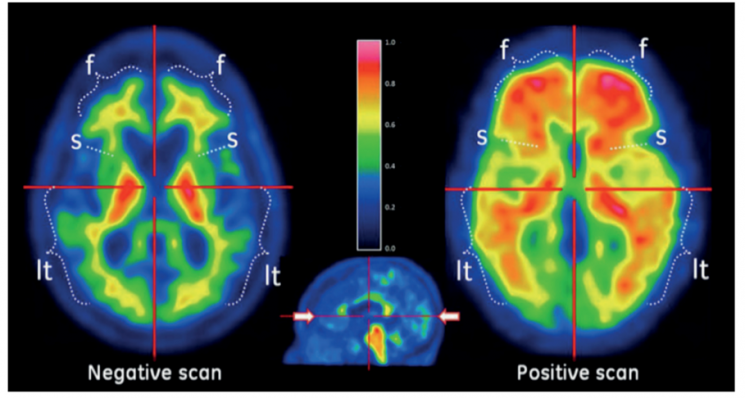 The image on the left (negative scan) shows normal brain activity. The image on the right (positive scan) represents the brain of an Alzheimer's dementia patient, with many red and yellow areas.
PET-CT also plays a key role in the early diagnosis of Alzheimer's dementia. Through this test, the accumulation of beta-amyloid protein, one of the main causes of dementia, can be accurately visualized, enabling diagnosis even before symptoms manifest. Alzheimer's dementia detected early can have its progression slowed through appropriate medication and lifestyle improvements.
Professor Yoo Namtae of Centum General Hospital said, "Early detection is the most important factor in degenerative brain diseases, so it is advisable for patients and their families to pay attention even to mild symptoms. In addition, actively utilizing advanced screening methods such as PET-CT for early testing can help detect and address the disease in advance, greatly contributing to maintaining the patient's quality of life."
Centum General Hospital recently established a Department of Nuclear Medicine and introduced advanced PET-CT and gamma camera equipment, which are now in operation.
© The Asia Business Daily(www.asiae.co.kr). All rights reserved.


















