Financial Industry, Enhancing Developer's Equity Ratio and More
'Big Players' Pension Funds and Financial Firms Need Equity Investment
Strengthening Construction Company PF Disclosure and Eradicating Industry Malpractices
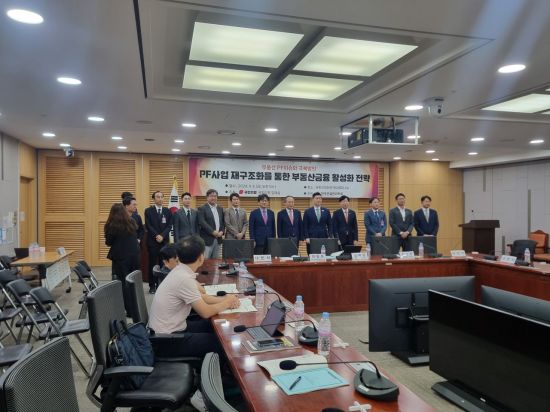 The financial industry agreed that in addition to strengthening the self-capital ratio of developers as part of the real estate project financing (PF) policy, policy improvements are needed to allow funds from 'major players' such as pension funds and financial companies to flow into the market through equity financing methods. On the 6th, participants took a commemorative photo at the seminar titled "Strategies to Revitalize Real Estate Finance through PF Project Restructuring," hosted by the office of Kim Jae-seop of the People Power Party at the National Assembly. Photo by Cha Min-young
The financial industry agreed that in addition to strengthening the developer's equity ratio as part of the real estate project financing (PF) policy, policy improvements are needed to allow 'big players' such as pension funds and financial institutions' capital to flow into the market through equity financing methods. While acknowledging the need for long-term capital expansion, it was pointed out that measures necessary on the ground, such as strengthening disclosure of construction company PFs and eliminating the industry's corrupt practices known as 'dojang-gab' (stamp fees), should also accompany these efforts.
Lee Yunhong, an adjunct professor at Hanyang University's Graduate School of Real Estate Convergence, who presented at the seminar, made these claims at the 'Strategies to Revitalize Real Estate Finance through PF Project Restructuring' seminar hosted by the office of Kim Jaeseop, a member of the National Assembly's Political Affairs Committee from the People Power Party, held at the National Assembly on the 6th.
The government is considering a follow-up measure to the real estate PF policy that would set PF loan limits based on the developer's equity ratio. Previously, financial institutions provided loans if the developer invested just 3% of the total project cost, but going forward, PF loans are expected to be available mainly to projects where the developer's equity ratio is higher.
The actual condition of domestic real estate projects is at a serious level. In fact, even senior PF loans are expected to be difficult to repay except for multi-family housing projects in the metropolitan area. Among popular metropolitan area projects, it is estimated that only partial repayment is possible for offices, officetels, and knowledge industry centers. For urban-type residential housing, even senior loans are expected to be difficult to repay. In projects located in provincial areas, except for some repayment in multi-family housing, offices, officetels, knowledge industry centers, and urban-type residential housing are all expected to be difficult to repay.
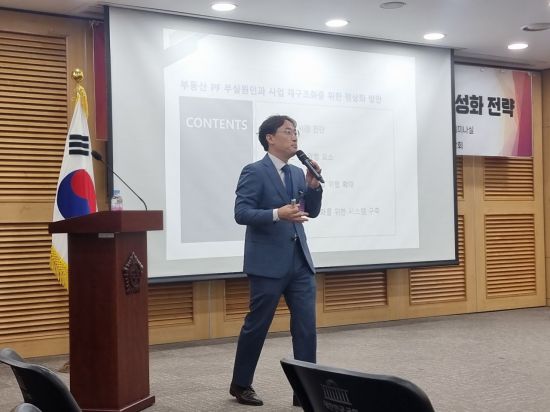 Associate Professor Lee Yunhong of Hanyang University Graduate School of Real Estate Convergence presenting on the 6th. Photo by Cha Minyoung
Professor Lee Yunhong said, "Profitability has significantly deteriorated due to decreased sales and increased project costs," adding, "There are places such as officetels, knowledge industry centers, and urban-type residential housing where senior repayment is difficult, so financial authorities need to consider this."
He also called for strengthening objective disclosure related to PFs by construction companies, saying, "There is a lack of expertise regarding the risk of accidents." It is expected that credit rating agencies' credit evaluations of construction companies will be properly conducted if disclosure of non-financial factors such as pre-sale rates and progress rates is strengthened.
He emphasized the need for the Financial Supervisory Service's supervisory system to evolve as well. Professor Lee said, "Experts are needed not just theoretically but to ensure that processes proceed normally afterward," and stressed, "PF practitioners should be hired and managed through a periodic monitoring system."
Following him, Son Jeongrak, a research fellow at Hana Financial Research Institute, said, "PF loan defaults are not a problem of a specific product but a structural issue of development projects," and added, "Improvement measures should be pursued in each area of development, construction, and finance."
He further stated, "To expand the developer's equity, it is necessary to broaden the scope so that capital from the financial market can enter the developer along with PF loans," and urged, "A redesign of the responsible completion system is needed so that mid-sized and smaller construction companies can participate to reduce construction costs, and government support is necessary in this process."
Voices expressing difficulties on the front lines also emerged. Park Geunhyung, head of the Real Estate Structured Investment Division at Shinhan Asset Management, pointed out, "One burden felt while operating the KAMCO fund is criticism due to discounted purchases," and said, "If financial institutions have to bear the risk because they invested, even if they want to invest, the risk burden is too great, so they cannot."
He added, "There is also the issue of project rights, known as 'dojang-gab' (stamp fees), when acquiring projects, and there is a troublesome situation where such costs are not properly accounted for," and said, "If these issues are well resolved through policy, it would be helpful."
Kim Kyungjun, head of the finance department at SK D&D, pointed out various challenges including issues related to the loan business, problems with reservation of repayment in kind, transfer of development and construction rights, and other objections. In particular, the transfer of development and construction rights, known as 'dojang-gab,' was identified as the biggest concern in the sale of distressed projects.
Kim said, "The reason why prices are lowered for auctions and the delinquency rate has not decreased much even with syndicated loan policies is due to structural problems in development projects," and criticized, "In the current market situation, loan supply and refinancing with construction company credit enhancement cannot be seen as fundamental solutions, and equity capital capable of absorbing market inventory is needed."
He added, "Strengthening project equity is an inevitable process for the future normalization of the real estate market," and said, "It should not necessarily be interpreted as a capital burden on developers. A policy direction is needed to induce abundant domestic institutional investors and financial institutions' liquidity into equity rather than loans."
Meanwhile, Kim Soyoung, vice chairman of the Financial Services Commission, who gave the congratulatory remarks that day, emphasized, "According to the business feasibility evaluation conducted in June this year, loans classified as requiring attention or at risk of default among the first evaluation targets amount to 21 trillion won, which is about 9.7% of the total PF exposure," and said the impact on financial institutions and construction companies would be limited.
Vice Chairman Kim explained, "Although loan loss provisions have been set aside for the first business feasibility evaluation targets, the impact on financial companies is not significant as capital ratios have increased through capital increases, and the impact on developers and construction companies appears to be less than initially feared."
She added, "A soft landing of real estate PF is being achieved within a predictable and manageable range," and said, "Financial authorities and related agencies plan to closely monitor restructuring and liquidation, including auctions, which will proceed in earnest in the future, and will continue to communicate with the Financial Construction Association."
© The Asia Business Daily(www.asiae.co.kr). All rights reserved.
![Clutching a Stolen Dior Bag, Saying "I Hate Being Poor but Real"... The Grotesque Con of a "Human Knockoff" [Slate]](https://cwcontent.asiae.co.kr/asiaresize/183/2026021902243444107_1771435474.jpg)

















