Global Electric Vehicle Battery Usage Excluding China from January to July According to SNE Research
12.6% Increase Year-on-Year... CATL Maintains 1st Place, Japanese Panasonic Alone Shows Negative Growth
From January to July this year, global electric vehicle battery usage excluding China increased by more than 10% compared to the previous year. South Korea's three major battery companies?LG Energy Solution, SK On, and Samsung SDI?all recorded growth, but their market shares slightly declined.
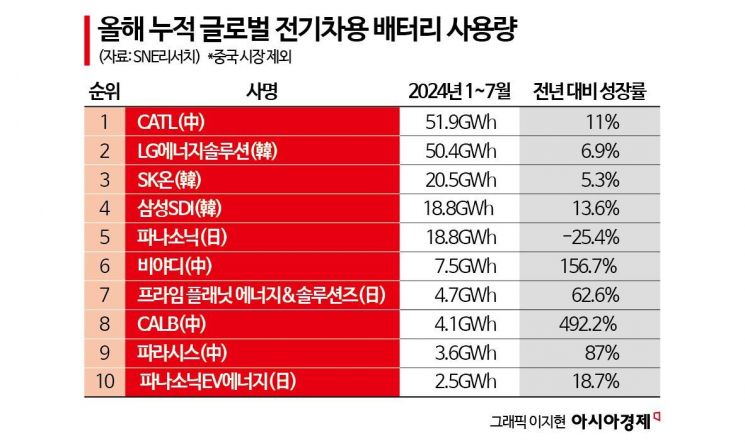
According to energy market research firm SNE Research on the 5th, the total battery usage installed in global electric vehicles (including plug-in hybrids and hybrids) reached approximately 192.8 GWh, marking a 12.6% increase compared to the same period last year.
LG Energy Solution maintained its position as the second-largest player in the global battery market with 50.4 GWh, growing 6.9% year-on-year. SK On recorded a 5.3% growth with 20.5 GWh, ranking third. Samsung SDI posted the highest growth rate among the three domestic battery companies at 13.6% (18.8 GWh).
Despite the growth compared to the previous year, market share declined. The combined global battery market share of the three Korean battery companies stood at 46.5%, down 2.1 percentage points from the same period last year.
Chinese Companies Show Remarkable Growth... BYD Up 157%, CALB Up 492%
China's CATL, which ranked first, saw its battery usage increase by 11% year-on-year to 51.9 GWh. However, its cumulative market share this year fell by 0.6 percentage points to 26.9%. CATL recently launched high-performance LFP batteries and plans to release new ternary (NCM) battery products in the second half of the year. Both new battery products have already secured numerous vehicle installations, which is expected to expand CATL's market share within China.
Chinese companies BYD and CALB, ranked 6th and 8th respectively, showed outstanding growth. BYD recorded 7.5 GWh and CALB 4.1 GWh, increasing by 156.7% and 492.2% year-on-year, respectively. Chinese company Farasis, ranked 9th, grew 87% with 3.6 GWh during the same period.
Japan's Panasonic, ranked 5th, recorded battery usage of 18.8 GWh. It was the only company among the top 10 to experience a decline (-25.4%) due to decreased sales of the Model 3. However, with the upcoming launch of Tesla-oriented 2170 and 4680 cells, Panasonic is expected to rapidly recover its market share centered on Tesla in the future.
Samsung SDI Achieves Highest Growth Due to Strong Performance in Europe and North America... LG Energy Solution and SK On Expect Growth in North American Market
Samsung SDI recorded the highest growth rate thanks to strong sales in the European market with BMW i4, i5, iX models, and popularity in North America with Rivian (R1T/R1S). Although operating profit in the second quarter fell nearly 40% due to a slowdown in electric vehicle demand, recovery in demand is expected in the fourth quarter.
SK On's growth was supported by strong sales of Hyundai's Ioniq 5, EV6, and EV9. However, it continues to post losses due to decreased plant utilization rates and increased initial costs from the start-up of a new plant in Hungary. In the second half of the year, SK On aims to reach breakeven with metal price stabilization and recovery in electric vehicle demand.
LG Energy Solution saw increased battery usage thanks to popular models such as Tesla Model 3/Y and Volkswagen ID.4, its major customers. However, fixed cost burdens and decreased electric vehicle demand in Europe have weighed on profitability. Nevertheless, strong battery sales in the North American market and tax credit effects led to a 24.2% increase in operating profit in the second quarter, improving performance.
SNE Research stated, "Currently, major global OEMs such as Tesla, Mercedes-Benz, Volkswagen, Hyundai and others are adopting CATL batteries," adding that while the three Korean battery companies still play an important role in the global electric vehicle battery market, challenges such as declining market share and cost burdens remain. The three domestic battery companies plan to strengthen competitiveness and recover market share through new product launches and cost reduction efforts.
© The Asia Business Daily(www.asiae.co.kr). All rights reserved.


















