July Current Account Surplus of $9.13 Billion
Largest Surplus in July in 9 Years
Three Consecutive Months of Surplus Driven by Strong Semiconductor Exports
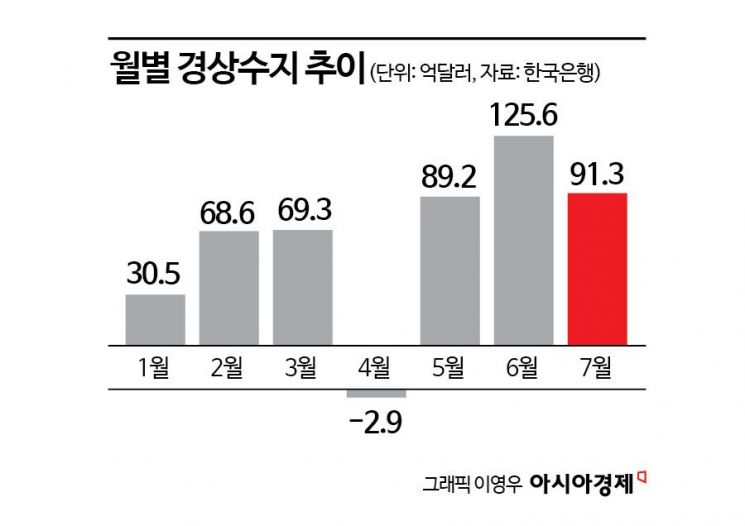
With continued strong semiconductor exports, South Korea's current account balance has achieved a surplus for three consecutive months.
According to the "July Balance of Payments (Provisional)" released by the Bank of Korea on the 6th, the current account surplus in July reached $9.13 billion (?12.188 trillion). This marks a surplus for three consecutive months since May.

Although the surplus amount decreased compared to last month's $12.56 billion, it is the largest July surplus in nine years since 2015. In July of last year, the surplus was around $4.11 billion, meaning the surplus more than doubled within a year.
The cumulative current account surplus from January to July this year was $47.17 billion, a sharp increase of $41.91 billion compared to the same period last year ($5.26 billion).
Breaking down the current account by category, exports reached $58.63 billion, up 16.7% year-on-year, while imports increased by 9.4% to $50.14 billion, resulting in a goods trade surplus of $8.49 billion. The goods trade surplus improved compared to last year as the increase in exports outpaced the rise in imports.
Semiconductors led the export improvement. Customs-based semiconductor exports in July increased by 50.1% compared to the previous year. This was followed by information and communication devices at 29.8%, petroleum products at 16.8%, machinery and precision instruments at 14.3%, chemical products at 2.6%, and steel products at 1.5%. On the other hand, passenger car exports decreased by 8.9%.
By region, exports to Southeast Asia rose by 27.4%, China by 14.9%, Japan by 10%, and the United States by 9.3%.
Song Jae-chang, Director of the Financial Statistics Department at the Bank of Korea's Economic Statistics Bureau, explained, "The current account surplus increased significantly as exports grew centered on IT items such as semiconductors and information and communication devices."
The services account recorded a deficit of $2.38 billion, mainly due to travel and other business services. The deficit widened compared to the previous month as overseas travel by South Korean nationals increased.
Director Song said, "During the July vacation season, outbound travel by domestic residents increased, while inbound travel by foreigners did not rise significantly, leading to an expanded deficit in the services account."
The primary income account showed a surplus of $3.15 billion, mainly from dividend income, while the secondary income account recorded a deficit of $130 million.
The financial account, which reflects capital inflows and outflows, saw a net asset increase of $11.03 billion in July. Direct investment increased with domestic investors' overseas investments rising by $4.33 billion and foreign investors' domestic investments increasing by $2.99 billion.
In securities investment, domestic investors' overseas investments, mainly in stocks, increased by $10.1 billion, while foreign investors' domestic investments in stocks and bonds rose by a similar scale, increasing by $3.92 billion.
Director Song stated, "Reflecting the recovery trend in the IT sector, domestic investors' overseas stock investments have increased significantly, leading to a continued rise in net financial assets. Recently, overseas bond investments have also been increasing, reflecting movements such as the U.S. interest rate cuts."
© The Asia Business Daily(www.asiae.co.kr). All rights reserved.


















