Basic Plan Announced on the 6th... 8 Years and 10 Months After Plan Disclosure
1.5 Times Larger Than Current Jeju International Airport
Environmental Damage and Speculation Concerns Spark Divided Opinions
Ministry of Land, Infrastructure and Transport: "Consensus with Jeju City Council Before Confirming Construction Start Date"
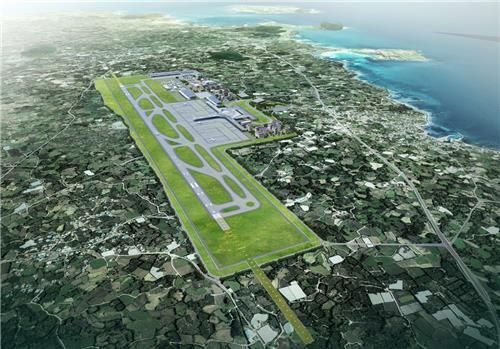
The construction project of Jeju Second Airport, which has been the subject of controversy for about nine years, has been confirmed as a national project and has entered the procedure for preparing for groundbreaking. The Ministry of Land, Infrastructure and Transport will announce the basic plan for the Jeju Second Airport construction project on the 6th.
Jeju Second Airport is planned to be developed on a scale of 5.51 million square meters in the Seongsan-eup area of Seogwipo City. It is about 1.5 times larger than the current Jeju International Airport, which is 3.5 million square meters. Since the opening of Jeju International Airport in 1968, the airport has reached saturation, and the plan is to build an additional airport while continuing to operate the existing one. This plan was first revealed in November 2015, eight years and ten months ago. The basic plan study began in December 2018.
The runway of the Second Airport will be 3,200 meters long and 45 meters wide, with one runway. It is large enough to accommodate takeoff and landing of large aircraft operated by global airlines. The plan also includes an apron of 311,000 square meters that can simultaneously park 28 aircraft and a passenger terminal of 118,000 square meters. The total project cost is estimated at 5.45 trillion won.
In the first phase, it is planned to accommodate 16.9 million passengers annually. Depending on the future increase in air travel demand, a second phase expansion to handle 19.92 million passengers annually will be considered. The Ministry of Land, Infrastructure and Transport stated that the current basic plan includes land development for the expansion project. Various promotion methods, including private investment, are being considered for cultural and commercial facilities and the creation of an aviation industry cluster beyond airport development.
The Ministry said, "Through Jeju Second Airport, we will provide safe and comfortable air traffic services to tourists visiting Jeju and accommodate the expected increase in domestic and international air travel demand, which will lead to an increase in tourists and economic revitalization in the Jeju region."
However, opposition from residents concerned about environmental damage, speculation, and reckless development remains a challenge to be overcome during the project process. Following the announcement of the basic plan, the Ministry will conduct an environmental impact assessment to prepare measures to mitigate environmental impacts caused by basic design and large-scale construction.
Environmental impact assessments for large-scale development projects in Jeju must be conducted in consultation with Jeju Province according to the "Jeju Special Act." After obtaining the consent of the Jeju Provincial Council, the Ministry will proceed with land compensation for residents near the airport site simultaneously with the detailed design, and after approval and announcement of the implementation plan, will begin construction.
However, opinions on the promotion of the Second Airport in the Jeju region remain sharply divided between supporters and opponents.
In a public opinion survey conducted in March by four Jeju local media outlets including JIBS, commissioned to Realmeter, among 1,522 residents across Jeju, 47.7% opposed the Jeju Second Airport, while 46.1% supported it. The "Emergency Residents' Council to Stop the Forced Construction of Jeju Second Airport," composed of civic groups within Jeju, recently urged the suspension of the announcement of the basic plan through press conferences and other means.
The group stated, "Significant environmental issues were pointed out during the strategic environmental impact assessment process of the Jeju Second Airport project, and speculation and reckless development booms are expected to be induced." They insist that "the decision on whether to proceed with the project should be made through a residents' referendum."
Regarding this, a Ministry of Land, Infrastructure and Transport official said, "Several years ago, opposition was about 80% to 20% in favor, but the opinions have softened to nearly equal support and opposition," adding, "We will fully consider the still divided situation and mediate conflicts," and that the start of construction will be agreed upon with the Jeju Provincial Council without specifying a particular time.
Regarding concerns about environmental destruction and speculation, the official explained, "Jeju Second Airport will be promoted as an 'eco-friendly airport,' supplying 60-80% of the passenger terminal's energy consumption with renewable energy and implementing eco-friendly projects such as creating alternative habitats for wildlife," and added, "The area near the site is designated as a land transaction permission zone, so there is no possibility of development, and thus no need to worry about speculation."
Once construction begins, it is expected to take about five years until completion and opening.
© The Asia Business Daily(www.asiae.co.kr). All rights reserved.

















