Repeated Noise for Harassment Purpose
Violates Stalking Punishment Act
Expert: "Cannot Solve by Suppression Alone"
#In 2021, Mr. A, a man in his 40s living in Jinju-si, Gyeongnam, harbored resentment against a neighbor who caused noise between floors and installed a woofer speaker on the living room ceiling. He then retaliated by emitting low-frequency mechanical sounds similar to a cellphone vibration 21 times through the speaker. The Ulsan District Court ruled that Mr. A's continuous intentional harassment of the neighbor constituted stalking and sentenced him to a fine of 7 million won.
Recently, there have been consecutive cases where individuals who retaliated against noise complaints were prosecuted for stalking. Some voices argue that it is unjust to punish noise victims for retaliation without considering the circumstances before and after the retaliation.
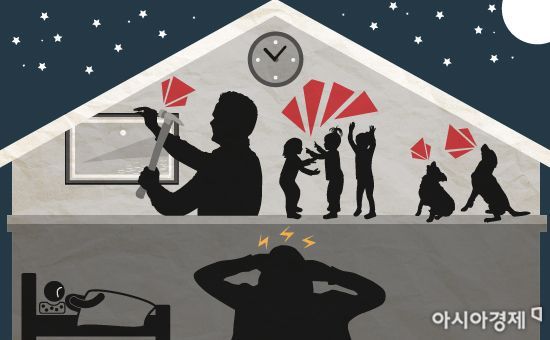
On the 6th, an online cafe with 100,000 noise complaint victims posted consecutive messages about being sued for noise retaliation.
One netizen lamented, "The neighbor's dog barked all night, causing me to lose sleep," and added, "I couldn't stand it anymore, so I played dog barking sounds toward the neighbor's house through a speaker, and I got sued."
The same netizen continued, "The police warned that if I intentionally cause noise after this time, I could be punished under the Stalking Punishment Act," and complained, "I only played sounds through a speaker; how can this be considered stalking?"
Posts about police investigations for violating the Stalking Punishment Act also followed. A netizen who was recently sued for noise retaliation said, "I was investigated by the police for intentionally making noise to harass the next-door neighbor," and added, "The upstairs neighbor was not punished for noise between floors, but only I was punished for using a device to make noise, which feels very unfair."
The reason noise retaliation is punishable is that under the current Stalking Punishment Act, approaching someone within their daily living area and causing anxiety and fear is defined as stalking.
Here, approach includes acts such as delivering sound and video through electronic devices or placing objects near the residence.
In fact, last December, the Supreme Court sentenced a man in his 30s from a villa in Gimhae, Gyeongnam, to a suspended prison term for knocking on the wall 31 times with a tool. The Supreme Court stated, "Stalking crimes are acts that instill anxiety and fear in the other party, infringing on their free decision-making," and ruled that the man was guilty of stalking.
However, experts pointed out that legal punishment for noise retaliation cannot be a fundamental solution.
Cha Sang-gon, director of the Residential Culture Improvement Research Institute, said, "Punishment is necessary for illegal retaliation against others to the extent that I have been harmed," but emphasized, "However, the noise between floors problem should not be solved by relying on coercive measures such as punishment and fines."
There are also concerns that legal punishment may only exacerbate conflicts between neighbors. Pyo Seung-beom, director of the Apartment Culture Research Institute, explained, "Those who retaliate against noise have already accumulated resentment toward neighbors due to noise between floors," and added, "If they are legally suppressed, the suppressed emotions may erupt in socially inappropriate ways."
There were also opinions that solutions should focus on mediation and conflict mitigation rather than punishment.
Director Pyo said, "When conflicts over noise between floors occur, quickly mediating between neighbors significantly reduces the likelihood of disputes," and added, "It is necessary to activate the noise management committees, which are to be installed in apartment complexes with over 500 households, so that managers can intervene early in conflicts and mediate."
© The Asia Business Daily(www.asiae.co.kr). All rights reserved.

















