Accelerating Industrial Complex Development by Lifting Greenbelt in Gwangju Future Car Industrial Complex
96% of Site is Greenbelt... "Selected as Industrial Complex Due to Location Advantage"
"Greenbelt to be Lifted Within the Year for Smooth Industrial Complex Development"
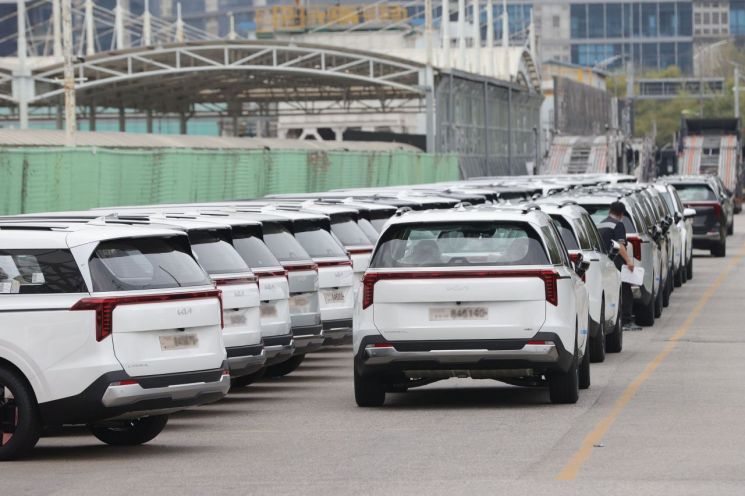 View of Kia Autoland in Gwangmyeong-si, Gyeonggi Province. The photo is unrelated to the article. [Photo by Yonhap News]
The government is accelerating the project by lifting the greenbelt restrictions within the Gwangju Metropolitan City Future Car National Industrial Complex. Since 96% of the industrial complex land is designated as greenbelt, lifting these restrictions will enable faster development of the complex.
On the 5th, the government announced this plan titled "Designing the Future of Gwangju with Advanced Technology and Culture" at the 28th Public Livelihood Forum held at the Gwangju Institute of Science and Technology (GIST).
The Ministry of Land, Infrastructure and Transport (MOLIT) will lift the greenbelt designation within the Gwangju Future Car National Industrial Complex. Of the total 3.3 million square meters of industrial complex land, 96% is designated as greenbelt. MOLIT plans to lift the greenbelt through designation as a national strategic project. National strategic projects are industrial complexes designated by MOLIT through the State Council, allowing greenbelt restrictions to be lifted without limitation upon project selection.
Notably, in February, the government allowed the lifting of greenbelt restrictions on Grade 1 and 2 environmental evaluation areas in local regions through the Public Livelihood Forum. However, Grade 1 and 2 areas in the Seoul metropolitan area cannot have their greenbelt status lifted.
The Gwangju Future Car Industrial Complex was selected as a candidate site for the Future Car National Industrial Complex in March last year at the 14th Emergency Economic and Livelihood Meeting. Gwangju is home to finished car manufacturers such as Kia and Global Motors, and hosts over 600 automotive parts companies. The automotive industry accounts for 44% of Gwangju's manufacturing output and 24% of employment, making it a key regional industry.
The selection of the Gwangju Future Car Industrial Complex in an area mostly designated as greenbelt is largely due to locational advantages. Kim Min-tae, Director of Industrial Location Policy at MOLIT, stated, "We plan to develop the future car industrial complex mainly for automotive materials, parts, and equipment companies. Since there are automobile production plants near the site and we intend to locate materials, parts, and equipment companies around them to form the complex, we ended up selecting an area mostly designated as greenbelt."
He added, "We plan to lift the greenbelt within this year and proceed with the industrial complex development as planned. When the Gwangju Future Car Industrial Complex was initially designated, we received applications from companies exceeding 150% of the planned site capacity. Some companies may withdraw their investments during the development process, so we conducted a thorough demand survey."
National strategic projects are designated after review by the Central Urban Planning Committee and the State Council. Related demand surveys were completed between April and May, and from June to this month, the Korea Research Institute for Human Settlements is conducting a feasibility evaluation. The project candidate site will be selected in November.
Meanwhile, MOLIT will change the route of the Bus Rapid Transit (BRT) project currently underway in Gwangju to promote carbon neutrality and activate public transportation. A large complex shopping mall near the Gwangcheon area is scheduled to open in 2027, and the BRT will be adjusted to stop there. The existing route runs approximately 10 sections from Baegun Square (Baegun Intersection) in Dong-gu to Hope Hospital in Buk-gu. BRT is a transportation system operating dedicated vehicles on exclusive lanes and stops, introduced to enhance bus speed and efficiency.
© The Asia Business Daily(www.asiae.co.kr). All rights reserved.

















