Itemized Price Check Available on the HIRA Website
The price of multifocal lenses for cataract surgery varies up to 23 times between hospitals, revealing that the gap in non-reimbursable medical fees remains significant.
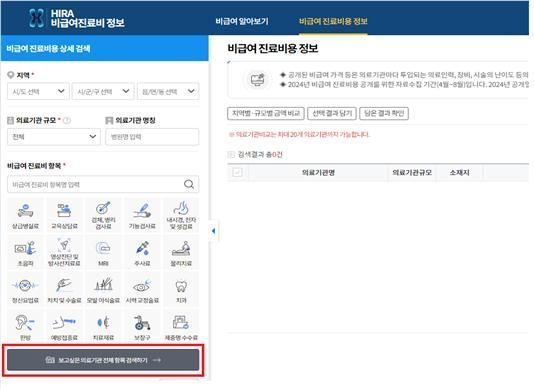 Health Insurance Review and Assessment Service website 'Non-covered Medical Expenses Information' screen.
On the 5th, the Ministry of Health and Welfare and the Health Insurance Review and Assessment Service (HIRA) announced that they will disclose the results of this year's survey and analysis of non-reimbursable medical fees by hospitals and clinics on the HIRA website and the mobile app 'Health-eum'.
Non-reimbursable medical services are those not covered by health insurance benefits, meaning patients must bear the full cost. Due to the influence of indemnity insurance and other factors, the scale of non-reimbursable services is increasing, and since hospitals set their own prices, there is a large price variation among hospitals.
The government investigates and discloses the major non-reimbursable medical fees for all medical institutions to guarantee the public's right to know and help them make rational choices. In its fourth year, this year it will disclose prices for 623 non-reimbursable items across all medical institutions.
As a result of surveying non-reimbursable medical fees at 70,562 medical institutions nationwide from April to June, the average cost of 334 items, accounting for 65.7% of the total, increased compared to last year, and 132 items rose more than the inflation rate of 2.6% in July this year.
For example, for multifocal lenses used in cataract surgery, one clinic in Seoul charged 290,000 KRW, while another charged 6,800,000 KRW, a 23-fold difference. The median price among surveyed medical institutions was 2,200,000 KRW. The highest price was about 3.1 times the median price.
The median price for physical therapy was 100,000 KRW, but one clinic in Gyeongnam charged 260,000 KRW. For HIFU (High-Intensity Focused Ultrasound) procedures used to treat uterine fibroids under ultrasound guidance, the minimum price was 2,000,000 KRW, the median was 8,000,000 KRW, and the maximum was 18,000,000 KRW.
The non-valve reconstruction surgery fee for treating nasal congestion symptoms ranged from a minimum of 51,000 KRW to a maximum of 5,000,000 KRW, a 98-fold difference. Even among clinics only, the price ranged from 200,000 KRW to 5,000,000 KRW, with the median price across all medical institutions at 1,730,000 KRW. Varicose vein surgery also showed a 3 to 4 times difference between the median and highest prices depending on the surgical method. The median price was around 1,500,000 to 1,600,000 KRW.
This survey analyzed only medical fees, and the Ministry of Health and Welfare explained that price differences between medical institutions may arise from various factors such as treatment standards and difficulty, personnel, and equipment.
According to the 'First Medical Reform Implementation Plan' announced on the 30th of last month, the government plans to expand the provision of non-reimbursable information that consumers are interested in and consider introducing measures to encourage appropriate price setting through consultations with the medical community for non-reimbursable items with large price disparities.
© The Asia Business Daily(www.asiae.co.kr). All rights reserved.

















