Easy Photo Compositing on Mobile Phones
"Watermark Mandate and Stricter Penalties Needed"
Park Mo (25), who lives in Eunpyeong-gu, Seoul, posted on a secondhand trading platform last month to purchase a gaming device. A few days later, he received a message from a seller who said they could meet his desired price and requested a photo of a piece of paper with the seller’s name written on it placed on top of the product for verification. Within about three minutes, the requested photo arrived, and Park transferred 300,000 won to the seller’s account. However, after the payment, the seller disappeared without any further contact. Park lamented, "I have had a lot of experience with secondhand transactions since school and have never been scammed before, so this is shocking," adding, "I received a verification photo but never thought it could have been manipulated."
 The reporter personally attempted to composite images using the default mobile phone application. The left photo shows a hand placed on the actual product, while the right photo is a composite created by separately photographing the product and the hand.
 [Photo by Yeom Da-yeon]
Recently, the number of victims falling for scams like Park’s case in the online secondhand trading market has been increasing. Although fraud in the online secondhand market has occurred every year, the methods are becoming increasingly sophisticated. In particular, there are concerns that AI-based image synthesis technologies such as deepfake can be used to forge not only product verification photos but also identification cards, potentially leading to greater scam damages.
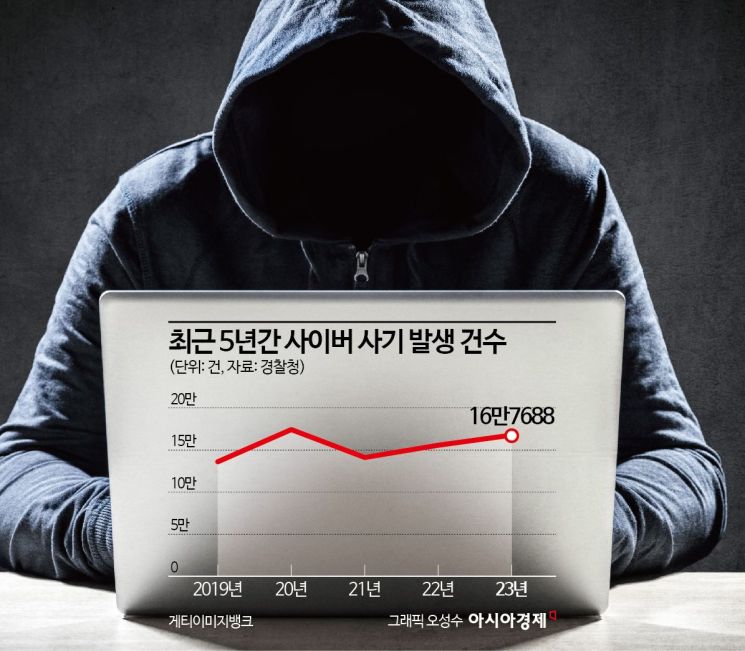
According to the National Police Agency, there were 774,959 cases of cyber fraud reported over the past five years. Most online fraud crimes involve secondhand transactions, and as trading becomes easier and more accessible, such scams have been on the rise annually. According to The Cheat, a scam victim information-sharing site, 240,508 cases were reported from January to August this year alone, with damages amounting to 232.76212 billion won. Considering that many secondhand transaction scams involve small amounts, the actual number of cases is expected to be even higher.
For this reason, it is common for buyers to request real verification photos from sellers during online secondhand transactions. This involves a procedure to confirm the possibility of a genuine transaction by receiving photos where the seller’s nickname or the transaction date is written on a post-it note and photographed together with the product on secondhand platforms or internet cafes. However, cases of sellers abusing deepfake technology by stealing photos posted by others or images from the internet and synthesizing them to meet buyers’ requests are increasing. While photo manipulation scams existed before, now anyone can easily and precisely create such images without special skills.
In fact, the method was so simple that photos could be synthesized using only the default applications installed on a smartphone. Separate photos were taken of a hand holding a paper with a name written on it and of the product alone. The fake photo synthesized from these two images was completed flawlessly in less than a minute. When compared to a photo taken with a hand actually placed on the product, there was little difference except for color tones. Even without advanced skills like Photoshop, shadows and shading were naturally transferred with just a few touches. AI-generated images have watermarks (identification marks) at the bottom, but these can be removed without a trace by resizing and cropping the area.
Experts unanimously agree that it is time to discuss mandatory watermarking and the introduction of legal penalties related to deepfake. Professor Lee Sung-yeop of Korea University’s Graduate School of Technology Management explained, "If deepfake technology has been used so far in elections or sex crimes, it is highly likely to be abused in broader social contexts such as secondhand trading in the future," adding, "There should be legislative discussions to mandate watermark display and to punish crimes such as transaction fraud using this technology."
Professor Kim Myung-joo of Seoul Women’s University’s Department of Information Security also said, "Watermarks indicating generated images should be made impossible to delete, and platforms should enforce this," adding, "In the U.S., there is a bill that considers removing watermarks as evidence of criminal intent and allows for aggravated punishment, and such legislation needs to be introduced domestically as well."
© The Asia Business Daily(www.asiae.co.kr). All rights reserved.
![Clutching a Stolen Dior Bag, Saying "I Hate Being Poor but Real"... The Grotesque Con of a "Human Knockoff" [Slate]](https://cwcontent.asiae.co.kr/asiaresize/183/2026021902243444107_1771435474.jpg)

















