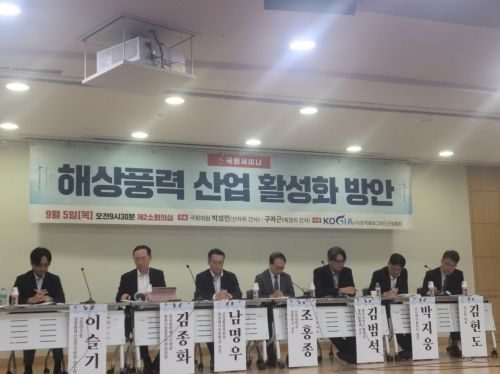
 On the 5th, a seminar on measures to revitalize the offshore wind power industry, hosted by Assemblymen Park Seong-min and Koo Ja-geun, is being held at the National Assembly Members' Office Building. Photo by Kang Hee-jong
In the domestic offshore wind power market, which is expected to expand to a scale of 100 trillion won in the future, experts pointed out that the government's active role is crucial to expanding the supply chain of Korean companies.
At the 'Offshore Wind Power Industry Revitalization Plan' seminar held on the 5th at the National Assembly Members' Office Building, hosted by Park Seong-min and Koo Ja-geun of the People Power Party and organized by the Korea Offshore Grid Industry Association, Seul-gi Lee, a research fellow at the Korea Institute for Industrial Economics and Trade, who presented at the seminar, stated, "Now, as the offshore wind power market is just beginning to grow, this is the last chance to nurture the domestic industry. Once companies from China and Europe with price and technological competitiveness dominate the market, it will be difficult to stop them."
The Ministry of Trade, Industry and Energy included in the offshore wind power competitive bidding roadmap announced last August that the non-price evaluation score in future offshore wind power bids will be expanded from the existing 40% to 50%, and evaluation factors related to industrial economic effects and security will be reflected in the non-price indicators. Accordingly, concerns that overseas companies such as those from China could dominate the domestic offshore wind power market by leveraging low prices have been largely alleviated.
Nevertheless, concerns among domestic offshore wind power-related companies have not been completely resolved. This is because the domestic wind power market has not been activated so far, leading to evaluations that domestic companies lag behind European and Chinese companies in competitiveness.
According to an analysis by Professor Beom-seok Kim of the Department of Wind Engineering at Jeju National University, among the entire offshore wind power supply chain?including project development, offshore wind turbines, auxiliary equipment, installation and construction, and operation and maintenance?domestic companies' competitiveness is particularly weaker in the offshore wind turbine sector compared to foreign companies. While tower competitiveness is relatively good, there is a lack of competitiveness in blade equipment and components, and it is necessary to overcome issues of reliability and price competitiveness.
In the case of turbines, foreign products have already been commercialized after demonstration at the 15-megawatt (MW) level, whereas domestically, development has been completed up to the 8MW level. Under these circumstances, if bidding is conducted, foreign companies will inevitably dominate the market.
Regarding this, Research Fellow Seul-gi Lee said, "Domestic companies have not had opportunities to recover research and development (R&D) costs, so R&D has been insufficient, and it has been difficult to achieve economies of scale compared to global companies," arguing that government intervention is necessary to nurture the domestic wind power industry. For example, domestic companies should have opportunities to commercialize their R&D results in the public domain.
There was also a call for detailed policy measures that can protect domestic companies within the scope that does not cause disputes at the World Trade Organization (WTO). Specifically, Research Fellow Lee suggested, "Bidding evaluation can be improved by strengthening evaluation items such as resource security, giving preferential treatment to equipment suited to domestic wind power resources like wind conditions, and adding evaluation criteria such as requirements for rapid procurement of key components in case of failures."
In fact, Japan evaluates whether parts with high failure rates can be replaced by domestic manufacturing and procurement, and whether there are early recovery measures such as shortened procurement periods under the 'power supply safety' category when conducting offshore wind auctions. The UK requires offshore wind auction participants to submit supply chain plans and demands fair opportunities at workplaces, health and safety standards, absence of modern slavery, and labor exploitation, which is interpreted as a measure to check specific countries.
Park Ji-woong, team leader at Doosan Enerbility, said, "The global offshore wind market is divided between China and the anti-China alliance, and Korea can gain opportunities among them," adding, "When importing large and heavy overseas large wind turbines, it is necessary to consider that all existing infrastructure such as domestic ports and bridges must be replaced." Kim Hyun-do, CEO of Geoview, said, "Even if the roadmap changes, how to design the specific bidding system is important," and "There may be companies that are only nominally domestic supply chain companies, so a method to filter them out is needed."
Voices advocating active cooperation with overseas companies also emerged.
At the discussion, Professor Beom-seok Kim of Jeju National University said, "It would be ideal to use the entire domestic supply chain in offshore wind power plants, but realistically, it is not easy," and proposed, "For a balanced supply chain, measures such as encouraging overseas companies to invest domestically to create domestic employment and establishing joint ventures to upgrade domestic companies' technology can be considered together." He also said, "Domestic companies should not rely too much on government policies but expand investments to quickly develop products that can compete with overseas companies."
Kim Jong-hwa, Chair of the Wind Industry Development Strategy Committee at the Korean Wind Energy Society, said, "The market must be formed first, then the supply chain will be created, and the levelized cost of energy (LCOE) can be lowered," adding, "If only domestic supply chains are emphasized to operators, financial procurement may not be possible."
Yu Tae-seung, CEO of COP Korea, said, "Developing large-scale offshore wind farms requires investment of trillions of won," and "The government should support cooperation with foreign operators to facilitate smooth project financing (PF)." Park Do-hyun, Executive Director of Equinor Korea, suggested, "If the government establishes a certification system for excellent domestic companies, it will help persuade overseas companies."
Nam Myung-woo, Director of the Renewable Energy Policy Division at the Ministry of Trade, Industry and Energy, said, "Before the offshore wind power bidding announcement in mid-October, we will hold a preliminary policy briefing session on the 20th of this month to discuss specific bidding and evaluation methods."
© The Asia Business Daily(www.asiae.co.kr). All rights reserved.

















