Public Forum on Livelihoods to Transform AI and Mobility Industry Landscape
"AI Gifted High School to Open in 2027... I Will Personally Oversee It"
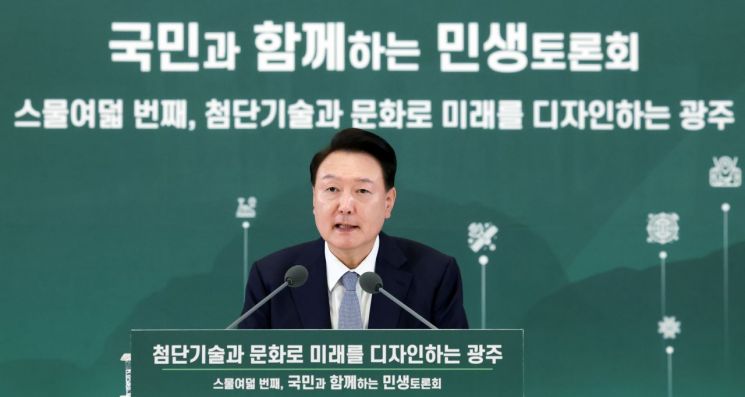 President Yoon Suk-yeol is speaking at the 28th "Public Livelihood Discussion" held on the 5th at Gwangju Institute of Science and Technology under the theme "Designing the Future of Gwangju with Advanced Technology and Culture."
 [Image source=Yonhap News]
On the afternoon of the 5th, President Yoon Suk-yeol held the 28th Public Discussion Forum under the theme "Designing the Future of Gwangju with Advanced Technology and Culture" at the Gwangju Institute of Science and Technology (GIST) in Gwangju Metropolitan City. He emphasized that "Gwangju must leap forward as a city of advanced technology and a global cultural city to become a driving force for South Korea's growth."
President Yoon held the public discussion forum in Gwangju two months after the Jeonbuk Public Discussion Forum in July, listening to local residents' concerns and discussing development plans. This visit marked his first trip to Gwangju in 110 days since visiting the 5·18 Democratic Cemetery, where the May 18 Democratic Movement memorial ceremony was held in May.
In his opening remarks, President Yoon stated, "We will significantly transform Gwangju's advanced industrial landscape based on artificial intelligence (AI) and mobility," presenting three development visions for Gwangju: ▲ an advanced technology city leading future industries with AI and mobility ▲ a global cultural hub city shining through culture ▲ a vibrant city where citizens enjoy a good quality of life.
President Yoon introduced his visits to AI data centers twice in April 2022 after being elected president in December 2021 during his presidential candidacy, evaluating that Gwangju is laying a solid foundation for the AI industry. He also stressed, "For the sustainable growth of the AI industry, nurturing talent is paramount," adding, "I will personally and meticulously ensure that the AI gifted high school, promised during the presidential election and the 2022 Emergency Economic and Livelihood Meeting, opens smoothly in 2027."
"Fostering an Autonomous Driving Future Mobility Industry Ecosystem"
He continued, "Using Gwangju's AI infrastructure, we will develop Gwangju into the center of the autonomous driving future mobility industry ecosystem." President Yoon said, "If the approximately 70 autonomous vehicle-related materials, parts, and equipment companies and support institutions in Gwangju combine with AI infrastructure, greater synergy can be achieved." He mentioned, "Once the Gwangju-Yeongam Autobahn expressway, announced during the presidential election and the Jeonnam Public Discussion Forum last March, is constructed, it can be used as a demonstration testbed for autonomous vehicles utilizing AI technology."
He promised to invest 53.4 billion KRW over the next five years to support the Gwangju autonomous driving materials, parts, and equipment specialized complex, designated in July last year, without delay. He explained that location regulations similar to green belts would be eased to allow the rapid establishment of the national future car industrial complex candidate site in Gwangsan-gu, covering an area of 1 million pyeong.
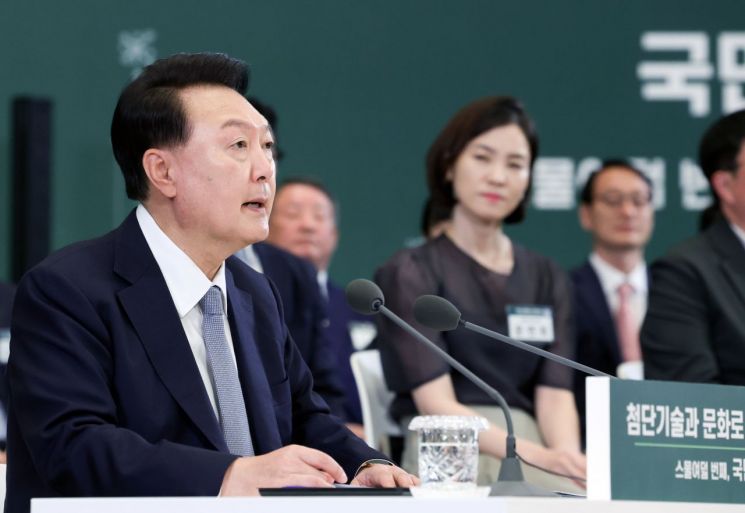 President Yoon Suk-yeol is speaking at the 28th "Public Livelihood Discussion" held on the theme of "Designing the Future of Gwangju with Advanced Technology and Culture" at Gwangju Institute of Science and Technology on the 5th.
 [Image source=Yonhap News]
118.1 Billion KRW Invested by 2027 to Build Biennale Exhibition Hall
President Yoon declared, "We will make Gwangju a global cultural hub city representing South Korea." He evaluated Gwangju as a cultural center city equipped with some of the nation's top cultural and artistic infrastructures, such as the Gwangju Biennale, the National Asia Culture Center, and the Gwangju National Museum. To strengthen Gwangju's international cultural and artistic status, he announced plans to invest 118.1 billion KRW by 2027 to build a new Biennale exhibition hall.
The site of the former Sangmu incineration plant, once an undesirable facility, will be transformed by investing 51.6 billion KRW by next year to build the Gwangju Representative Library, and an additional 43.6 billion KRW will be invested by 2028 to convert it into a complex cultural community facility. At the National Gwangju Museum, 29.9 billion KRW will be invested by next year to build a ceramics culture hall, creating a hub that encompasses underwater relics from Sinan and Asian ceramic culture.
He also mentioned that through the Local 100 project, which discovers and supports Gwangju's unique brands using its attractions and content, more people will be encouraged to visit Gwangju. President Yoon said, "For Gwangju to grow into a true Asian central city leading cultural and artistic exchanges, it is more important to properly utilize existing cultural infrastructure to cultivate the region's unique charm and make it a city everyone wants to visit than merely building new cultural facilities." He particularly emphasized that since the National Asia Culture Center is a facility with massive government investment, Gwangju City and the government must work together to fully realize the investment's effects.
Developing a Regional Core Hospital Responsible for Essential Medical Care
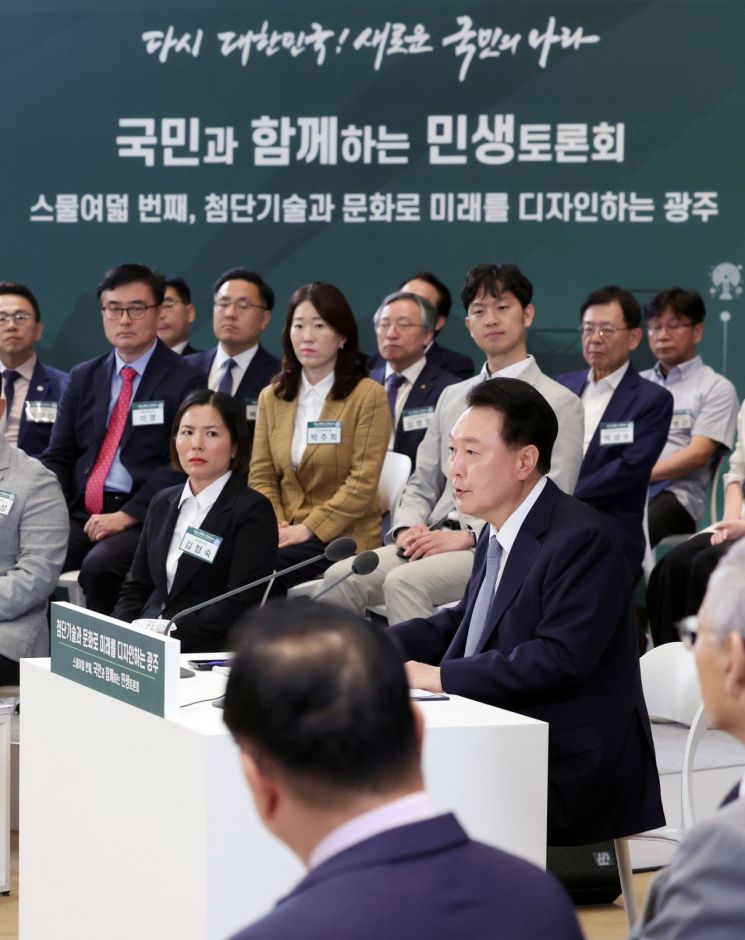 President Yoon Suk-yeol is speaking at the 28th "Public Livelihood Discussion" held on the 5th at Gwangju Institute of Science and Technology under the theme "Designing the Future of Gwangju with Advanced Technology and Culture." [Image source=Yonhap News]
Additionally, regarding the complex shopping mall construction project targeted for completion in 2027, he pledged support for improving transportation accessibility, including the establishment of the Bus Rapid Transit (BRT) system in Gwangju. President Yoon stated, "We will nurture a regional core hospital responsible for essential medical care in the Gwangju and Jeonnam areas and significantly increase investment in regional healthcare so that residents can enjoy medical services comparable to those in the metropolitan area."
President Yoon also highlighted the importance of safe water supply measures to respond to climate change, such as the drought that struck the southern region last spring. He added that support would be provided to ensure that the Yeongsan River is properly utilized as a drinking water source for Gwangju citizens through water quality improvement and securing water volume.
The forum was attended by over 80 people, including Gwangju citizens, businesspeople, cultural artists, researchers, parents, and members of the Gwangju Metropolitan City Local Era Committee. From the government, Woo Dong-gi, chairman of the Local Era Committee, and Yoo In-chon, Minister of Culture, Sports and Tourism, were present. Locally, Kang Ki-jung, mayor of Gwangju Metropolitan City, attended, along with Sung Tae-yoon, Chief of Policy Office; Lee Do-woon, Chief of Public Relations; Park Chun-seop, Chief of Economic Affairs; and Jang Sang-yoon, Chief of Social Affairs from the Presidential Office.
© The Asia Business Daily(www.asiae.co.kr). All rights reserved.
![Clutching a Stolen Dior Bag, Saying "I Hate Being Poor but Real"... The Grotesque Con of a "Human Knockoff" [Slate]](https://cwcontent.asiae.co.kr/asiaresize/183/2026021902243444107_1771435474.jpg)


















