Up to 3 Years Imprisonment for Viewing Only
Mandatory Labeling of AI-Generated Videos Proposed
The ruling and opposition parties are accelerating the establishment of related laws to curb the spread of deepfake (illegal synthetic) sex crimes, which have emerged as a social issue. While strengthening punishment for deepfake criminals, they focused on preparing measures to mandate labeling that indicates the content is virtual information created using AI (artificial intelligence). In particular, there were also opinions that a fundamental prevention plan should be initiated through a fact-finding survey on deepfake crimes.
According to the National Assembly Legislative Information System on the 5th, there are about 30 bills related to deepfake sex crimes proposed in the 22nd National Assembly. These are mainly concentrated on amendments to the "Special Act on the Punishment of Sexual Violence Crimes" and the "Act on Promotion of Information and Communications Network Utilization and Information Protection, etc." Since the social issue recently spread, from the 27th of last month until today, an average of 3 to 4 related bills have been introduced daily.
Looking at the main contents of the proposed bills, first, they focused on strengthening punishment for suspects to raise social awareness of deepfake criminals. Representative Park Chung-kwon of the People Power Party defined deepfake crimes and stipulated that violators be sentenced to up to five years in prison. Specifically, it prohibits the distribution of information edited, synthesized, or processed against the victim’s will, using AI technology on images, videos, or audio targeting a person's face, body, or voice. Representative Lee Dal-hee of the People Power Party introduced a bill to newly establish punishment provisions that impose a minimum of five years’ imprisonment for those who threaten others using child and adolescent sexual exploitation materials. Sexual exploitation materials targeting children and adolescents are considered more heinous than those targeting adults, but until now, only punishments under the 'Special Act on the Punishment of Sexual Violence Crimes' were possible.
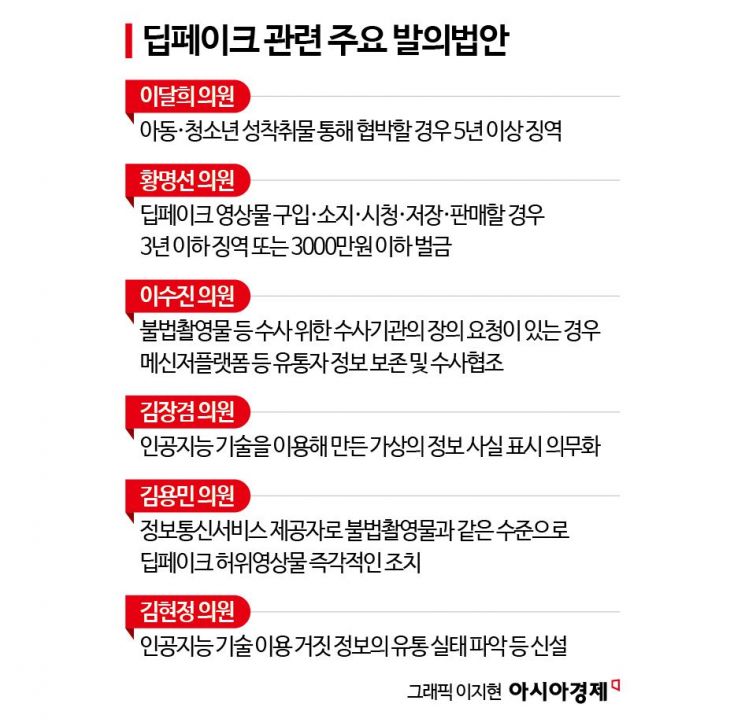
There is also a bill to punish those who watch deepfake sex crime videos. Representatives Kim Yong-min and Hwang Myung-sun of the Democratic Party each introduced bills that punish not only producers and distributors of deepfake sex crime videos but also those who possess, purchase, store, or watch them with up to three years imprisonment or a fine of up to 30 million won. Until now, there were no regulations to punish the purchase, possession, viewing, storage, or sale of videos produced using deepfake technology, so this is to legally punish such acts. Representative Kim emphasized, "The pain felt by victims due to illegal synthetic materials is no different from that caused by illegal recordings taken against the subject’s will."
Post-incident measures such as video deletion for victims are also being prepared. Representative Lee Soo-jin of the Democratic Party secured provisions requiring cooperation with investigations and preservation of information on distributors upon request by investigative agencies to prevent mass distribution of illegal videos through some messenger platforms like Telegram. Representative Lee In-seon of the People Power Party introduced a bill to establish a Digital Sexual Crime Victim Support Center to enable the government to delete deepfake victim videos, and Representative Kim Yong-min of the Democratic Party also mandated that information and communication service providers immediately take action against deepfake fake videos at the same level as illegal recordings.
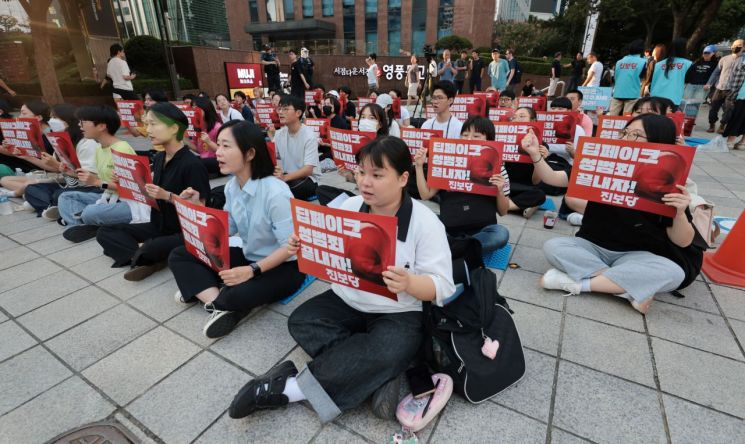
Related laws to prevent deepfake sex crimes in advance have also been proposed. Representative Cho Eun-hee of the People Power Party allowed investigative agencies to conduct undercover investigations targeting not only children but also adults regarding deepfake sex crime videos. Additionally, Representative Kim Jang-gyeom of the People Power Party introduced an amendment to the Information and Communications Network Act mandating AI-generated content labeling for online platform operators such as internet portals. Representative Kim Hyun-jung of the Democratic Party proposed a plan for the Korea Communications Commission and the Ministry of Science and ICT to establish a system to identify damage caused by false videos created using AI technology.
On the afternoon of the same day, the ruling and opposition parties will hold an emergency policy forum on the theme "How to Eradicate Deepfake Sex Crime Videos" through the full meeting of the National Assembly Science, Technology, Information and Broadcasting and Communications Committee. Professor Kim Myung-joo of Seoul Women’s University’s Department of Information Security will present on "The Dual Nature of Generative Artificial Intelligence (AI) and the Need for Safety Regulation," and Professor Lee So-eun of the Department of Media Communication at National Pukyong University will present on "Current Status and Response Strategies for Deepfake Sex Crime Videos."
© The Asia Business Daily(www.asiae.co.kr). All rights reserved.



















