Local Allocation Tax of 67 Trillion Won and Total Budget of 72.0872 Trillion Won Drafted
Project Expenses 4.6394 Trillion Won... 1.4 Trillion Won for Regional Economic Revitalization
Significant Expansion of Compensation Payments for 5.18 Minjuhwa Movement, etc... 'Social Integration'
The Ministry of the Interior and Safety has set the 2025 budget at 72 trillion won. Of this, 67 trillion won will be allocated as local allocation tax to local governments nationwide, while the remaining 4.6 trillion won will be focused on supporting vulnerable groups, population decline, local extinction, and government innovation projects.
On the 5th, the Ministry of the Interior and Safety announced that it has prepared a total budget of 72.0872 trillion won for next year, including 67.0385 trillion won in local allocation tax, which is 27.92 billion won more than this year due to an increase in estimated domestic taxes following the favorable growth trend of the domestic economy.
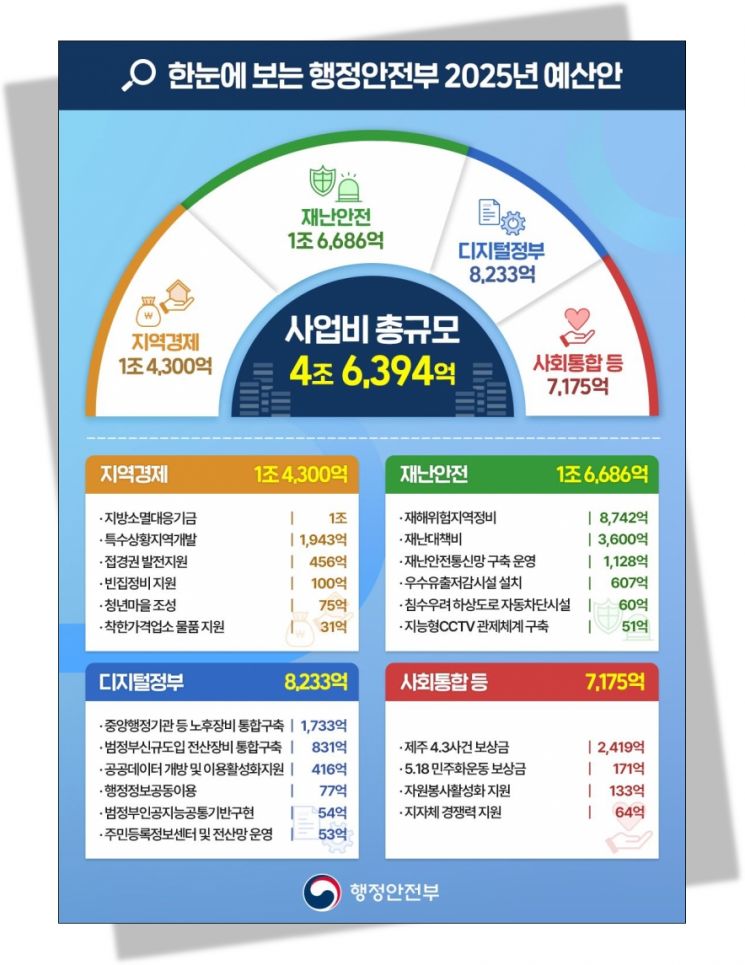
The project budget amounts to 4.6394 trillion won, focusing on enabling citizens to feel the policy achievements and changes of the Yoon Seok-yeol administration through ▲support for low-income, vulnerable groups, and disaster victims ▲response to population decline and local extinction risks ▲government innovation and public safety secured by utilizing innovative technologies such as artificial intelligence. It allocated 1.43 trillion won to the local economy, 1.6686 trillion won to disaster safety, 823.3 billion won to digital government, and 717.5 billion won to support for social integration. In addition, personnel expenses and basic operating costs were maintained at 409.3 billion won, the same level as this year, in line with the government's sound fiscal policy.
4.6 Trillion Won Project Budget Allocated to Strengthening Local Economy and Disaster Management
Looking in detail at the 4.6394 trillion won project budget, 1.43 trillion won will be spent on regional specialization projects utilizing local unique resources and support for improving residents' living conditions to realize the era of local autonomy. This includes developing tourism resources in border areas underdeveloped due to the division of North and South Korea and creating infrastructure to improve residents' settlement environments. The budget for themed hub areas was increased by 1.1 billion won to 5.9 billion won compared to this year, and support for hosting the world's first international expo themed on 'Islands' to establish a blueprint for sustainable island development is planned (from 900 million won to 2.3 billion won).
1.6686 trillion won will be invested to strengthen preventive safety management against large natural disasters such as typhoons and earthquakes. This includes flood control in residential areas (from 217.8 billion won to 285.8 billion won), installation of flood prevention facilities on submerged roads (a net increase of 6 billion won), activation of seismic reinforcement through certification systems (from 1.3 billion won to 2.6 billion won), and investigation and evaluation of potential disaster factors (a net increase of 300 million won).
8.233 billion won will be spent on building a digital government system, a mid- to long-term priority project of the government. 162.7 billion won will be invested in converting and integrating outdated servers and computer equipment of first-class systems closely related to citizens' lives into cloud form, and 3 billion won each will be newly allocated for establishing a 24-hour monitoring control system and for server and center redundancy.
Public services provided through familiar private platforms such as Naver and Kakao will also be expanded. To this end, 3.5 billion won more than this year, totaling 10.3 billion won, will be used for opening digital services. For the civil service system overhaul that has been accelerating since early this year, 500 million won and 1.1 billion won will be invested respectively in online issuance of certificate of seal impression and the establishment of a public service application system without required documents.
7.175 billion won will be allocated to support projects for social integration, including compensation for victims related to past incidents. Budgets of 17.1 billion won and 241.9 billion won were allocated for compensation payments to those related to the May 18 Democratic Movement and the Jeju 4.3 Incident, respectively. These amounts represent increases of 13.3 billion won and 15.7 billion won compared to this year.
Budget Allocated for Vacant House Management and Disaster Damage Prevention... "Focus on Tangible Daily Results"
Looking more closely, support measures for the local economy reflecting citizens' voices revealed in the field of livelihood stand out. For example, to support the settlement conditions of residents of the five West Sea islands who face difficulties due to special geographical conditions, the monthly settlement living support allowance per person was increased by 20,000 won, raising the West Sea 5 Islands settlement living support fund from 6.7 billion won this year to 7.2 billion won.
Support for managing vacant houses, which is increasing due to population decline and local extinction, will also be undertaken. To solve problems such as residential landscape and security caused by neglected vacant houses, the vacant house maintenance support project will be expanded to more than 1,000 units targeting population-declining areas, and the budget will be increased from 5 billion won this year to 10 billion won. In addition, the number of "Good Price Stores" that voluntarily contribute to stabilizing local prices by providing services at affordable prices will be increased by 5,000, and support for their supplies will be raised from 1.8 billion won this year to 3.1 billion won.
Support for rapid response to disaster damage recovery and strengthening the safety net for vulnerable groups will also be focused on. Representative examples include expanding the budget for private and public facility restoration to stabilize the lives of disaster victims and quickly restore facilities (from 60 billion won to 120 billion won) and strengthening disaster safety surveys for establishing customized policies for vulnerable groups (from 100 million won to 400 million won).
The operation of the Local Extinction Response Fund was also systematically adjusted. It will continue to support the creation of core living infrastructure in population-declining areas and promote large-scale development projects through fund formation utilizing private capital.
Investment will also be made to realize a digital platform government leading the AI era. This includes establishing a government-wide foundation for utilizing the latest technologies such as ChatGPT and supporting their application to administrative tasks, as well as strengthening control systems that automatically detect and notify disasters and abnormal situations. 5.4 billion won will be newly invested in implementing a government-wide AI common platform, and 10.5 billion won, 4.2 billion won more than this year, will be spent on improving the electronic document communication system. Additionally, 5.1 billion won will be allocated to build an intelligent CCTV control support system that quickly detects and notifies crimes and abnormal signs for preemptive response.
Jung Young-jun, Director of the Planning and Coordination Office, said, "The Ministry of the Interior and Safety has prepared the 2025 budget focusing on stabilizing people's livelihoods, protecting vulnerable groups, reversing the trend of local extinction, and leading the AI era, so that citizens can feel the results in their daily lives."
© The Asia Business Daily(www.asiae.co.kr). All rights reserved.

















