Government Faces Burden in Direct Subsidy Support
"Include Support Basis, Government Makes Decisions"
Will Cooperation Between Ruling and Opposition Parties Clear the National Assembly Hurdle?
The People Power Party's semiconductor special law, which will be promoted as the party's official stance, is about to be proposed. The government and the ruling party have entered final negotiations over methods such as directly providing subsidies to semiconductor companies.
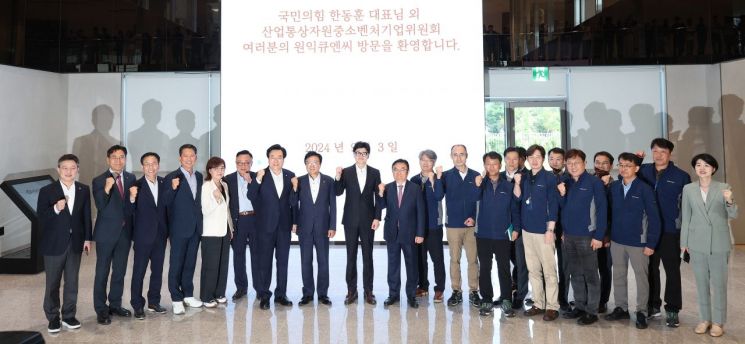
Kim Sang-hoon, the Policy Committee Chairman of the People Power Party, said in a phone interview with Asia Economy on the 4th, "We have completed gathering opinions from government ministries regarding the semiconductor special law and are just before proposing the revised bill." Ko Dong-jin, a People Power Party lawmaker who was the main proposer of the semiconductor special law in June, also explained, "It seems that the lawmaker's office, the party's policy committee, and the government have finished practical consultations and are in the final stages of coordination." Han Dong-hoon, the leader of the People Power Party, stated on the 8th of last month that he would compile and coordinate the semiconductor special laws proposed separately by lawmakers Ko Dong-jin, Park Soo-young, and Song Seok-jun to create a special law promoted as the party's official stance.
The part that the government and ruling party are coordinating until the last moment is the government's direct subsidy support to companies. Lawmaker Ko said, "Rather than pushing through the direct support part that the government finds burdensome, necessary adjustments should be made." Lawmaker Park said in a phone interview that day, "Lawmaker Ko and I are trying to include the legal basis for the government to provide direct support in the bill." This is interpreted as including a basis clause in the bill but indicating that the National Assembly will not intervene in the subsidy amount decided by the government.
It is also known that the bill includes provisions without a sunset period for subsidies and tax benefit support to companies. While the bill does not explicitly specify an increase in the tax credit rate for semiconductor companies' facility investments and research and development expenses, it allows flexibility. A separate committee to determine the tax credit rate for companies will be established and set by presidential decree. This differs from the proposals by Lawmaker Park and Kim Tae-nyeon of the Democratic Party of Korea, which included provisions to increase the tax credit rate by 10 percentage points per company.
Meanwhile, as the ruling party leadership requests bipartisan cooperation from the opposition party for the development of the semiconductor industry, attention is focused on the passage of the semiconductor special law in the National Assembly. Earlier, on the 3rd, Leader Han visited a semiconductor company in Gumi, Gyeongbuk, and said, "I told Lee Jae-myung, the leader of the Democratic Party, not to politicize semiconductors, and he responded without hesitation, saying let's do well." On the same day, Choo Kyung-ho, the floor leader of the People Power Party, said in his speech as the representative of the negotiating groups in the National Assembly, "There can be no ideology in semiconductors. Let us seek constructive alternatives together through bipartisan consultations."
© The Asia Business Daily(www.asiae.co.kr). All rights reserved.
![Clutching a Stolen Dior Bag, Saying "I Hate Being Poor but Real"... The Grotesque Con of a "Human Knockoff" [Slate]](https://cwcontent.asiae.co.kr/asiaresize/183/2026021902243444107_1771435474.jpg)
















