Traditional Liquor Benefits Including 50% Liquor Tax Reduction and Online Sales
SME Ombudsman: "Flexibility in Main Ingredients, Allow Small Amounts from Other Regions"
Ministry of Agriculture, Food and Rural Affairs: "Research Underway, Considering Legal Amendments"
After being excluded from the designation of traditional liquor (regional specialty liquor) due to containing a very small amount of ingredients produced in other regions, the local government filed a complaint, and the Small and Medium Business Ombudsman has begun to promote regulatory improvements.
According to the Small and Medium Business Ombudsman and Uiseong-gun, Gyeongbuk, on the 5th, Company H, which manufactures and sells alcoholic beverages in Uiseong-gun, Gyeongbuk, was planning to launch 'Sagwa Aejangmi,' a regional specialty liquor, in line with the diversifying consumer trends. To give Sagwa Aejangmi a rose scent, H added rose extract (0.1% of the total volume) produced in Gyeonggi-do, a different region, in addition to the main ingredient, apples, and applied for a liquor manufacturing license.
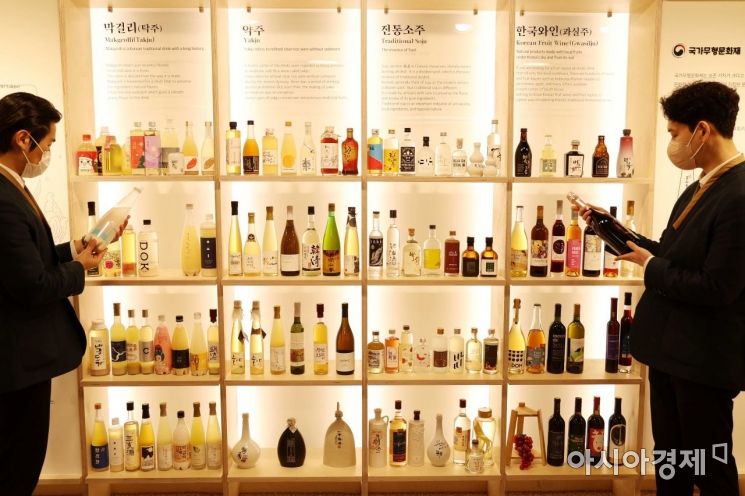
However, the National Tax Service Liquor License Support Center, which conducted standard inspections and analyzed various components including additives in Sagwa Aejangmi, judged the 'rose extract' as a main ingredient and denied the license on the grounds that the traditional liquor manufacturing method was inappropriate. Consequently, the Ministry of Agriculture, Food and Rural Affairs, the competent authority, excluded Sagwa Aejangmi from the traditional liquor designation.
Traditional liquor is alcohol brewed using local agricultural products as the main ingredient by farmers. When designated as traditional liquor, it receives a 50% reduction in liquor tax and, unlike other liquors prohibited from online sales, it can be sold online. However, traditional liquor must be manufactured using agricultural products produced in the jurisdiction of the manufacturing site or adjacent areas as the 'main ingredient.'
A Uiseong-gun official stated, "There are no farms producing roses in Uiseong-gun or adjacent cities, counties, and districts, and it is unreasonable to consider a very small amount of agricultural products, less than one decimal point of the total volume, as the main ingredient." He added, "If the very small amount of extract is excluded from the main ingredient, it can simplify administrative procedures for obtaining a separate liquor license and reduce time and economic costs," requesting improvements.
Article 2 of the current Act on the Promotion of Traditional Liquor Industry defines 'main ingredient' as "an ingredient that can represent the characteristics of the liquor product to be manufactured." It also stipulates, "If there are multiple types of ingredients, the top three ingredients by weight ratio of the final product (excluding brewing water and added ethanol)" are considered.
A Small and Medium Business Ombudsman official said, "We have proposed to the Ministry of Agriculture, Food and Rural Affairs, the competent authority, to relax the main ingredient standards for regional specialty liquors to allow the use of small amounts of ingredients produced in other regions, as long as they are procured within adjacent areas."
The Ministry of Agriculture, Food and Rural Affairs is reviewing whether to improve the regulations to promote the consumption of local agricultural products. A representative from the Food and Dining Industry Division of the Ministry said, "We are reviewing various issues, including whether to define the main ingredient as the ingredient with the highest weight ratio in the final product," adding, "Since we are currently conducting related research projects, we will consider whether to amend the law based on the results."
© The Asia Business Daily(www.asiae.co.kr). All rights reserved.

















