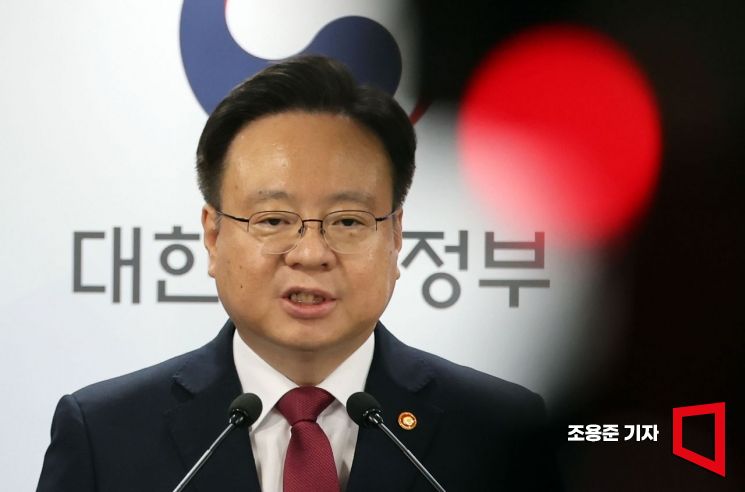
 Minister of Health and Welfare Cho Kyu-hong is announcing the pension reform promotion plan on the 4th at the Government Seoul Office in Jongno-gu, Seoul. Photo by Jo Yong-jun jun21@
The government will gradually raise the basic pension to 400,000 won. The pension increase will first be implemented for low-income elderly by 2026, and the support target will be expanded in 2027.
On the 4th, the government held the 3rd National Pension Deliberation Committee meeting of this year and finalized the "Pension Reform Promotion Plan," announcing that the basic pension amount will be increased from the current 300,000 won to 400,000 won. The 400,000 won basic pension was a pledge made by President Yoon Seok-yeol during his presidential campaign.
The basic pension increase will begin with low-income elderly in 2026. The remaining elderly will receive the increase benefits in 2027. However, the criterion of "bottom 70% income" for basic pension eligibility remains unchanged. This is interpreted as respecting the majority opinion of the Pension Reform Public Deliberation Committee, which advocated maintaining the scope of basic pension recipients.
Efforts to strengthen the basic pension system will also be pursued. First, a residency requirement will be added to the basic pension eligibility criteria. This is to address fairness issues where individuals with low domestic contribution receive the basic pension. Going forward, to receive the basic pension, one must have resided in the country for at least 5 years after the age of 19. Additionally, the scope of income and asset reporting for basic pension recipients will be expanded overseas to enhance the transparency of the system.
For livelihood benefit recipients, an additional basic pension will be provided. Currently, the basic livelihood security livelihood benefit is paid by subtracting the recognized income amount from 32% of the median income. Since receiving the basic pension reduces the livelihood benefit, the support effect is diminished. Experts have pointed out that giving the basic pension is meaningless and have urged the establishment of income compensation measures for low-income elderly.
Accordingly, the government decided to deduct the additionally paid basic pension amount from the recognized income amount for basic livelihood security. This means that even if the basic pension is received more, the livelihood benefit will not be reduced. Among elderly aged 65 and over receiving the basic pension, about 9.9%, or approximately 644,000 people, will benefit from this.
© The Asia Business Daily(www.asiae.co.kr). All rights reserved.
![Clutching a Stolen Dior Bag, Saying "I Hate Being Poor but Real"... The Grotesque Con of a "Human Knockoff" [Slate]](https://cwcontent.asiae.co.kr/asiaresize/183/2026021902243444107_1771435474.jpg)
















