It has been argued that tokenization, artificial intelligence (AI), and non-bank financial intermediation (NBFI) should be considered when envisioning the future of the international financial system. There were also calls to strengthen cybersecurity-related laws to respond to the increase in cyber incidents following the COVID-19 pandemic.
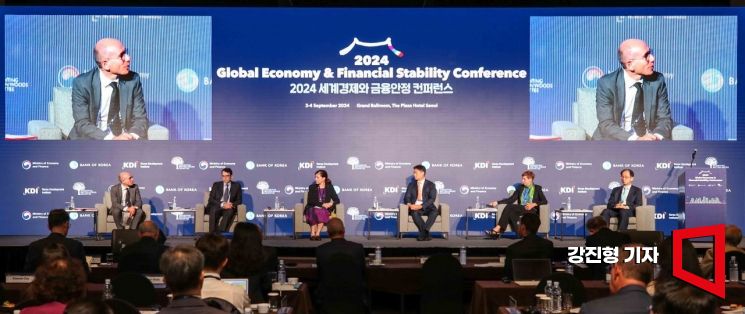 William Roos (left), Director of Trade Development Policy at the French Ministry of Finance, along with economists, are attending the "2024 Global Economy and Financial Stability Conference" held on the 4th at the Plaza Hotel in Jung-gu, Seoul, engaging in discussion. Photo by Jinhyung Kang aymsdream@
John Schindler, Secretary General of the Financial Stability Board (FSB), attended the presentation of Session 4, "Digital Finance, AI, and Financial Stability," at the "2024 World Economy and Financial Stability Conference" held on the 4th at the Plaza Hotel in Jung-gu, Seoul. He stated, "To bring about substantial change in financial innovation, it is necessary to dismantle the foundation itself, like dismantling a hospital or a high-rise hotel," adding, "For large-scale financial innovation, a new platform must be based on, and that is distributed ledger technology."
He further emphasized that tokenization, AI, and NBFI must be considered when envisioning the future of financial innovation. Secretary General Schindler explained, "Tokenization refers to utilizing assets in the form of digital tokens using distributed ledger technology," and "It is possible to bring actual physical real estate assets onto distributed ledger technology and trade them."
He added, "The increasing use of AI and the risks posed by generative AI to the financial system remain valid."
Schindler said, "About 40 to 50% of financial intermediation is shifting to NBFI," and "The fact that 40 to 50% of global financial intermediation is moving to NBFI means it is operating on a completely new foundation, so while focusing on discussions about tokenization and AI, we cannot ignore the transition to NBFI."
NBFI stands for Non-bank Financial Intermediation, referring to credit intermediation activities conducted outside the banking sector, commonly known as "shadow banking." Although involved in credit intermediation outside the banking system, it is not subject to the same level of prudential regulation as banks.
During Session 4, discussions were held on the impact of technological innovations such as digitalization and AI on the financial sector. Junil Kim, Visiting Research Fellow at the Korea Development Institute (KDI), chaired the session, with presentations by Secretary General Schindler and Mahvash Qureshi, Director of the Monetary and Capital Markets Department at the International Monetary Fund (IMF). Zhou Xiaonan, Head of the UBS Digital Assets Team, and Sungkwan Yoon, Head of the Digital Currency Research Department at the Bank of Korea, participated as discussants.
In the subsequent presentations, discussions on cybersecurity took place. Director Qureshi stated, "Technological innovation is causing a major revolution in the financial sector, but cybersecurity has emerged as a new risk," adding, "Compared to before the pandemic, cyberattacks have more than doubled."
He continued, "In particular, 20% of cyber incidents occur in the financial sector, including banks, insurance companies, and asset management firms, and both advanced and emerging countries are significantly exposed to cyber incidents," emphasizing, "Cybersecurity legislation at the national level is still weak, so appropriate response and recovery procedures are necessary. Since cyber incidents have significant cross-border ripple effects, international standards will also be needed."
© The Asia Business Daily(www.asiae.co.kr). All rights reserved.

















