Retired drug detection dogs and their owners spent healing time through a forest experience.
The Korea National Arboretum recently held a forest experience program called ‘Forest Mungstaurant’ at the National Saneum Natural Recreation Forest located in Danwol-myeon, Yangpyeong-gun, Gyeonggi-do, where retired drug detection dogs and their adoptive families participated together, the agency announced on the 4th.
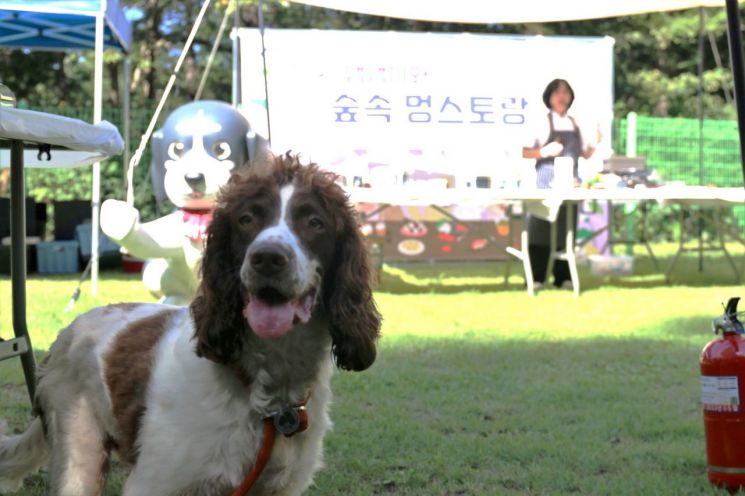 The Forest Recreation Office held a "Forest Mungstaurant" on the 3rd at the National Saneum Natural Recreation Forest, allowing retired drug detection dogs and their adoptive families to have healing time in the forest. Provided by the National Natural Recreation Forest Management Office
The event was attended by retired drug detection dogs who dedicated their lives to public service and have since left the field, their adoptive families, and general small and medium-sized dog owners.
The Recreation Forest Management Office supported the adoptive families of the drug detection dogs participating in the event by enabling them to prepare and taste dishes made from forest products on site.
In particular, the event drew attention as a father and son pair of retired drug detection dogs, who had been adopted by different families and lived apart, were reunited.
Since the 1st of this month, the Recreation Forest Management Office has relaxed the criteria for dog entry by allowing up to three dogs depending on the facility size and removing age restrictions upon entry. However, large dogs are still not permitted inside the recreation forest.
Kim Myung-jong, head of the Recreation Forest Management Office, said, "To ease restrictions on the entry of special-purpose dogs (such as drug detection dogs, military dogs, and search and rescue dogs) that have contributed to society, we plan to continue regulatory reforms related to the use of recreation forests, including designating a tentative ‘Large Dog Day.’"
Meanwhile, retired drug detection dogs refer to those that have served at frontline customs sites such as airports and ports and have retired, or detection dogs that were eliminated during the training process.
The Korea Customs Service Customs and Border Management Training Institute is placing retired drug detection dogs into private homes so they can live new lives. Before adoption, the dogs undergo socialization training programs to help them quickly adapt to their new homes.
© The Asia Business Daily(www.asiae.co.kr). All rights reserved.
![User Who Sold Erroneously Deposited Bitcoins to Repay Debt and Fund Entertainment... What Did the Supreme Court Decide in 2021? [Legal Issue Check]](https://cwcontent.asiae.co.kr/asiaresize/183/2026020910431234020_1770601391.png)
















