Increased Importance of Selecting Hospitals for 119 Transport Services
Since February of this year until recently, requests to the 119 Emergency Situation Management Center to "find a hospital" have surged. As the medical gap has prolonged, the role of the Emergency Situation Management Center in transporting emergency patients to hospitals has grown significantly.
On the 4th, Yonhap News quoted the National Fire Agency reporting that from February this year until the 25th of last month, the number of hospital selections made by the Emergency Situation Management Center reached a total of 1,197 cases. During the same period last year, there were 519 cases, marking a total increase of 131%.
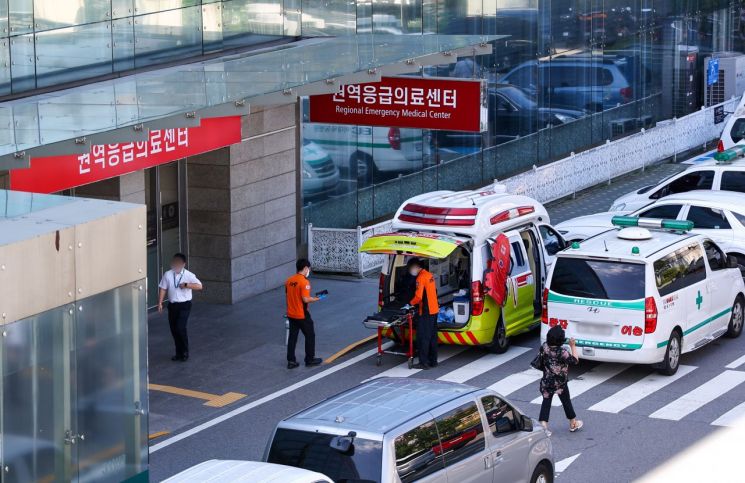 On the morning of the 3rd, ambulances are waiting in front of the Regional Emergency Medical Center at a university hospital in Seoul city. [Image source=Yonhap News]
During the same period, the proportion of "hospital selection for transport" in the Emergency Situation Management Center's tasks also increased significantly. Last year, it was 1.8%, but this year it rose to 4.1%, more than doubling. "Public guidance on hospitals and clinics" also increased by 2.2 percentage points, from 41.8% to 44% during the same period.
The Emergency Situation Management Center has long been responsible for selecting hospitals by assessing the severity of patients upon request from emergency medical teams, sending "severe emergency patients" to regional or emergency medical centers or large hospitals, and transporting "mild or non-emergency patients" to local emergency medical institutions or nearby hospitals and clinics.
Previously, emergency medical teams often found hospitals directly, but now, as the workload of performing emergency treatment while searching for hospitals has become too heavy, the National Fire Agency has reportedly strengthened the role of the Emergency Situation Management Center since February this year. It is also understood that the increase in hospitals refusing patients due to the prolonged medical gap has influenced this situation.
In fact, according to data on re-transports by emergency medical teams received by the office of Jeong Seong-guk, a member of the National Assembly's Education Committee from the People Power Party, from the National Fire Agency, there were 17 cases where emergency teams re-transported patients four times by June 10 of this year. Although only the first half of the year has passed, this already exceeds the total records of last year (16 cases) and 2022 (10 cases).
Several reports of so-called "emergency room spinning" cases have increased public anxiety. Recently, a 28-month-old girl who was refused transport by 11 emergency rooms has been in a coma for a month, sparking controversy. Additionally, when a fatal accident occurred at Guro Station on Seoul Subway Line 1 on the 9th of last month, an injured worker was transferred between multiple hospitals for 16 hours.
© The Asia Business Daily(www.asiae.co.kr). All rights reserved.
![Clutching a Stolen Dior Bag, Saying "I Hate Being Poor but Real"... The Grotesque Con of a "Human Knockoff" [Slate]](https://cwcontent.asiae.co.kr/asiaresize/183/2026021902243444107_1771435474.jpg)
















