Hankyung Association's Report on 'Review of Voting Rights Restrictions for Financial and Insurance Companies'
"Please Include 'Financial-Related Industries' in Voting Rights Exercise Scope"
There has been a call to ease the restrictions on voting rights for shares of financial and insurance affiliates under the Fair Trade Act. The argument is that a legal foundation should be established to allow financial and insurance companies belonging to business groups restricted from cross-shareholding to enter new businesses such as fintech.
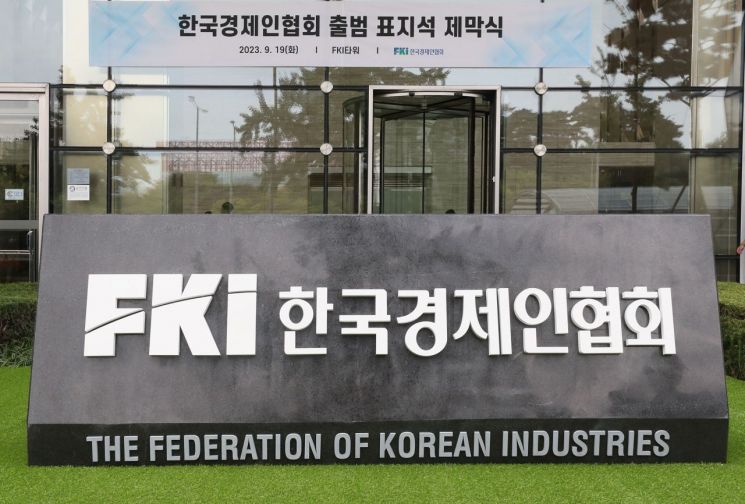
On the 4th, the Korea Economic Association stated this in a report titled "Review of Voting Rights Restriction Regulations on Financial and Insurance Companies under the Fair Trade Act as Financial-Industrial Separation Regulations," commissioned to Professor Hong Dae-sik of Sogang University Law School.
The report pointed out that the scope of financial and insurance companies currently belonging to business groups restricted from cross-shareholding, which are regulated from exercising voting rights on domestic affiliate shares, is excessively broad. Under the Fair Trade Act, the scope of "financial or insurance business" follows the Korean Standard Industrial Classification according to the Statistics Act. According to this standard, not only deposit-taking financial institutions such as banks and insurance companies but also companies with only credit functions, such as capital and credit card companies, are classified as financial and insurance companies.
The report criticized, "In a situation where the boundaries between finance and industry are blurring due to convergence, defining financial and insurance businesses based on the Korean Standard Industrial Classification has limitations in reflecting the rapidly changing financial environment."
Recently, the judiciary has also limited the interpretation that financial and insurance companies are subject to voting rights restriction regulations under the Fair Trade Act only when they "receive customer deposits," the report pointed out.
According to the report, the Supreme Court finalized a ruling in April to cancel the corrective order issued by the Fair Trade Commission at the end of 2022 against K Cube Holdings, wholly owned by Kim Beom-su, founder of Kakao, on allegations of violating financial-industrial separation.
The Fair Trade Commission issued the corrective order claiming that K Cube Holdings should be classified as a financial company because over 95% of its total revenue from 2020 to 2021 was financial income, and that it exercised voting rights over shares held in Kakao and Kakao Games. K Cube Holdings filed a lawsuit against the Fair Trade Commission in response. The court ruled in favor of K Cube Holdings, judging that companies earning financial income by managing only their own funds cannot be subject to financial-industrial separation regulations.
The report evaluated, "It is significant that the interpretation distinguishes between industrial activities managing customer deposits (third-party funds) and those managing proprietary assets (own funds) within financial and insurance businesses under the Korean Standard Industrial Classification, applying voting rights restrictions only to financial businesses managing third-party funds."
The report proposed revising the definition of financial and insurance businesses under the Fair Trade Act to ease restrictions on voting rights. Referring to U.S. legislative examples, it suggested including "financial-related businesses" related to financial activities, such as credit rating services, tax agency services, and virtual asset exchanges, as entities on which financial and insurance companies can exercise voting rights. The intention is to establish a legal foundation for financial and insurance companies belonging to business groups restricted from cross-shareholding to enter new businesses such as fintech.
It also proposed limiting the scope of voting rights restriction regulations to "financial and insurance businesses handling deposit-type products under the Financial Consumer Protection Act and its enforcement decree," referencing the classification of financial products and services under the Financial Consumer Protection Act.
© The Asia Business Daily(www.asiae.co.kr). All rights reserved.
![Clutching a Stolen Dior Bag, Saying "I Hate Being Poor but Real"... The Grotesque Con of a "Human Knockoff" [Slate]](https://cwcontent.asiae.co.kr/asiaresize/183/2026021902243444107_1771435474.jpg)
















