The performance test of a supercritical carbon dioxide (CO2) power generation system, which will replace steam power generation, has been successfully completed. Supercritical carbon dioxide power generation produces electricity by heating carbon dioxide to drive a turbine, instead of the conventional method of boiling water to generate steam to operate the turbine. It is also regarded as a next-generation energy technology because it can generate power by utilizing carbon dioxide emitted from industrial complexes.
The Korea Atomic Energy Research Institute (hereinafter KAERI) announced on the 4th that it successfully completed a performance test producing 100 kWe of power using a supercritical carbon dioxide power generation system.
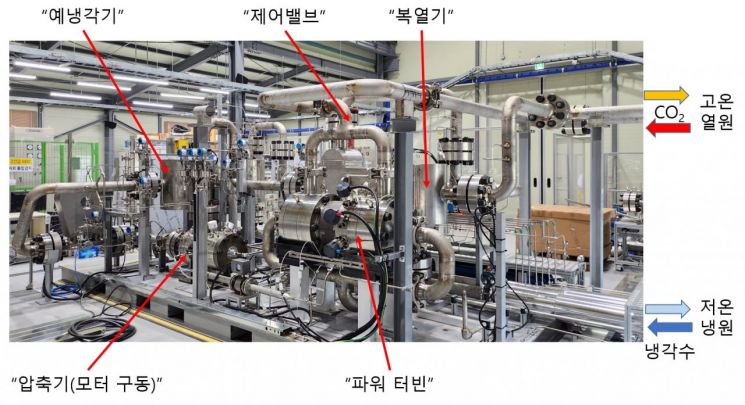 Current Status of Supercritical Carbon Dioxide Power Generation System Construction. Provided by Korea Atomic Energy Research Institute
This is the first domestic case of producing electricity using supercritical carbon dioxide power generation. Currently, due to the high level of technical difficulty, technology development and demonstration are only being pursued in places such as the United States (10 MW demonstration) and Europe (2 MW demonstration). This highlights the significance of the performance test successfully completed by KAERI.
The system developed by KAERI operates on the core principle of generating electricity by driving compressors and turbines with supercritical carbon dioxide. In the compressor, the fluid (carbon dioxide) is compressed from low pressure to high pressure and circulated within the system. The high-pressure fluid then flows into the turbine, rotating the internal blades, which in turn generates electricity.
Previously, KAERI developed the compressor, a core component of the supercritical carbon dioxide power generation system, in 2020. This year, with the completion of turbine development, performance testing for power generation was able to proceed.
The turbine consists of a rotating shaft, rotors (blades) attached to the ends of the shaft that generate energy, and bearings that support the shaft. KAERI devised a two-way suction and two-way discharge turbine system, creating two symmetrical inlets and outlets for carbon dioxide flow, and placed rotors at both ends of the shaft to balance the forces.
As a result, control of the shaft and rotors became possible even at high-speed rotation of 40,000 RPM, enabling efficient power generation.
Typically, when a pure substance reaches a supercritical state, it exhibits properties of both liquid and gas. In particular, supercritical carbon dioxide has a high density near the critical point, where supercritical conditions begin, making it easy to compress like a liquid. At high-temperature supercritical states, it has low viscosity like a gas, resulting in less friction and free expansion inside machinery, making it a highly efficient fluid for power generation systems.
The critical point of carbon dioxide is 31℃ and 7.38 MPa (megapascals), which is significantly lower than that of water. It is inexpensive and readily available. Additionally, due to its gaseous properties, the machinery is less prone to corrosion, making it suitable for supercritical power generation systems.
The supercritical carbon dioxide power generation system has advantages over conventional steam power systems, including high thermal efficiency at high temperatures and the ability to miniaturize equipment to one-tenth the size with a simple configuration. It can generate electricity by operating devices using various heat sources such as solar heat, high-temperature fuel cells, nuclear fusion, next-generation reactors, engine exhaust heat, gas turbine exhaust heat, and coal-fired power plants.
Due to these advantages, the United States is currently focusing on securing technology for supercritical carbon dioxide power generation systems, such as the 10 MWe ‘STEP Project (the Supercritical Transformational Electric Power Project)’ led by the U.S. DOE in San Antonio, Texas.
KAERI’s research achievements were obtained through the project “Development of Supercritical CO2 Power Generation Technology for Surface Ship Exhaust Heat Recovery,” conducted under the dual-use technology development program led by the Defense Acquisition Program Administration. The project involved a consortium of four organizations: KAERI, Jinsol Turbomachinery Co., Ltd., KAIST, and POSTECH.
Jin-Young Cho, Director of the Advanced Reactor Research Center, stated, “Power generation using the supercritical CO2 system will lay the foundation for applying power conversion systems to next-generation reactors and small modular reactors in the future.” He added, “KAERI will strive to achieve the final research goal of producing a total electric output of 500 kW within this year.”
© The Asia Business Daily(www.asiae.co.kr). All rights reserved.

















