Founder of 'Deep Learning'
Collaborates with Korea to Advance High-Level Cognitive Function Development of the Brain
Yoshua Bengio, a world-renowned artificial intelligence (AI) authority from Canada and a professor at the University of Montreal, has joined hands with KAIST to develop next-generation AI.
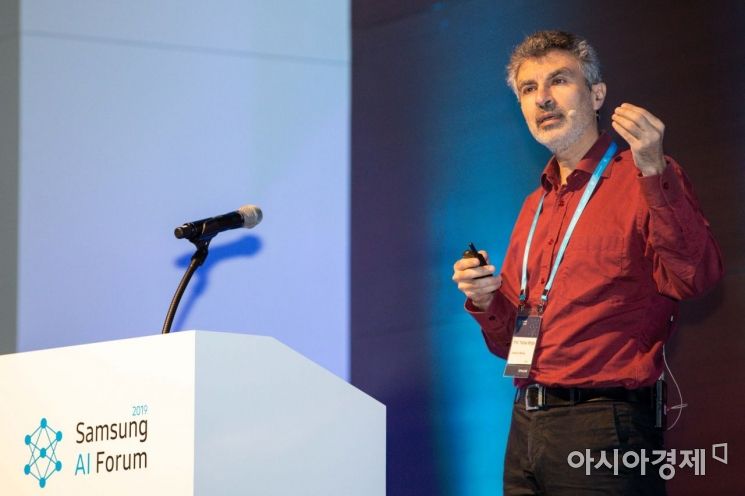 Professor Yoshua Bengio of the University of Montreal, recognized as a global AI expert. Photo by Jinhyung Kang
On the 4th, KAIST announced that Professor Seongjin Ahn's research team from the School of Computing, in collaboration with Professor Bengio's team, has established the "KAIST-MILA Prefrontal AI Research Center" and will engage in international joint research to develop next-generation AI technologies.
This research aims to secure foundational technologies to implement "Prefrontal AI," which integrates high-level cognitive functions managed by the prefrontal cortex into AI. Professors Seunghoon Hong of KAIST and Seongsu Ahn of Pohang University of Science and Technology (POSTECH) are also participating.
The center will combine Professor Bengio's Montreal Institute for Learning Algorithms (MILA) and KAIST's AI research capabilities to focus on developing "System 2" AI technology that mimics human high-level cognitive abilities.
Professor Bengio is a figure who has had a profound impact on modern AI research. Alongside Geoffrey Hinton, Yann LeCun, and Andrew Ng, he is often referred to as one of the "Four Kings of AI." He received the Turing Award in 2018 for his contributions to AI development. Professor Bengio played a particularly important role in the birth and advancement of deep learning technology.
Unlike 'System 1,' which is responsible for intuitive and fast cognition, Professor Bengio has focused on the development of 'System 2,' which performs complex and sequential thinking processes such as mathematical logical reasoning, mimicking human high-level cognitive abilities. Although large language models (LLMs) have made remarkable progress, deep learning technology still shows limitations in effectively implementing high-level cognitive functions.
Professor Seongjin Ahn explained the significance of the research, saying, “Collaboration with Professor Yoshua Bengio will be an important milestone in the development of next-generation AI technology,” and added, “Through this research, we will develop deep learning algorithms that mimic the high-level cognitive functions performed by the human prefrontal cortex and establish a technical foundation to implement safe and reliable AI agents.”
© The Asia Business Daily(www.asiae.co.kr). All rights reserved.
![Clutching a Stolen Dior Bag, Saying "I Hate Being Poor but Real"... The Grotesque Con of a "Human Knockoff" [Slate]](https://cwcontent.asiae.co.kr/asiaresize/183/2026021902243444107_1771435474.jpg)
















