August Nonfarm Payrolls to be Released on the 6th
S&P and ISM August PMIs Both Below 50... Manufacturing Contraction Continues
The three major indices of the U.S. New York Stock Exchange are showing a downward trend in early trading on September 3rd (local time), the first trading day of the month. The New York Stock Exchange, which was closed the previous day for Labor Day, is in a cautious wait-and-see mode amid anticipation of various employment indicators to be released this week, including the August nonfarm payroll report that will influence the Federal Reserve's (Fed) interest rate cut decision on the 18th. The manufacturing sector slowdown news released this morning also heightened market caution.
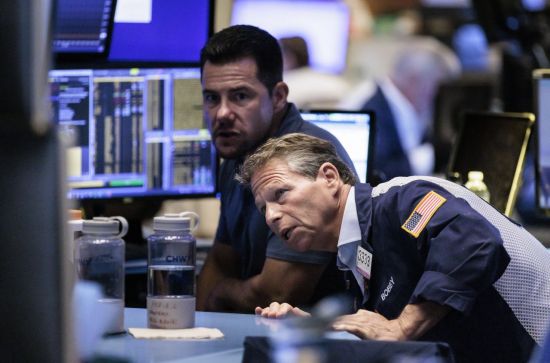
As of 10:03 a.m. in New York stock market trading, the Dow Jones Industrial Average, centered on blue-chip stocks, is down 1.06% from the previous trading day, standing at 41,124.33. The S&P 500 index, focused on large-cap stocks, is trading at 5,586.16, down 1.1%, and the Nasdaq index, centered on technology stocks, is down 1.4% at 17,466.02.
The New York stock market in August started with a sharp decline due to the shock from the 'July employment report' released early last month. Fear of a recession led to a sell-off, but the decline was later recovered as recession concerns eased. The September market trend is also expected to be influenced by various employment indicators to be released this week and the Fed's corresponding interest rate cut decisions. Since September is generally considered the worst month for stock performance throughout the year, seasonal headwinds are also expected to be overcome.
This morning, indicators that gauge the U.S. manufacturing economy were released one after another. The August Manufacturing Purchasing Managers' Index (PMI) released by S&P Global recorded 47.9. A figure below 50 indicates economic contraction, while above 50 indicates expansion. It fell below both the previous month (49.6) and the forecast (48), accelerating the contraction phase. Following this, the Institute for Supply Management (ISM) reported an August Manufacturing PMI of 47.2, continuing the contraction phase. Although it rose from the previous month (46.8), it fell short of market expectations (47.5). This increased concerns about economic downturn and widened the market's initial decline.
The indicator investors are most focused on this week is the August nonfarm payroll report to be released by the U.S. Department of Labor's Bureau of Labor Statistics (BLS) on the 6th. According to expert forecasts compiled by Bloomberg, nonfarm payrolls are expected to have increased by 165,000 last month, a significant rise from July's 114,000. The unemployment rate is projected to have fallen by 0.1 percentage points to 4.2% in August, after rising from 4.1% in June to 4.3% in July.
Wall Street expects that if nonfarm payrolls fall below 100,000 or the unemployment rate rises above 4.4%, the Fed will implement a 'big cut' of 0.5 percentage points at the September Federal Open Market Committee (FOMC) meeting. This reflects the view that if the labor market cools rapidly, the Fed may expand the scale of interest rate cuts. Fed Chair Jerome Powell also mentioned in his speech at the Jackson Hole meeting on the 23rd of last month that the timing and pace of rate cuts depend on future data, outlook, and risk balance.
Currently, the interest rate futures market reflects a 65% probability that the Fed will cut rates by 0.25 percentage points in September. The market sees a 74.1% chance that the Fed will cut rates at all three meetings in September, November, and December, with at least one big cut. Depending on the size of the September rate cut and Chair Powell's remarks, there is also a possibility of disappointment selling from investors expecting a total 1 percentage point cut by the end of the year.
Other employment data releases will follow. On the 4th, the July Job Openings and Labor Turnover Survey (JOLTs) will be released, and on the 5th, ADP's August private employment report and weekly initial and continuing unemployment claims will be published.
The Fed's economic conditions report, the 'Beige Book,' will be released on the 4th.
Henry Allen, a macroeconomic strategist at Deutsche Bank, analyzed, "Although August started incredibly tough, the market began to regain calm after August 5th," adding, "Partly, there has been more positive economic data that helps alleviate fears of a recession."
By stock, Nvidia, the leader in artificial intelligence (AI), is down 5.53%. U.S. Steel is down 3.59%. This follows Vice President Kamala Harris, the Democratic presidential candidate, visiting Pittsburgh, Pennsylvania, where U.S. Steel's headquarters is located, on Labor Day to express opposition to U.S. Steel's sale to Nippon Steel. Boeing, the U.S. aircraft manufacturer, is down 7.95% after Wells Fargo downgraded its investment rating from 'equal weight' to 'underweight.' Unity Software, a video game company, is surging 8.31% after Morgan Stanley upgraded its investment rating from 'equal weight' to 'overweight.'
Government bond yields are declining. The U.S. 10-year Treasury yield, a global bond yield benchmark, fell 7 basis points (1 bp = 0.01 percentage points) from the previous trading day to 3.83%, and the 2-year Treasury yield, sensitive to monetary policy, dropped 4 basis points to 3.88%.
International oil prices are plunging. West Texas Intermediate (WTI) crude oil is down $2.66 (3.62%) from the previous trading day, trading at $70.89 per barrel, and Brent crude, the global oil price benchmark, is down $3.21 (4.14%) at $74.31 per barrel.
© The Asia Business Daily(www.asiae.co.kr). All rights reserved.
![Clutching a Stolen Dior Bag, Saying "I Hate Being Poor but Real"... The Grotesque Con of a "Human Knockoff" [Slate]](https://cwcontent.asiae.co.kr/asiaresize/183/2026021902243444107_1771435474.jpg)
















