"Energy Transition Must Be Achieved Within 15 Years... Time Is Running Out"
China: "Need for Joint Technology Development and Mutual Utilization"
Yoon Byung-seok, CEO of SK Gas, emphasized on the 3rd at the '2nd Korea-China Korean Academy of Engineering Forum on Engineering Technology Development' held at the Shilla Hotel in Jung-gu, Seoul, that Korea and China must closely cooperate for the transition to carbon-free energy. He proposed establishing a cooperative system in areas where each country has technological strengths, such as fuel cells, solar power, and hydrogen.
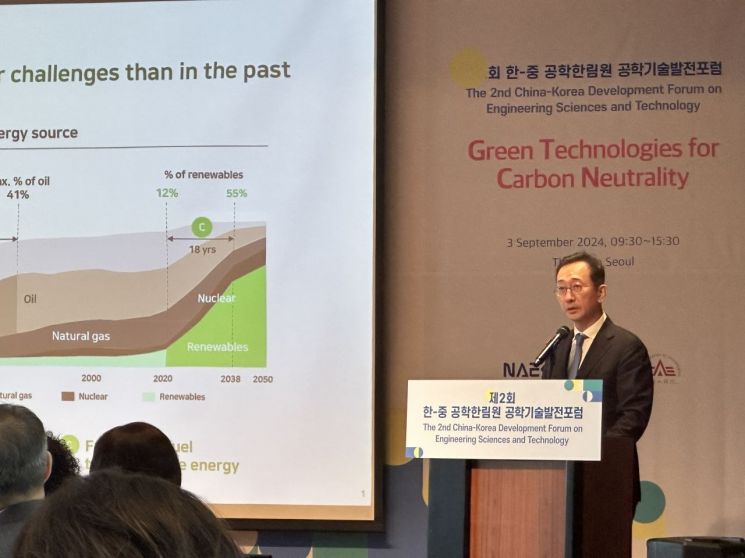 Yoon Byung-seok, CEO of SK Gas, is presenting the current status of Korea's carbon-free energy business, focusing on the SK Gas case, at the 2024 Korean Academy of Engineering Forum on Engineering Technology Development held at the Shilla Hotel in Seoul on the 3rd.
 [Photo by Lee Sung-min]
CEO Yoon said, "Building a carbon-free energy infrastructure takes about 50 years," adding, "From the early stages of the project, facilities and other elements must be standardized to jointly create an energy value chain between the two countries." He further stated, "Since Korea and China have a large share of carbon emissions in industry and power generation sectors, cooperation between the two countries is essential."
As cooperation measures, he suggested ▲unification of policies such as incentives ▲technological cooperation in areas of national competitive advantage ▲collaborative planning across the entire value chain. He proposed pre-coordination of laws and regulations such as clean hydrogen certification, product standards, and safety management, technological cooperation like Korea’s fuel cells and China’s solar panels, and cooperation plans utilizing China’s abundant renewable energy sources and large-scale hydrogen demand.
After his lecture, when asked about specific measures, CEO Yoon explained, "If equipment specifications are not matched at the initial manufacturing stage, compatibility will be impossible, so cooperation is needed from the manufacturing phase," adding, "Since it is difficult for one country to handle the entire value chain, early cooperation would be advantageous for raw material imports and other aspects."
Chinese officials attending the forum also agreed on the necessity of Korea-China cooperation. Zhang Xiaoye, a research fellow at the China Meteorological Science Research Institute, said, "To protect our shared home, Earth, the whole world must cooperate for carbon neutrality," adding, "We need to establish a good roadmap, benchmark each other, jointly develop technologies, and mutually utilize technologies."
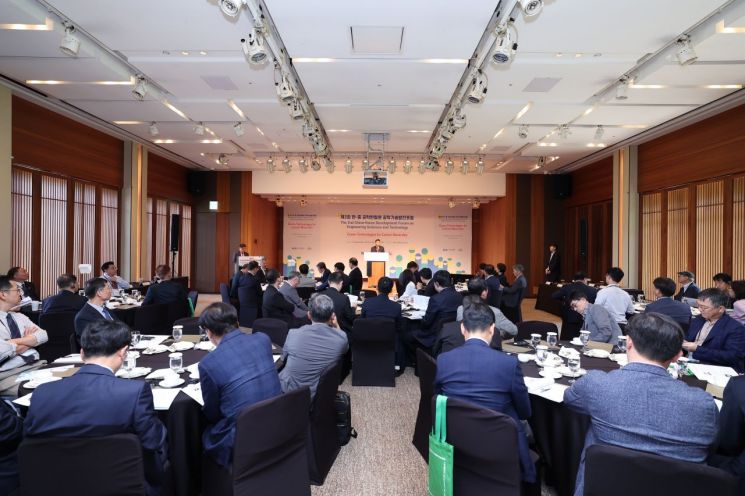 Scenes from the "2nd Korea-China Engineering Technology Development Forum" held on the 3rd at the Shilla Hotel in Jung-gu, Seoul.
 [Photo by Korea Academy of Engineering Sciences]
On the same day, CEO Yoon introduced the current status of Korea’s carbon-free energy business, focusing on the SK Gas case. He explained, "The biggest difficulty in developing net-zero related businesses is the physicochemical limits," noting, "Ammonia and gas turbine efficiency have doubled over the past 60 years, while CPU speeds have increased by 10 to the 15th power in the same period. Compared to digital technology, energy transition requires much longer time."
In the past, energy transitions from wood to coal, and then to oil each took about 50 years, but there is less than 15 years left until 2038, the government’s target year to raise the share of carbon-free power generation to 70%.
SK Group is developing renewable energy businesses centered on affiliates such as SK Gas and SK E&S. They plan to realize net-zero focusing on wind power, hydrogen, ammonia, energy storage systems (ESS), and CCUS (carbon capture, utilization, and storage). SK Gas plans to complete the LNG value chain by utilizing the LNG/LPG combined cycle power plant Ulsan GPS and the LNG terminal KET, which were built with an investment of 1.4 trillion won. Additionally, they are promoting an ammonia cracking business using blue hydrogen imported from overseas by leveraging existing infrastructure.
© The Asia Business Daily(www.asiae.co.kr). All rights reserved.


















