Statistics Korea August Consumer Price Trends
Petroleum Products Rise by Only 0.1%
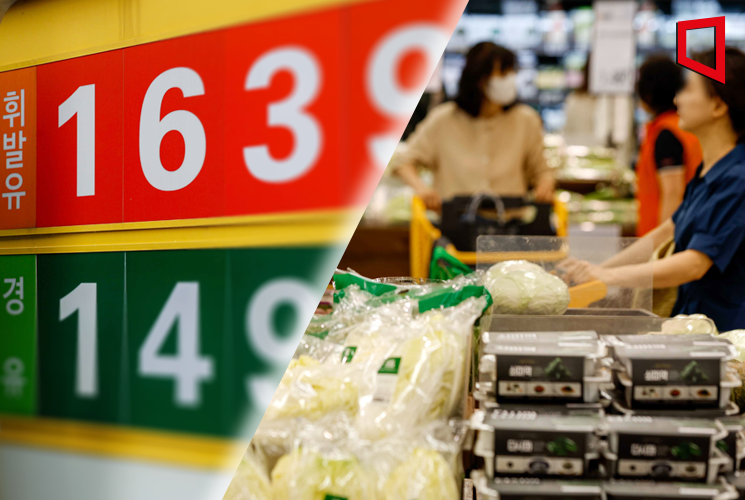
The consumer price inflation rate last month recorded 2.0%, the lowest in 3 years and 5 months. This is due to the stabilization of international oil prices, which curbed the rise in petroleum products, and the arrival of fresh fruits, which slowed the price increase of agricultural products compared to the previous year.
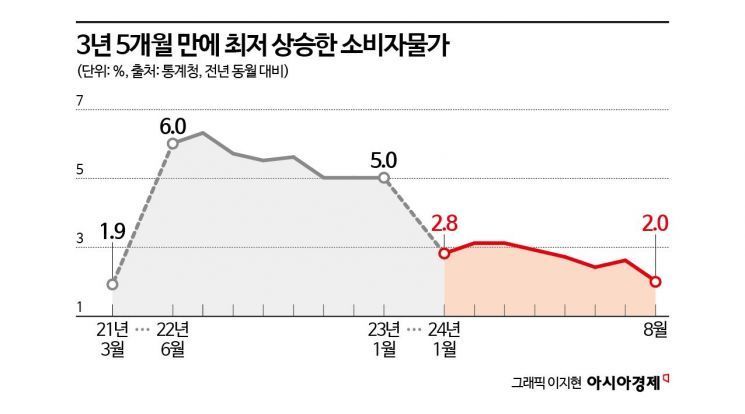
According to the 'Consumer Price Trends for August 2024' released by Statistics Korea on the 3rd, the consumer price index last month was 114.54 (2020=100), up 2.0% from the same month last year. The consumer price inflation rate maintained a 2% level following May (2.7%), June (2.4%), and July (2.6%), and it is the lowest level since March 2021 (1.9%). Gong Mi-sook, the Economic Trend Statistics Officer at Statistics Korea, explained, “Overall, the significant drop in petroleum products and the considerable reduction in the price increase of agricultural and marine products had a major impact.”
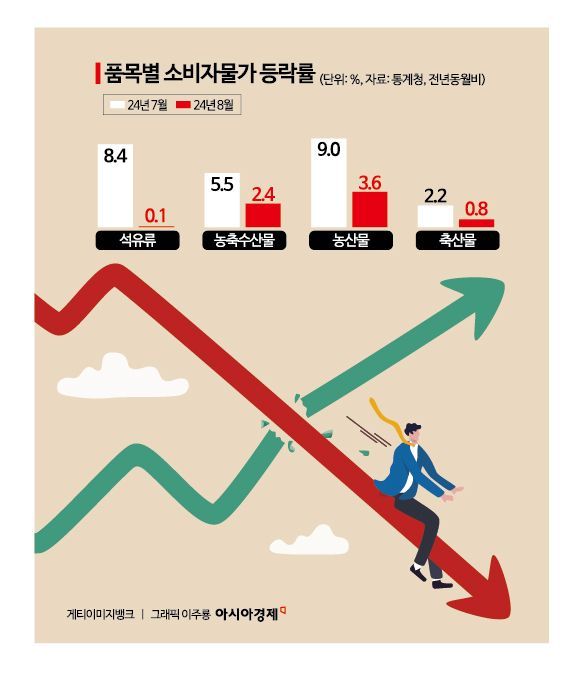
Petroleum products, which pushed prices up by 8.4% in July, rose by only 0.1%. This was due to the combined effect of falling international oil prices and a base effect from last year's unusually high fuel prices. Petroleum products showed the lowest increase in six months since a 1.5% decline in February. The overall contribution to inflation also decreased by 0.31 percentage points compared to the previous month.
This is because international oil prices, which are typically reflected in consumer prices with a 2-3 week lag, have been on a downward trend since July. Dubai crude oil, the benchmark for imported crude oil prices, fell from $83.8 per barrel in July to $77.6 in August. Specifically, diesel dropped by 1.9% and gasoline by 0.7%. On the other hand, liquefied petroleum gas (LPG) for automobiles rose by 16.8%, marking the highest increase since July 2022 (21.4%). A Ministry of Economy and Finance official stated, “Recently, the market has not significantly reflected the impact of instability in the Middle East, and the high base effect from last September is expected to continue into next month.”
Agricultural, livestock, and marine products rose by only 2.4% compared to the same month last year, significantly less than the 5.5% increase in July. This was due to favorable weather conditions compared to last year, which prevented major supply issues in agricultural products. Agricultural products rose by 3.6%, a smaller increase than the 9.0% in the previous month.
The fresh food index increase slowed significantly to 3.2% from 7.7% in July. In particular, the increase in fresh fruit prices slowed to 9.6% from 21.3% in the previous month, due to the release of new-season fruits.
However, pears (120.3%) and apples (17.0%) still recorded high increases. Officer Gong analyzed, “The increase rate for pears is continuously falling.” Pears recorded the highest increase ever surveyed, rising 154.6% in July. A Ministry of Economy and Finance official added, “Although the new-season Hongro apples were released in August, the supply of pears has not yet significantly increased. When the new-season Singo pears are fully available in September, prices are expected to stabilize around the Chuseok holiday.”
Fresh vegetable prices fell by 1.7% compared to the same month last year but rose by 16.5% compared to July. The increase was larger than the 6.3% rise in the previous month. Statistics Korea explained that vegetables are highly affected by weather conditions such as heatwaves and heavy rain.
Electricity, gas, and water prices rose by 3.3%. Urban gas (6.9%), district heating fees (9.8%), and water charges (3.8%) increased, while electricity rates fell by 0.4%. Service prices rose by 2.3%. Personal services increased by 3.0%, with dining-out prices rising 2.8%. Insurance service fees (15.1%), apartment management fees (5.1%), and chicken (5.2%) also showed upward trends.
Looking at the core inflation, which shows the underlying trend by excluding agricultural products and petroleum, the index rose 1.9% compared to the same month last year. The OECD standard core inflation rate, excluding food and energy, rose 2.1%, the smallest increase in 36 months since August 2021 (1.9%).
The living cost index, which includes frequently purchased or spent items, rose 2.1%, slowing down from 3.0% in the previous month. A Ministry of Economy and Finance official said, “Some vegetable prices are high due to the impact of heatwaves, which may cause consumers to feel that inflation is high. However, overall, the trend is slowing down.”
The Ministry of Economy and Finance forecasted that if there are no additional shocks such as abnormal weather or oil price instability, a stable inflation rate in the low 2% range will continue. To solidify this trend, the government plans to supply a record 170,000 tons of 20 major seasonal products including napa cabbage and radish, and provide discount support worth 70 billion won. The import fruit tariff quota period, which is set to expire at the end of this month, will also be extended until the end of the year to expand supply.
Kim Beom-seok, the 1st Vice Minister of Economy and Finance, emphasized at the economic vice ministers' meeting, “Prices of napa cabbage and radish have been falling since last week, and apple prices are lower than both last year's Chuseok peak and the average year. We will manage the average price of the 20 major seasonal products to be lower than in 2021, before the high inflation period.”
© The Asia Business Daily(www.asiae.co.kr). All rights reserved.
![User Who Sold Erroneously Deposited Bitcoins to Repay Debt and Fund Entertainment... What Did the Supreme Court Decide in 2021? [Legal Issue Check]](https://cwcontent.asiae.co.kr/asiaresize/183/2026020910431234020_1770601391.png)