US Interest Rates Expected to Drop This Month for the First Time in 2 Years and 6 Months
Attention on Whether Overall Commodity Prices Will Rise
Gold and Copper Expected to Climb, Oil Likely to Show Weakness
As the United States is expected to end its more than two-year-long aggressive tightening of monetary policy this month, attention is focusing on commodity prices. Generally, interest rate cuts are considered events that can raise overall commodity prices because they reduce the holding costs of commodities for suppliers and stimulate demand due to improved financial conditions.
The U.S. Likely to End Tightening Policy This Month
The U.S. central bank, the Federal Reserve (Fed), is expected to mark the end of its tightening policy by cutting the benchmark interest rate from the current 5.25?5.5% for the first time in two and a half years at the Federal Open Market Committee (FOMC) meeting on the 18th (local time). In the U.S., after the consumer price index (CPI) surged over 9% following the COVID-19 pandemic, the Fed raised interest rates for the first time in March 2022 with the goal of bringing inflation down to 2%.
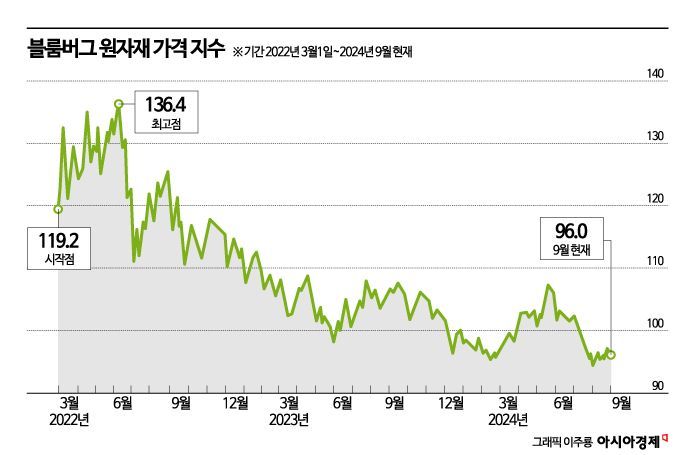
During this period, it succeeded in controlling commodity prices. The Bloomberg Commodity Index, which tracks prices of 24 commodities, has fallen from 119.2 in March 2022 to 96.0 currently.
Will Commodity Prices Rise with Interest Rate Cuts?
With the U.S. likely entering an interest rate cut cycle this month, there are forecasts that prices across commodities may show an upward trend. The British weekly magazine The Economist explained on the 2nd, "In a 'good easing cycle' that begins with inflation under control and healthy economic growth, demand for commodities tends to persist, causing initial price increases to last longer."
The most notable is gold. Gold prices have a strong inverse relationship with interest rates. When interest rates are cut, bank deposits become less attractive, leading to increased gold buying. Moreover, with two wars ongoing globally and major central banks increasing their gold holdings instead of the dollar?which could weaken?there are even expectations that gold prices could rise more sharply than anticipated.
According to Investing.com, international gold prices surpassed $2,500 per ounce last month, reaching an all-time high, and stood at $2,529 per ounce as of the 2nd. Mitsubishi UFJ Financial Group expects gold prices to reach $3,000 per ounce by next year.
Copper, nicknamed "Doctor Copper" for being a leading indicator of the real economy, is also expected to rise during the interest rate cut cycle. The Economist added that copper’s role in the global transition to green industries further increases its potential for price gains. As the world moves toward a green era, electricity is gaining attention, and copper is a key material used in manufacturing wires for power generation.
However, despite interest rate cuts, oil prices are expected to remain low due to oversupply. In October, the Organization of the Petroleum Exporting Countries (OPEC) and its allies, known as OPEC+, plan to increase oil production. The U.S., which is outside the oil cartel, continues to raise its output. Meanwhile, demand is not increasing as China, the largest consumer, is experiencing a slow recovery in its domestic economy, supporting the outlook for continued low oil prices.
At the New York Mercantile Exchange, the near-month October delivery West Texas Intermediate (WTI) crude oil closed at $73.55 on the 30th of last month, down 3.1%. Oil prices fell 5.6% last month alone and have been weak for two consecutive months.
Coal, grains, and other bulk commodities are considered the least sensitive to interest rates. These "bulk materials" are known to be more influenced by local factors such as seasonal inventory cycles and weather conditions.
© The Asia Business Daily(www.asiae.co.kr). All rights reserved.

















