Government Starts Daily Emergency Medical Briefings from Today
23 Emergency Rooms in Crisis Being Monitored Daily
The government will deploy more than 200 military doctors and public health doctors to hospitals with restricted emergency room operations starting from the 4th. It also emphasized that although some emergency rooms are currently facing operational difficulties, there is no situation that warrants concern about collapse.
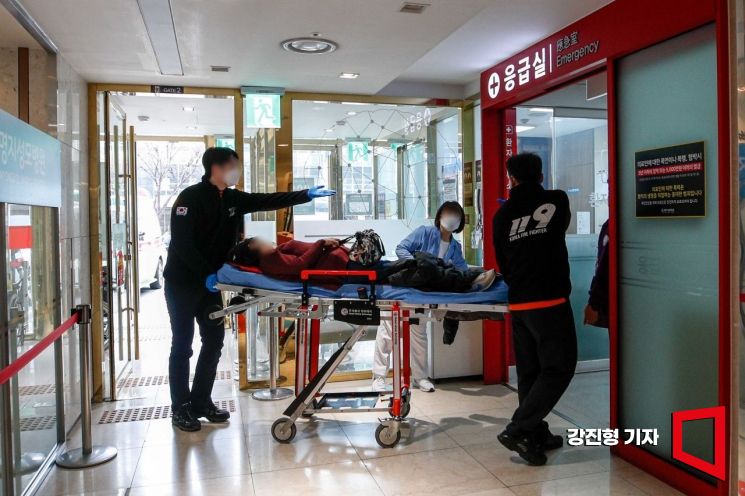 On the 11th, as collective actions by doctors, mainly residents, continue, a patient is entering the emergency room at a secondary general hospital in Seoul. Photo by Jinhyung Kang aymsdream@
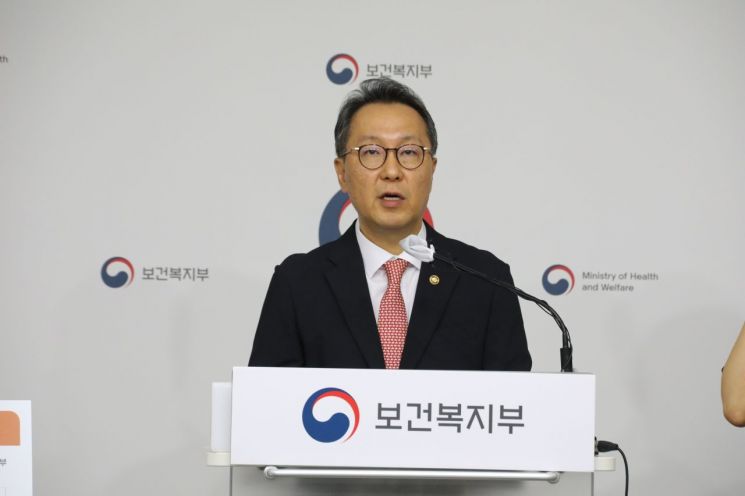
On the 2nd, Park Min-su, the 2nd Vice Minister of the Ministry of Health and Welfare, stated at a daily briefing on emergency medical care and emergency response held at the Government Complex Sejong, "The government will start a daily emergency medical care briefing from today to provide the public with more detailed information about emergency medical care," adding, "Although concerns have been raised recently about shortened operations at some emergency medical institutions in certain regions, the government plans to respond swiftly with additional measures."
Deployment of Military Doctors and Public Health Doctors
The government’s policy is to promptly deploy substitute personnel such as military doctors and public health doctors to emergency rooms facing operational crises.
Vice Minister Park explained, "Due to the absence of residents and other factors, the capacity of emergency rooms and follow-up care has decreased to about 70-80% of normal levels, creating difficult conditions," but added, "However, it is not true that the number of emergency room staff has been reduced to less than half, as some claim." He continued, "The government will carefully deploy personnel such as military doctors and public health doctors mainly to institutions facing operational difficulties and utilize nearby regional emergency centers to minimize disruptions in the treatment of severe and emergency patients."
Accordingly, a total of 15 military doctors will be deployed to medical institutions with partially restricted emergency room operations on the 4th of this month, and about 235 military doctors and public health doctors will be concentrated in high-risk institutions in eight dispatch phases starting from the 9th. Jung Dong-ryong, Director of Public Health Policy at the Ministry of Health and Welfare, said, "Although this may change at the last minute, some of the 15 military doctors dispatched immediately this time will include emergency medicine specialists."
The government will also share medical personnel capable of emergency or follow-up care by region and expand the rotation duty system to promptly meet regional emergency medical care demands. From the 11th to the 25th, about two weeks will be designated as the Chuseok holiday emergency response period, during which all efforts will be made to minimize disruptions in the treatment of severe and emergency patients.
Vice Minister Park urged, "We ask the public to refrain from using large hospitals and instead use local clinics and hospitals for less urgent and less severe patients."
"Emergency Rooms Where Specialists Resigned Are Improving"
The government judged that, considering the overall emergency medical capacity, the 'emergency room collapse' situation raised by some is not the case. Among all emergency medical institutions, 23 are particularly at risk of operation, and the government has assigned a person in charge at each hospital to monitor the situation daily.
According to the Ministry of Health and Welfare, out of 409 emergency rooms, 406 (99%) operate 24 hours a day, and 27 (6.6%) operate with reduced beds. As of the 30th of last month, the number of emergency medical institution beds was 5,918, which is 97.5% of the usual 6,069 beds in the first week of February.
Based on reports to the Health Insurance Review and Assessment Service, the number of emergency medicine specialists at 180 regional and local emergency medical centers slightly increased from 1,504 in December last year to 1,587 as of the 26th of last month. However, due to the collective resignation of residents, the total number of doctors working in emergency rooms was only 73.4% of the usual level.
Some regional and local emergency medical centers are experiencing difficulties due to specialist resignations, but the Ministry of Health and Welfare explained that the situation is improving.
Currently, three hospitals?Konkuk University Chungju Hospital, Kangwon National University Hospital, and Sejong Chungnam National University Hospital?are operating emergency rooms with reduced hours. According to the Ministry of Health and Welfare, Konkuk University Chungju Hospital initially had seven planned resignations, but two returned after persuasion by local governments and the hospital. Although the emergency room operation was at risk of suspension, currently only night and weekend operations are restricted. Kangwon National University Hospital and Sejong Chungnam National University Hospital will restrict adult night care starting today but plan to operate normally during the Chuseok holiday.
Vice Minister Park said, "I heard that Ewha Mokdong Hospital was facing difficulties, but I have been informed that the situation has been resolved and there are no immediate problems," adding, "We are individually assessing and closely monitoring the situations at other institutions as well."
Regarding the criticism that there is a large gap between field opinions and the government’s judgment, he said, "If you look closely, there may be difficulties, and the government does not deny this," adding, "We are encouraging local governments to establish regional cooperation systems, and through this, the problems can be resolved."
More Than 4,000 Hospitals on Duty Compared to This Year's Lunar New Year
As the Chuseok holiday approaches, the number of emergency room visits increased last month due to factors such as the resurgence of COVID-19. According to the Ministry of Health and Welfare, the average daily number of emergency room visits during normal times was 17,892, but it rose to 19,783 in the third week of last month. In particular, the number of mild and non-emergency patients classified as levels 4-5 under the Korean Triage and Acuity Scale (KTAS) increased from 8,285 to 8,541 during the same period.
It is also concerning that emergency room visits typically surge during holidays. According to the Ministry of Health and Welfare, emergency room visits during last year’s Chuseok holiday increased by 72% compared to the previous week. The proportion of mild patients rose from 50.4% in the week before Chuseok to 60.7% during the holiday.
Accordingly, the government plans to designate more than 4,000 hospitals and clinics on duty during this Chuseok holiday, which is about 400 more than during this year’s Lunar New Year holiday. Director Jung explained, "If there is a shortage of applications for duty hospitals and clinics, according to the Emergency Medical Service Act, the Minister of Health and Welfare, provincial governors, and city/county/district heads can separately designate duty institutions by type of medical institution and medical specialty."
Vice Minister Park emphasized, "The current emergency medical care problems, such as the shortage of medical personnel, are structural issues accumulated over a long period due to delayed medical reform," adding, "Fundamental solutions require comprehensive medical reform to proceed simultaneously."
Meanwhile, the government plans to promptly improve health insurance fees to prevent the outflow of emergency medical personnel and strengthen follow-up care capacity. The 250% additional fee for emergency room specialist consultations and the 200% additional fee for follow-up care including surgery, treatment, and anesthesia will be finalized quickly after the Health Insurance Policy Deliberation Committee meeting scheduled for this week.
A supply and demand forecasting organization for medical personnel will also be launched promptly, with committee member recommendations beginning this month. Vice Minister Park said, "The medical school quota for the 2026 academic year has already been reflected in the university entrance examination plan, but if the medical community proposes reasonable measures, we are open to discussion."
© The Asia Business Daily(www.asiae.co.kr). All rights reserved.


















