First Presidential Absence Since the 6th Republic
Chairman Woo Won-sik "Regret President Yoon's Absence"
Children of Anti-Communist Special Committee Chair and Descendants of Koryoin Attend
The 22nd National Assembly held its opening ceremony about three months after the start of its term. This is the latest opening ceremony since the establishment of the Sixth Republic system following the 1987 constitutional amendment. President Yoon Suk-yeol did not attend the opening ceremony, which is also the first time since the Sixth Republic.
On the 2nd, Speaker Woo Won-sik said at the National Assembly opening ceremony, "The 22nd National Assembly is holding a belated opening ceremony along with the start of the first regular session of its term," and added, "We apologize to the people." Regarding President Yoon's absence, he commented, "There was a rare meeting between the leaders of the two major parties, and it would have been good for the public if the president had attended the opening ceremony, so it is truly regrettable." Chief Justice Cho Hee-dae of the Supreme Court and Constitutional Court Chief Justice Lee Jong-seok attended from the judiciary, and Prime Minister Han Duck-soo attended from the executive branch.
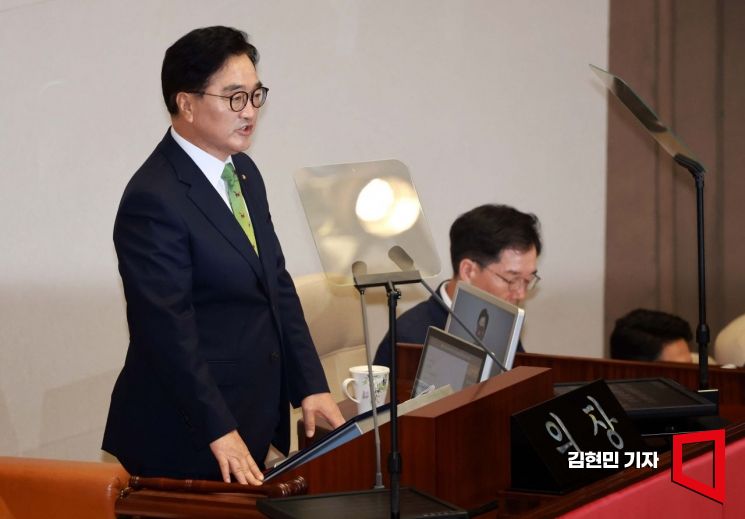 Speaker Woo Won-sik is delivering the opening address at the inauguration ceremony of the 22nd National Assembly and the opening ceremony of the 418th National Assembly (regular session) held on the 2nd at the National Assembly plenary hall. Photo by Hyunmin Kim kimhyun81@
Speaker Woo requests a "progressive attitude" from the government... also targets pro-Japanese controversies
Speaker Woo said, "Democracy can only be fully realized through the separation of powers," and added, "We must strengthen the National Assembly's primary role of legislation and check the executive branch from the people's perspective." He continued, "I also ask the government to show a responsible and progressive attitude," and emphasized, "I reiterate, without respecting the National Assembly, it is impossible to achieve results in state affairs." This was interpreted as a remark targeting President Yoon's absence from the opening ceremony and his repeated use of the veto power against bills promoted by the opposition party.
At the National Assembly opening ceremony that day, Kim Jeong-ryuk, vice chairman of the Republic of Korea Provisional Government Commemorative Project Association and son of Kim Sang-deok, chairman of the Special Investigation Committee on Anti-National Acts of the Constituent National Assembly, as well as descendants of the Koryo-saram who were forcibly relocated to the Maritime Province during the Japanese colonial period, also attended. Speaker Woo's invitation to these individuals was also seen as an acknowledgment of the government's 'pro-Japanese controversy,' 'New Right personnel controversy,' and 'General Hong Beom-do controversy.' Woo stated, "The anti-Japanese independence movement is the starting point of our constitution, which declared popular sovereignty. That history has shaped the nation's identity and become a source of pride for the people," and added, "The National Assembly has the duty to protect and inherit the history and spirit of the independence movement. With those who joined us today, the 22nd National Assembly will remember the painful history and move forward into the future."
Speaker Woo proposes constitutional amendment dialogue to President Yoon... also mentions electoral reform
Speaker Woo also proposed a dialogue for constitutional amendment to President Yoon, saying, "I hope the president's decision can open the blocked path." Woo emphasized, "The constitutional amendment referendum should be held by the local elections at the latest next year. This is a realistic way to achieve the amendment, free from political misunderstandings. Let's discuss it in earnest."
He raised the necessity of amending the constitution to fit current realities, as 37 years have passed since the 9th constitutional amendment in 1987. Woo said, "We have failed to reflect past changes and create a path for future changes, so reality has lost its way. This cannot continue. We must end the cycle of repeated constitutional amendment discussions that end up going nowhere." He added, "We must not waste the first two years of the 22nd National Assembly's first half before entering the full-scale presidential election phase," and urged, "I propose again to both ruling and opposition parties to keep the scope and timing of the amendment open, but hold the constitutional amendment referendum by the local elections at the latest next year."
Speaker Woo also urged immediate discussion of electoral reform in the National Assembly. He said, "No one opposes an electoral system that strengthens proportionality, representation, and diversity," and added, "We must create a pluralistic party system that fully reflects vote shares in seat allocation and embraces diverse public opinions. This is the way out of polarized politics." He warned, "The closer the general election approaches, the harder it becomes. Then, electoral districts are drawn at the last minute, resulting in blind elections," calling it "a serious infringement on the people's right to participate." He requested, "Let's start discussions immediately so that political reform does not remain just a declaration this time."
Emphasizing the National Assembly's role for people's livelihood... proposes social dialogue on medical crisis
Speaker Woo emphasized the National Assembly's role in addressing people's livelihood issues such as worsening economic sentiment and the medical crisis. He pointed out, "People's livelihood is not a number; it is the field. It is not the livelihood seen behind walls or at desks," and stressed, "We must embrace people's livelihood immediately." This was to highlight that despite improving economic indicators, the worsening economic sentiment requires the National Assembly to take the lead for the people's livelihood.
Regarding the resolution of the medical service gap caused by conflicts between the government and medical professionals, he urged the government to have a realistic sense and conduct proactive reviews tailored to the field and the public. Woo said, "The medical service gap caused by the conflict has continued for six months," and criticized, "It started in the name of reform, but the reality the people face is hospitals without doctors."
He continued, "Emergency patients are losing their lives while searching for emergency rooms, and now the public's anxiety that they must not get sick is growing daily. Even medical personnel remaining in emergency medical sites say they can no longer endure," and criticized, "However, the government says the emergency medical system is functioning smoothly. This is very different from the reality felt by the people."
Speaker Woo called for the government, ruling and opposition parties, medical stakeholders, patients, and victims to come together and find solutions with determination, saying, "Many lawmakers across party lines are deeply concerned, so please join in creating a forum for social dialogue."
He also urged the ruling and opposition parties, which have recently fostered a cooperative atmosphere by passing 28 people's livelihood bills at the August extraordinary session and holding a ruling-opposition leaders' meeting for the first time in 11 years the day before, to promptly produce results on various livelihood issues.
Speaker Woo mentioned bills with little difference in opinion between the ruling and opposition parties, such as easing debt burdens for small business owners, expanding parental leave, responding to deepfake sex crimes, supporting vulnerable groups in the climate crisis, responding to electric vehicle fires and safety measures, and delayed settlements of T-mep (Timon and Wemakeprice), and requested, "Let's create a National Assembly that embraces people's livelihood by promptly carrying out the matters both parties have promised." He also argued that economic actors such as small and medium enterprises, self-employed persons, franchise stores, agencies, and platform tenants should be granted bargaining rights, calling it "a means to create a 'balance of power' and improve unfair practices."
Furthermore, regarding pension reform, Speaker Woo said, "There was significant progress in the 21st National Assembly. The ruling and opposition parties have virtually agreed on the extent of the insurance premium increase," and proposed, "Let's not revert the hard-won results to square one and proceed sequentially with discussions on the agreed parts." He also said, "Let's make the 22nd National Assembly a 'climate assembly,'" urging the prompt establishment of a National Assembly Climate Special Committee and granting it the authority to review related bills and budget and settlement deliberations to make it a committee that leads substantial change.
© The Asia Business Daily(www.asiae.co.kr). All rights reserved.

















