About 13,500 Non-specialized Nurses Working as PAs
"It's Difficult to Suddenly Require Training for Existing PA Nurses"
As the Nursing Act, which legalizes Physician Assistant (PA) nurses, has passed the National Assembly, it appears that nurses who have been performing PA duties without having completed related education or without a specialized nurse license will continue their existing work without separate procedures. Some argue that measures are needed to address the decline in medical quality due to a lack of expertise.
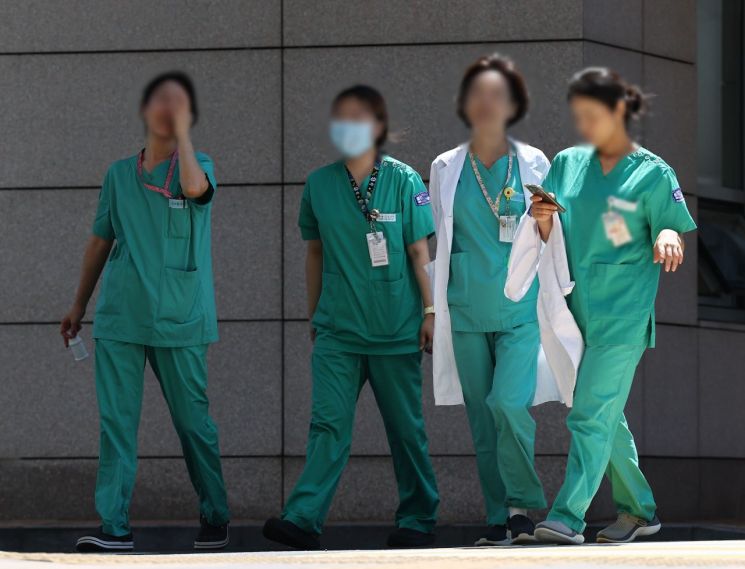 Nurses are walking at a large hospital in Seoul on the 28th of last month, when the Nursing Act bill, which aims to legally protect the medical acts of Physician Assistant (PA) nurses, passed the National Assembly's Health and Welfare Committee.
 [Image source=Yonhap News]
On the 3rd, Park Hyerin, Director of the Nursing Policy Division at the Ministry of Health and Welfare, said in a phone interview with Asia Economy, "Nurses who have been performing PA duties will be allowed to continue their work as a transitional measure," adding, "When new PA nurses are produced, they will have to follow the regulations to be established." Park also noted, "For example, it is difficult to suddenly require those who have been performing PA duties for 10 years to undergo education."
According to Article 14 of the Nursing Act, which passed the plenary session of the National Assembly on the 28th of last month, nurses who wish to perform PA duties must hold specialized nurse qualifications or qualifications based on clinical experience and completion of an educational course as prescribed by the Ministry of Health and Welfare Ordinance.
Specialized nurses are the only nursing personnel, aside from nurses, whose qualifications are explicitly recognized under the Medical Service Act. To become a specialized nurse, one must complete a master's degree program of more than two years and pass a qualification exam administered by an institution commissioned by the Ministry of Health and Welfare. Approximately 400 specialized nurses are certified annually through the qualification exam, and as of last year, there were 17,346 certificate holders.
It is understood that a significant number of nurses currently performing PA duties are not specialized nurses. The Ministry of Health and Welfare estimates about 14,000 active PA nurses, the Korean Nurses Association estimates about 16,000, and the Korean Association of Specialized Nurses also reports that more than 13,500 nurses, in addition to specialized nurses, are performing PA duties as dedicated nurses.
In a recent paper titled "Legal and Rational Solutions for the Expanded Duties of Physician Assistants," published in the August issue of the international journal Journal of Korean Academy of Nursing by Professor Choi Sujeong of Sungkyunkwan University Graduate School of Clinical Nursing and Professor Kim Minyoung of Jeju University Department of Nursing, it was diagnosed that PA nurses have steadily increased in Korea to compensate for the shortage of physicians, and in small-scale hospitals, newly graduated nurses are often appointed as PA nurses.
The paper pointed out that a similar pattern continues even after the Ministry of Health and Welfare's "Pilot Project on Nursing Duties" in March, which recommended more than three years of clinical experience. In urgent situations where medical gaps must be filled, each medical institution focuses on immediately deploying PA personnel to practical work rather than on long-term operational systems, educational systems, or quality management of PA personnel.
Because of this, concerns have been raised about the decline in medical quality due to the lack of expertise of existing PA nurses. Choi Sujeong, president of the Korean Association of Specialized Nurses, said, "No one can say it is okay just because someone has 10 years of experience without any qualifications," and explained, "No matter how much clinical proficiency one has, there are subjects that must be studied, and objectively proving sufficient knowledge is done by obtaining a license or qualification." She emphasized, "We need to move toward a direction that ensures sufficient expertise, even if it means granting special exceptions to those who have been performing PA duties to facilitate obtaining specialized nurse qualifications."
© The Asia Business Daily(www.asiae.co.kr). All rights reserved.

















