Opening Ceremony and Regular National Assembly Session Held on the 2nd
Legislation and Budget Review Scheduled for 100 Days
The first regular session since the launch of the 22nd National Assembly has begun. The opening ceremony, which had been unable to take place due to extreme confrontations between the ruling and opposition parties, was barely held. Although the National Assembly is showing a thawing mode for the first time in a while, such as holding talks between party leaders, a thorny path is expected.
On the afternoon of the 2nd, the National Assembly held a plenary session to hold the opening ceremony of the 22nd National Assembly as well as the opening ceremony of the September regular session. This marks the longest delayed opening ceremony in history. Previously, the 21st National Assembly held its opening ceremony on July 16, but this time, the ceremony was held 95 days after the launch of the National Assembly, much later than before.
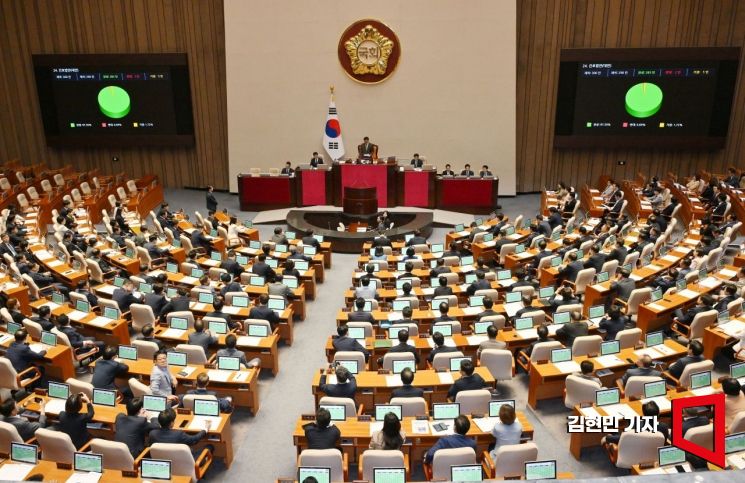
Starting with the opening ceremony, the National Assembly entered a 100-day regular session schedule. On the 4th and 5th, Park Chan-dae, floor leader of the Democratic Party, and Choo Kyung-ho, floor leader of the People Power Party, will deliver speeches as representatives of the negotiation groups. Then, from the 9th to the 12th, a four-day government questioning session will be held. Each standing committee will review budgets and bills. Ahead of the regular session, the People Power Party announced 170 major bills in six areas including the livelihood economy, low birthrate, and medical reform. The Democratic Party also announced that it would push 165 bills in areas such as the economy and population extinction at the party level. Legislative work between the ruling and opposition parties is expected to be difficult. Both sides emphasize 'livelihood legislation,' but their positions differ greatly.
For now, the ruling and opposition parties have agreed to hold a plenary session on the 26th after reviewing bills. However, the plenary session is expected to see clashes as it will also deal with re-votes on the four broadcasting laws, the Yellow Envelope Act, and the nationwide 250,000 won support law, all of which President Yoon Seok-yeol has exercised his veto power on.
From October 7 to 25, a 19-day audit of state affairs will be conducted. During the audit, confrontations between the ruling and opposition parties are expected over various suspicions related to First Lady Kim Geon-hee, the East Sea oil field development allegations, and the Chae Sang-byeong special prosecutor law. In addition, the opposition has expressed intentions to push for 'two special prosecutors (Chae Sang-byeong and First Lady Kim special prosecutor laws)' and 'four parliamentary investigations (Chae Sang-byeong, Seoul?Yangpyeong Expressway, broadcasting control, East Sea oil field development allegations),' making clashes inevitable. Pension reform is also likely to become a contentious issue.
The ruling and opposition parties are also expected to clash over the budget bill. The opposition has announced plans for a major cut related to the budget. Jin Sung-jun, policy chief of the Democratic Party, said, "Once the government formally submits next year's budget bill to the National Assembly, we will begin a microscopic review," adding, "We will block tax cuts for the wealthy and cut unnecessary budgets so severely that it will cause an outcry."
© The Asia Business Daily(www.asiae.co.kr). All rights reserved.

















