The Supreme Court has ruled that even if a commercial building landlord with an actual reconstruction plan limits the lease period for a prospective new tenant, preventing the existing tenant from recovering the key money, this cannot be regarded as an 'act of obstructing key money recovery.'
According to the legal community on the 2nd, the Supreme Court's First Division (Presiding Justice Seo Kyunghwan) overturned the appellate court's partial ruling in favor of tenant A in a damages lawsuit against landlord B and remanded the case to the Seoul Southern District Court.
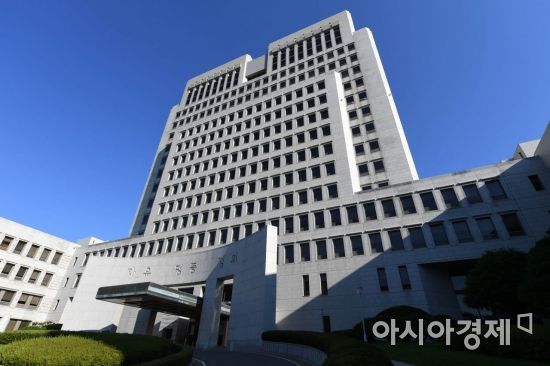
The court stated, "The appellate court erred in its interpretation of 'acts of obstructing key money recovery' as defined in Article 10-4, Paragraph 1, Subparagraph 4 of the Commercial Building Lease Protection Act, which affected the judgment," as the reason for the reversal and remand.
A, who had been operating a restaurant on the first floor of a building on Yangcheon-ro in Gangseo-gu, Seoul since 2016, signed a lease contract with landlord B in April 2018 for a lease period of three years from July 1, 2018, to June 30, 2019, and then entered into a new lease contract in June 2021 extending the lease period until June 30, 2022. Subsequently, the lease period was automatically extended by tacit renewal on July 1, 2022.
On August 26, 2022, A signed a contract to transfer all facilities and rights of the restaurant to C, who intended to take over the restaurant, for a key money of 70 million KRW, and requested B to enter into a lease contract with C.
However, B notified C that a lease contract could only be concluded for a three-year lease period due to plans to reconstruct the building, and as a result, C gave up on taking over the restaurant. Since the key money contract with C fell through, A had to return the store to B without recovering the key money and filed a lawsuit against B. A claimed that B should pay the 70 million KRW key money that A could not recover because B refused to enter into a lease contract with C.
In the first trial, since B did not respond to the lawsuit, A's claim was accepted as is. However, the court dismissed the claim for delay interest on the day of service of the complaint copy, reasoning that delay interest on the 70 million KRW key money would accrue from the day after the service of the complaint copy.
The appellate court ruled that B's actions constituted an act of obstructing key money recovery and ordered B to pay approximately 20 million KRW in damages.
The court stated, "The defendant clearly expressed an intention to refuse to arrange a new tenant for the plaintiff without justifiable reason, thereby obstructing the plaintiff's opportunity to recover key money from C, who intended to become the new tenant. Therefore, the defendant is liable to compensate the plaintiff for the damages incurred."
The court judged that it was difficult to consider the reconstruction plan as finalized because B only vaguely mentioned the reconstruction timing as around the end of 2025 and did not notify specific demolition or reconstruction plans.
However, the court recalculated the damages according to the proviso in Article 10-4, Paragraph 3 of the Commercial Building Lease Protection Act, which states that the amount of damages for obstructing key money recovery cannot exceed the lower of the key money agreed to be paid by the new tenant or the key money at the end of the lease.
The court calculated the key money at the end of the lease as 24.97 million KRW (sum of 7.2 million KRW for tangible property appraisal and 17.77 million KRW for intangible property appraisal) and ruled that B should compensate 19.976 million KRW, 80% of the damages, for equitable distribution of loss.
However, the Supreme Court's judgment differed.
The court found that "39 years have passed since the building received its occupancy approval, and B has left a significant portion of the building, including A's restaurant, vacant for reconstruction. The contracts with tenants include a special clause stating 'no lease after August 2025 due to planned reconstruction,' recognizing the necessity of reconstruction and the sincerity of B's intention."
Furthermore, the court concluded, "B's notification generally aligns with specific reconstruction plans and schedules, and it is difficult to view it as imposing unreasonable conditions on prospective new tenants. Therefore, B's notification cannot be regarded as an act of obstructing key money recovery under the Commercial Building Lease Protection Act."
© The Asia Business Daily(www.asiae.co.kr). All rights reserved.

















