The People's Bank of China purchased government bonds worth approximately 19 trillion Korean won in the open market to manage the bond market and stabilize the economy. This marks the first time in about 20 years that government bonds have been traded in the open market.
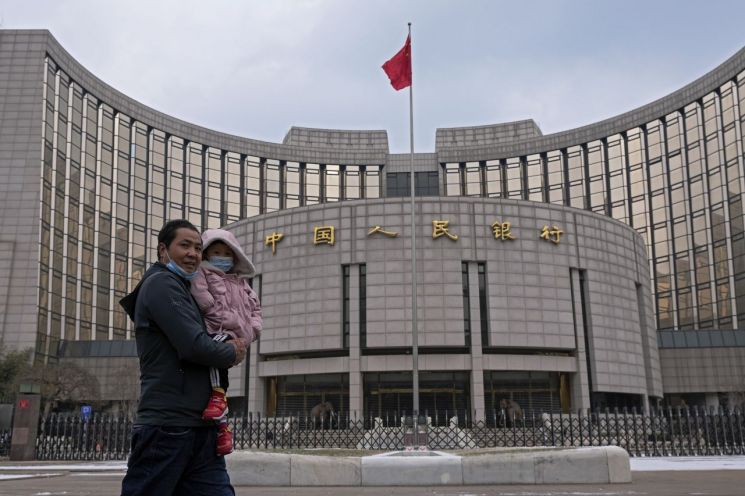 A pedestrian is passing by holding a child in front of the People's Bank of China building in Beijing, China.
 [Photo by AP Yonhap News]
The Open Market Operations Office of the People's Bank of China stated on the 30th, "To implement the requirements of the Central Financial Work Conference held last October, the People's Bank conducted open market operations involving government bonds this month, purchasing short-term government bonds from some primary dealers in the open market and selling long-term government bonds," adding, "The net monthly purchase amount of government bonds was 100 billion yuan (approximately 18.8 trillion Korean won)."
The People's Bank of China’s use of the method called 'open market government bond operations' is considered unusual. On the bank’s official website, a new section titled 'Open Market Government Bond Operations Announcement' was added on the 28th, and this announcement is the first under that section.
The Hong Kong South China Morning Post (SCMP) evaluated, "China's central bank has conducted government bond transactions in the open market for the first time in nearly 20 years, unveiling a long-awaited monetary tool aimed at managing the domestic bond market and stabilizing the economy."
Recently in China, despite concerns over economic slowdown and sluggish stock markets, investors including banks have been flocking to government bonds amid the government's bond issuance plans.
As a result, the yield on China's 10-year government bonds hit a record low closing rate of 2.12% earlier this month and only recovered to around 2.17% after intervention by authorities. A decline in bond yields indicates a rise in bond prices.
The issue is that Chinese authorities have increased bond issuance in recent years to stimulate the economy, and large-scale issuance of national and local government bonds is expected within this year.
According to official government statistics and state media reports, as of July, China has yet to issue more than half of the planned quota for local government bonds and ultra-long-term special government bonds for this year, with approximately 2.68 trillion yuan (about 502 trillion Korean won) in additional bond issuance pending.
Concerns have also been raised that if the ideal upward-sloping yield curve?where long-term bond yields are higher than short-term yields?continues to deviate, the profit-making ability of China's state-owned banks could be threatened.
Moreover, the second-quarter economic growth rate came in at 4.7%, below market expectations of 5.1%, raising 'red flags' about achieving this year’s growth target of around 5%. Additionally, the manufacturing Purchasing Managers' Index (PMI), which indicates economic trends, has shown a 'contraction' phase for three consecutive months through last month, signaling continued negative indicators.
Amid these circumstances, with the bond market also sending 'abnormal signals,' the People's Bank of China has stepped in directly to stabilize bond yields.
A financial market official in South Korea interpreted, "In China, the 'inversion phenomenon'?where short-term interest rates rise and long-term rates fall?is continuing, and the People's Bank of China has shown its intention to use price indicators (interest rates) as an important policy tool."
The People's Bank of China's announcement came a day after it disclosed that Governor Pan Gongsheng held a roundtable meeting with representatives from the Two Sessions (the National People's Congress and the Chinese People's Political Consultative Conference), experts, scholars, and financial company leaders.
According to the People's Bank, at the roundtable held on the 26th, Governor Pan stated, "The People's Bank will continue to maintain a stance of 'supportive monetary policy' in the next phase, strengthen counter-cyclical adjustments (macroeconomic policies that swiftly ease when the economy faces downward pressure and cool down overheating during upswings), comprehensively operate various monetary policy tools, and enhance financial support for the real economy."
He also said, "At the same time, we must study, stockpile, and increase policy measures, strengthen the adjustment and coordination of macro policies, and support a favorable posture for economic recovery."
© The Asia Business Daily(www.asiae.co.kr). All rights reserved.
![Clutching a Stolen Dior Bag, Saying "I Hate Being Poor but Real"... The Grotesque Con of a "Human Knockoff" [Slate]](https://cwcontent.asiae.co.kr/asiaresize/183/2026021902243444107_1771435474.jpg)











