Lieutenant Promotion Candidate Moon Hee-woo, Navy Lieutenant in the Spotlight
"I Will Grow into a Maritime Rescue Expert," He Declares Determination
South Korea's Navy has produced its first female deep-sea diver.
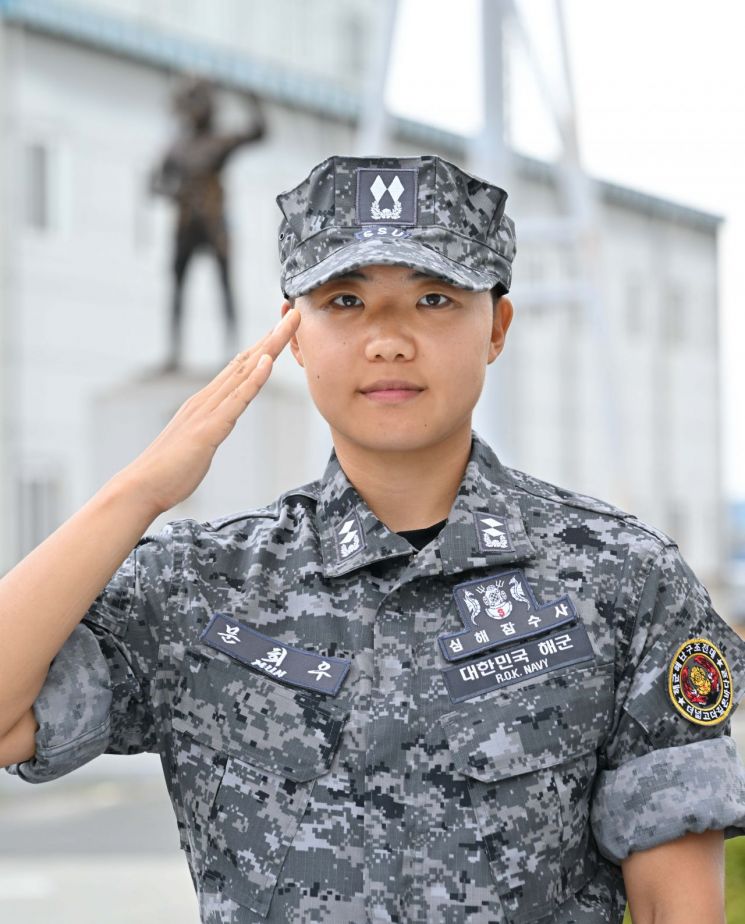
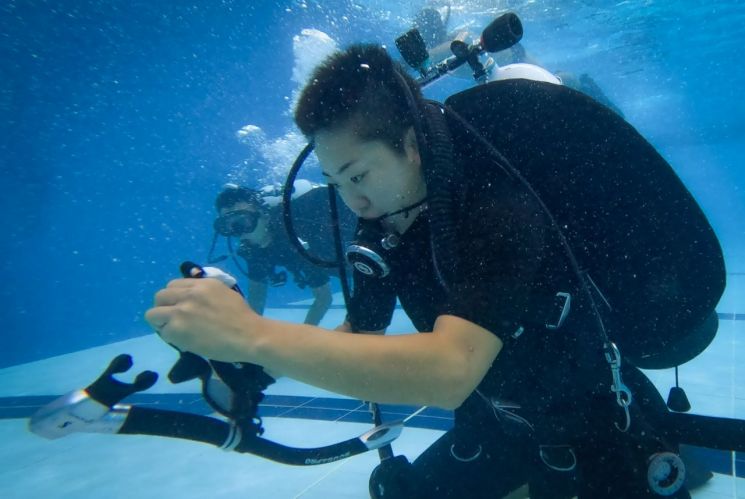
The Navy announced on the 30th that 64 trainees, including 9 officers, 24 non-commissioned officers, and 31 enlisted personnel, graduated from the Basic Course of the Special Salvage Unit (SSU) and became deep-sea divers.
Among them, Lieutenant Moon Hee-woo, who is scheduled for promotion to captain, earned the deep-sea diver badge as the first female in the Navy. Lieutenant Moon majored in Physical Education and Oceanography in college and entered the military as the 132nd class of Officer Candidate School, commissioning as a Navy second lieutenant in June 2022. She served as a navigator on the Daegu-class frigate and as a logistics planning officer at the Naval Education Command before applying for the basic salvage course this year.
Having been familiar with water since her college days, obtaining scuba diving and lifeguard certifications, she wanted to help others in the water and had a longing to become a deep-sea diver. Of course, it took courage to apply for the actual deep-sea diver course, but she wrote the application with the mindset that "a soldier does not give up without trying."
Female trainees were allowed to enter the basic salvage course with short hair. However, Lieutenant Moon, thinking that long hair might interfere with swimming and other training, cut her hair, which had reached her shoulders, to about 1 cm the day before enrollment.
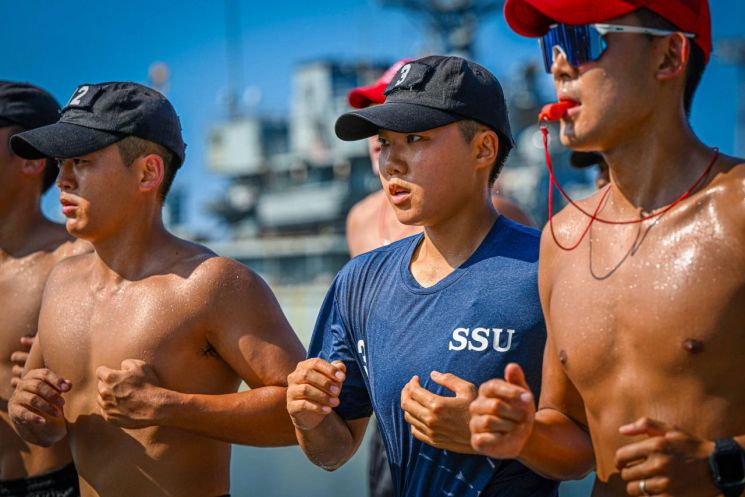
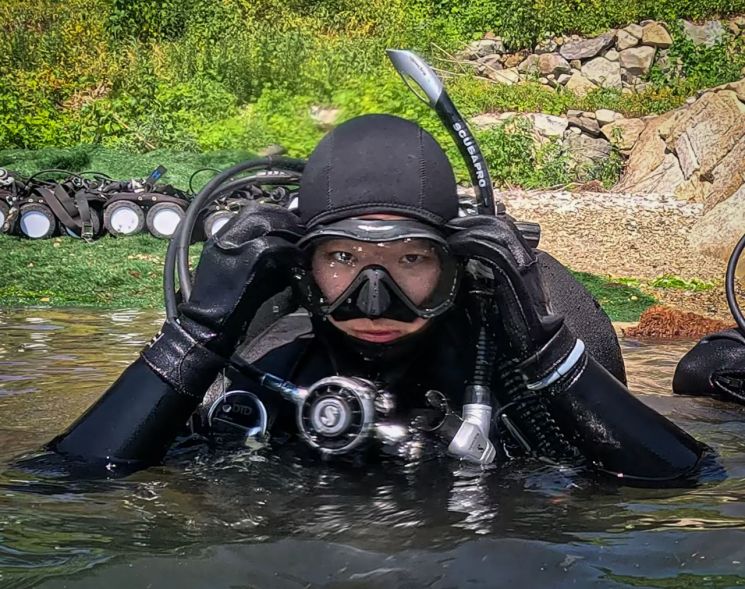
She said, "Throughout the training, I thought I made a good decision cutting my hair short, and it was so comfortable that I am considering keeping it that way." After passing the same physical fitness and swimming tests as male trainees, she entered the basic course. After enrollment, she said, "Every day felt like a test of my limits." Lieutenant Moon recalled, "I remember eating chocolate bread, energy bars, and candy during long-distance sea swims. Floating in the sea with seawater and sweet snacks entering my mouth together gave a 'sweet and salty' sensation that was more special than any gourmet dessert." Although she had been training physically for about a year since deciding to apply to the SSU, she said the life-saving training, where rescuers risk their own lives, was extremely tough.
Lieutenant Moon reflected, "Life-saving training starts after exhausting almost all physical strength through running, gymnastics, swimming, and wearing heavy gear. My body didn’t move as I wanted, and I swallowed a lot of water. My vision even turned white underwater."
Moreover, she was the oldest trainee, eight years older than the youngest classmate. Lieutenant Moon emphasized, "My physical recovery after training was slower, and I struggled to keep up with the physical training, but I never once thought about giving up." Having passed the same standards as male trainees and earning the title of "first female deep-sea diver," Lieutenant Moon said, "I am the first female deep-sea diver and will remain the only one until a new challenger emerges. I am determined to grow as a salvage expert so that juniors can see me and be inspired to take on the challenge."
The deep-sea divers who graduated that day underwent training for 12 weeks starting June 10. From weeks 1 to 6, they built basic physical strength and swimming skills through daily 7-hour swimming sessions, running 4 to 9 km, and special salvage gymnastics. The training included a 3-nautical-mile (about 5.5 km) swim without gear and a 4-nautical-mile (about 7.4 km) swim wearing fins and a mask. From week 7, they continued with daily 10 km runs, rubber boat operation training, and scuba diving training. From weeks 8 to 11, they practiced emergency escape, personal treatment, search training, and dives to depths of 60 feet (about 18 m) and 130 feet (about 39 m). Officers and non-commissioned officers who completed the basic course will undergo an additional 14 weeks of training to acquire the ability to dive up to 91 m using the Surface Supplied Diving System (SSDS).
© The Asia Business Daily(www.asiae.co.kr). All rights reserved.
![Clutching a Stolen Dior Bag, Saying "I Hate Being Poor but Real"... The Grotesque Con of a "Human Knockoff" [Slate]](https://cwcontent.asiae.co.kr/asiaresize/183/2026021902243444107_1771435474.jpg)


















