'New Frontiers of Fintech: ESG' Seminar
As the ESG (Environmental, Social, and Governance) trend sweeps through the financial sector, an analysis has emerged that the fintech (finance + technology) industry is also entering this market. It is argued that if the related industry enters the institutional framework and legislative efforts are added, the integration of fintech and ESG can be activated.
On the 29th, Seojungho, Senior Research Fellow at the Korea Institute of Finance, said at the ‘New Areas of Fintech: ESG’ seminar held at Dongdaemun Digital Plaza (DDP) in Jung-gu, Seoul, “While fintech companies have so far focused on remittance and payment functions, they will expand their scope to ESG in the future.”
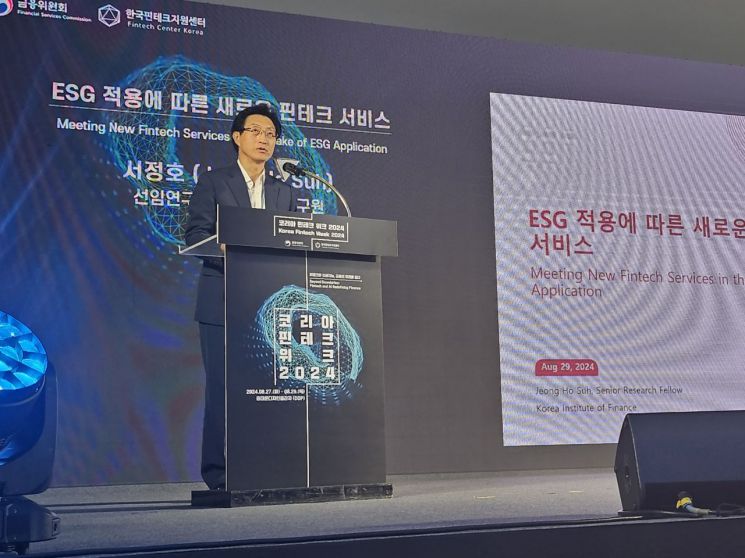 Seongho Seo, Senior Research Fellow at the Korea Institute of Finance, is presenting at the seminar "New Areas of Fintech: ESG" held on the afternoon of the 29th at Dongdaemun Design Plaza (DDP) in Jung-gu, Seoul.
 [Photo by Youngju Jeon ange@]
He cited the ‘Carbon Calculator’ launched in Egypt last December as an example. The Carbon Calculator is a service introduced through a partnership between global payment technology company Mastercard and Egyptian digital payment company MDP, which calculates and estimates the carbon footprint resulting from card payments. Senior Research Fellow Seo explained, “It can influence consumer behavior by showing the social impact each time a purchase occurs,” adding, “This information can also be provided through financial applications (apps). It is a service that can be introduced without much burden.”
Switzerland’s token securities (STO) ‘TreeCoin’ is also a successful case of fintech and ESG integration. TreeCoin issued a token called ‘Tree’ alongside a project to plant 10 million eucalyptus trees in Paraguay. One Tree token corresponds to one eucalyptus sapling and is known to have a value of about $23 (30,656 KRW). After about four years, when the eucalyptus is sold as timber, 40% of the profits are returned to Tree investors, and 50% is used for additional reforestation projects.
Senior Research Fellow Seo said, “TreeCoin is a socially meaningful model,” but added, “Token securities have not yet been legalized, so it will take time to introduce them domestically.” Kim Jeong-il, Head of the ESG System Risk Analysis Team at the Financial Market Stability Bureau of the Financial Supervisory Service, said, “The token securities-related bill was discussed in the 21st National Assembly but was discarded due to the expiration of the term,” adding, “Related discussions are re-emerging, and we hope that infrastructure will be established in the 22nd National Assembly.”
The role of fintech in the ESG field is evident not only in Environment (E) but also in Social (S) and Governance (G). Team Leader Kim said, “Credit evaluation models are being improved with fintech technology to expand financial support for vulnerable groups,” and added, “These models will continue to improve, and the Financial Supervisory Service plans to monitor this.” Senior Research Fellow Seo also explained, “In developing countries with low bank account ownership rates, fintech companies already play a significant role,” and “They are also helping to resolve polarization in middle-income and advanced countries.” He further added, “Fintech technology also helps meet the requirements of supervisory authorities related to governance and internal control.”
At the seminar, there was also a claim that to grow ESG businesses in the fintech industry, the definitions of ‘ESG Fintech’ or ‘Green Fintech’ must first be clarified. Yoon Taehwan, CEO of Root Energy, said, “Because Green Fintech is an industry not included in the standard industrial classification, early startups find it difficult to receive venture capital (VC) investment or persuade limited partners (LPs),” and suggested, “It would be good to establish a foundation for the activation of Green Fintech by clearly defining it or revising the standard industrial classification.”
Senior Research Fellow Seo also emphasized, “The first thing financial authorities should do is define what Green Fintech really is.” He expressed concern, saying, “There is a need to strengthen ESG funds such as climate technology support funds or fintech innovation funds,” but warned, “If there is no definition or statistics related to Green Fintech, even if support is desired, it could become a policy in name only.”
© The Asia Business Daily(www.asiae.co.kr). All rights reserved.

















