All Judges Unanimously Declare "Article 8, Paragraph 1 of the Carbon Neutrality Act Unconstitutional"
Strengthened Climate Measures Must Be Established by March 2026
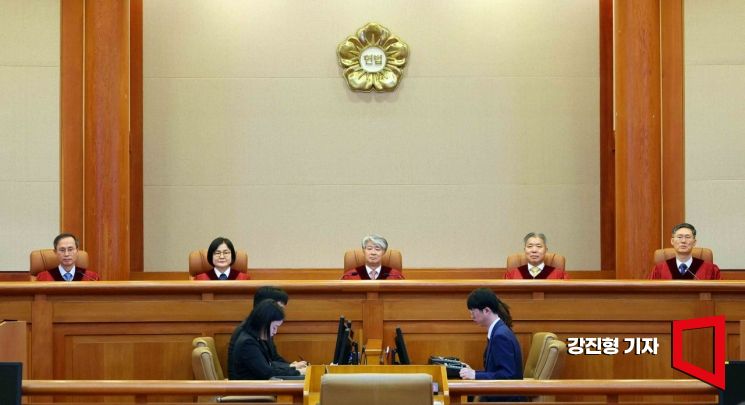 Chief Justice Lee Jong-seok of the Constitutional Court and other constitutional justices entered and took their seats in the Constitutional Court courtroom in Jongno-gu, Seoul, where the constitutional complaint and unconstitutionality law trial were held on the afternoon of the 29th. Photo by Kang Jin-hyung aymsdream@
The Constitutional Court has ruled that the Carbon Neutrality Basic Act, which does not present greenhouse gas reduction targets beyond 2031, is not in accordance with the Constitution.
At around 3:26 p.m. on the same day, the Constitutional Court unanimously declared that Article 8, Paragraph 1 of the "Carbon Neutrality and Green Growth Basic Act (Carbon Neutrality Basic Act)" is "not in accordance with the Constitution" among four constitutional complaints on climate litigation filed by infants, youth, and civic groups.
Article 8, Paragraph 1 of the Carbon Neutrality Act stipulates that the national greenhouse gas emissions must be reduced by more than 35% compared to 2018. The government set a target to reduce greenhouse gas emissions by 40% by 2030, but there is no standard beyond 2031.
The Constitutional Court stated, "(The provision) does not present any form of strategic level reduction targets from 2031 to 2049," and added, "It violates the duty to protect fundamental rights by contravening the principle of minimum protection and the principle of legal reservation, thereby infringing on the petitioners' environmental rights."
The principle of minimum protection means that the state must take at least minimal protective measures to safeguard the basic rights of the people, and the principle of legal reservation means that administrative actions must have a legal basis.
According to the Constitutional Court's decision, the provision will be suspended after February 28, 2026. Until then, the government and the National Assembly must establish stronger climate measures.
However, the court dismissed the petitioners' claim that the greenhouse gas reduction target set until 2030 is too low and infringes on the basic rights of the people.
This lawsuit was filed by youth, infants, and civic groups starting in 2020. It is Asia's first climate lawsuit dealing with the national greenhouse gas reduction targets.
© The Asia Business Daily(www.asiae.co.kr). All rights reserved.
![Clutching a Stolen Dior Bag, Saying "I Hate Being Poor but Real"... The Grotesque Con of a "Human Knockoff" [Slate]](https://cwcontent.asiae.co.kr/asiaresize/183/2026021902243444107_1771435474.jpg)
















