Financial Authorities Hold 4th Real Estate PF Soft Landing Measures Review Meeting
Delinquency Rate of PF Loans Across All Financial Sectors at 3.56%, Up 0.01%p from 1Q
Securities Industry PF Delinquency Rate Exceeds 20%... "3.3 Trillion Won Restructuring Fund to Be Established"
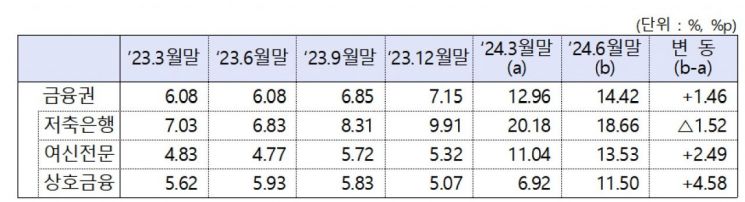 Loan Delinquency Rate on Land Collateral (Source: Financial Services Commission, Financial Supervisory Service)
The outstanding balance of second-tier financial sector land-secured loans (Tosamdae) has decreased, but the delinquency rate has exceeded 14%. In particular, while the overall project financing (PF) delinquency rate in the financial sector slightly rose to 3.56%, the delinquency rate in the securities industry, centered on bridge loan delinquencies, exceeded 20%.
On the 29th, financial authorities held the '4th Real Estate PF Soft Landing Measures Review Meeting' and disclosed the PF loan and Tosamdae delinquency rates as of the second quarter of this year. The financial authorities began publishing these figures from the first quarter to coincide with the full-scale implementation of PF soft landing measures.
According to the aggregation results, as of the end of June this year, the outstanding balance of second-tier financial sector Tosamdae was 24.1 trillion KRW, down 3.9 trillion KRW from the end of March. However, the Tosamdae delinquency rate for the second quarter recorded an unstable trend, rising 1.46 percentage points (P) from the previous quarter to 14.42%. Compared to the same period last year, it was 8.34 percentage points higher. The delinquency rate for savings banks’ Tosamdae fell 1.52 percentage points from the previous quarter to 18.66%. Specialized credit finance companies recorded 13.53%, and mutual finance cooperatives 11.50%, rising 2.49 percentage points and 4.58 percentage points respectively during the same period.
The total PF loan balance across all financial sectors, including banks, securities, and insurance, was 132.1 trillion KRW. While the overall PF loan delinquency rate rose slightly by 0.01 percentage points from the previous quarter to 3.56%, the securities industry’s PF loan delinquency rate surged to 20.02%, up 2.45 percentage points from the previous quarter. In response, the securities industry announced at the meeting that it would establish a 3.3 trillion KRW PF restructuring fund, with 600 billion KRW coming from securities firms’ own capital.
By sector, the PF loan delinquency rates for banks, insurance, and savings banks rose by 0.16 percentage points, 0.28 percentage points, and 1.26 percentage points respectively. Meanwhile, specialized credit finance companies and mutual finance cooperatives saw decreases of 0.89 percentage points and 2.81 percentage points respectively.
Regarding the financial market situation, the financial authorities evaluated that the PF-ABCP issuance rates and spreads, which had sharply increased in November 2022, began stabilizing from early 2023, reaching 3.78% and 49.0 basis points (1bp=0.01%) as of August this year, maintaining smooth refinancing conditions. Corporate bonds, both high-grade (AA-) and lower-grade (BBB+), have also shown a downward trend in issuance rates and spreads since peaking in November 2022, indicating a stable financial market.
Particularly concerning the business feasibility evaluation, which attracted much attention and concern, the amount of loans with caution or risk of default (21 trillion KRW) accounted for 9.7% of the total PF exposure (216.5 trillion KRW), within the expected range. With capital ratios rising through capital increases, the impact on financial companies is limited and considered manageable.
Meanwhile, the 'PF Syndicated Loan (joint loan)' fund of up to 5 trillion KRW, formed by banks and insurance sectors, is expected to execute its first loan soon. The financial authorities stated that the PF syndicated loan applications are continuously being accepted from five banks (NH, Shinhan, Woori, Hana, KB), and participating financial institutions are negotiating with project operators considering business feasibility for the syndicated loan inquiries received so far. The Financial Services Commission explained, "Some projects are undergoing internal processing such as credit screening, so the first syndicated loan is expected to be executed soon."
The Kamco Fund (1.1 trillion KRW), jointly established by Kamco and the private sector, has currently completed about 230 billion KRW in investment execution, and the fund formed by banks and holding companies (0.6 trillion KRW) has executed about 200 billion KRW in investments. The savings bank sector has completed about 430 billion KRW of investment out of approximately 540 billion KRW in the non-performing loan cleanup fund, with the remaining amount to be executed depending on market conditions. The specialized credit finance sector has also completed about 360 billion KRW of investment out of approximately 420 billion KRW in the PF normalization support fund and plans to complete full execution by September.
The Financial Services Commission assessed that considering the expected scale of loans with caution or risk of default, the limited impact on market participants such as financial companies, construction companies, and developers, and the smooth operation of the funding support system, the real estate PF soft landing is occurring within a predictable and manageable range. Regarding business feasibility evaluation, they explained, "Financial companies will be guided to establish effective and concrete restructuring and liquidation plans by the 6th of next month, and from the end of September, implementation performance will be thoroughly inspected to ensure smooth restructuring and liquidation."
They added, "For all projects outside the first evaluation target, business feasibility evaluations will be conducted by November based on the end of September, and from December, a continuous evaluation system will be implemented to conduct quarterly evaluations for all projects."
© The Asia Business Daily(www.asiae.co.kr). All rights reserved.
![Clutching a Stolen Dior Bag, Saying "I Hate Being Poor but Real"... The Grotesque Con of a "Human Knockoff" [Slate]](https://cwcontent.asiae.co.kr/asiaresize/183/2026021902243444107_1771435474.jpg)
















